Renault Grand Scenic
As the third model to be launched in Renault's latest Mégane model family, Renault Grand Scénic shares an unmistakable resemblance with other members of the line-up. Nonetheless, it has its own, distinct personality and demonstrates a less functional, more car-like approach to the MPV concept. Its dynamic design quality is particularly evident in the front-end treatment.
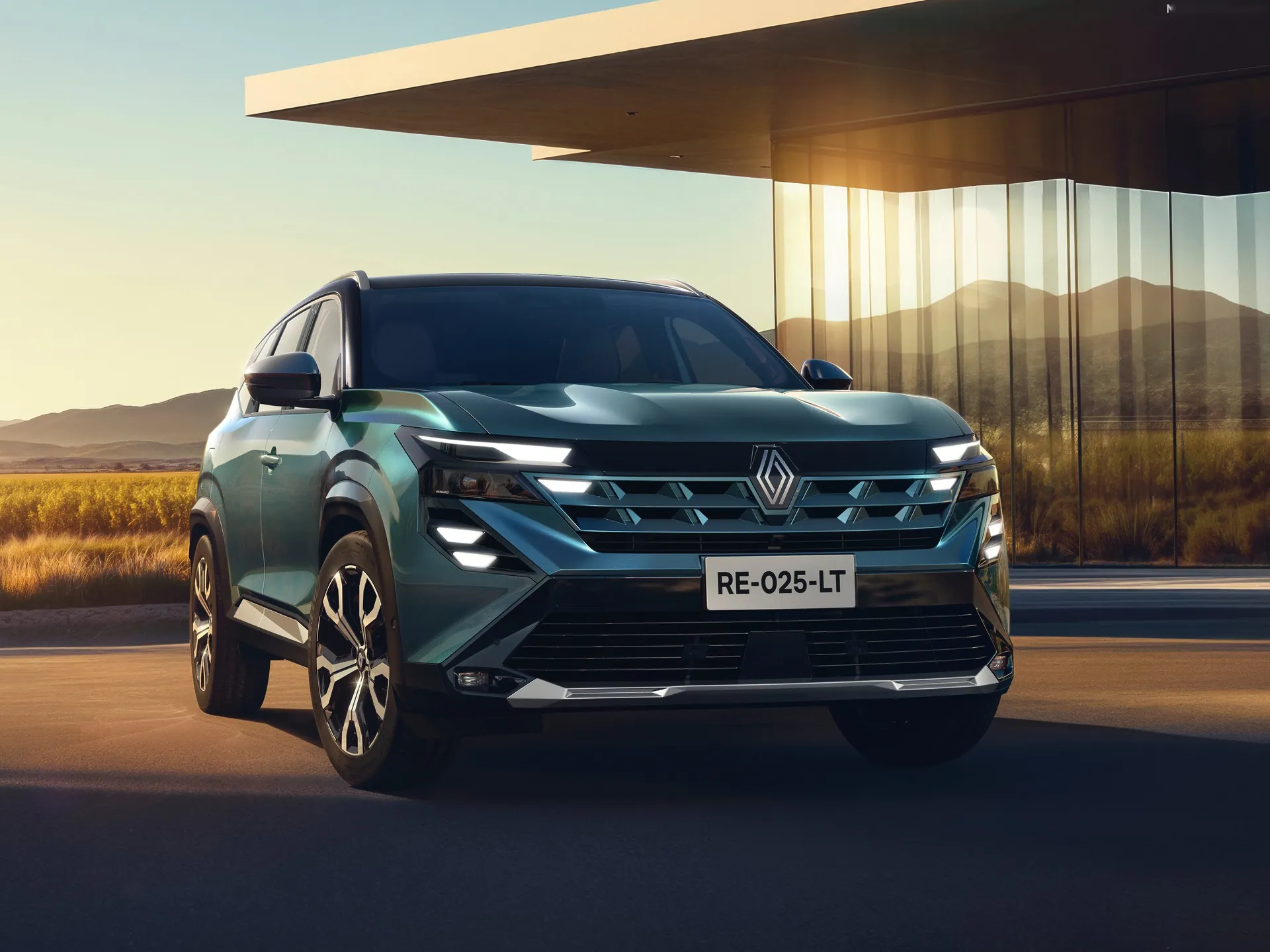
Central to the revisions for Renault Grand Scénic is a stronger and more dynamic front end, reflecting Renault's new design identity. All the elements - bonnet, wings, headlights, bumper and A-pillars - have been restyled and the result serves to emphasise the model's distinctive character and appeal.
Renault Grand Scénic is distinguished by chrome horizontal trim elements in the upper and lower grilles, which combine with the optional satin chrome roof bars to make a visual statement about the car's quality and status.
Renault Grand Scénic's proportions and large glazed area (from 3.6 to 5.1m2 with the optional panoramic opening sunroof) make for vast cabin space and on-board comfort with an airy feel. Overall length is 4,560mm, an increase of 62mm on its predecessor, while the wheelbase has been extended by 34mm to 2,770, ensuring plenty of space and comfort for up to seven occupants.
The boomerang-shaped rear lights give the vehicle a high-tech, signature "curtain of light" effect that is unique to the model. The line of these light units extends forwards along the flanks, following a character line that adds dynamic appeal to the side view, a quality that is further accentuated by the sloping roofline and rake of the rear screen.
Detail touches demonstrate Renault Grand Scénic's styling upgrade, such as the chrome-finished grille, foglamp back plates and door handles, gloss black B-pillars, chrome tailgate trim and body-coloured side protective mouldings with chrome trim.
High quality fit, finish and materials are in evidence throughout, while robustness and quality are expressed in elements such as the curves of the front wings and the muscular shoulders. Grand Scénic sits squarely on the road, with wide front and rear tracks (1,536 and 1,539mm respectively), and its proportions, belt line and large door panels convey a reassuring, protective feel.
The combination of fluid lines and generous forms gives maximum effect from the play of light across the bodywork, particularly in versions finished with metallic paint.
Special attention has been paid to perfecting the fit and finish of the body panels, for example between the A-pillars and the front wings. Parking sensors are neatly integrated into the front and rear bumpers and, following a technique used on Mégane Hatch and Coupé, the roof is brazed to the body sides using laser welding, eliminating the need for roof trimming. Windscreen wipers are concealed below the bonnet line, essentially for aesthetic reasons, but with the added benefit of better acoustic performance and aerodynamic efficiency.
Renault Grand Scénic's greater length and longer wheelbase contribute to more comfort for everyone on board. The design of the interior also focuses on delivering an enjoyable ride, with more cabin space, comfort and stowage, building on the strengths that helped make the original Scénic and Scénic II such a success.
Driver and front passenger have a wider field of vision, thanks to the A-pillars being positioned further back. This improves the side-to-side view by more than 8 per cent to 87°, while the vertical field of vision has increased by more than 15 per cent to 31°, giving better visibility at junctions and roundabouts.
The longer (2,770mm) wheelbase gives second row passengers best-in-class kneeroom of 275mm, while there is appreciably more space for those in the third row, too, where headroom has increased by 54mm to 842mm and kneeroom by 27mm to 102mm. This makes it the most spacious seven-seat compact MPV on the market for third row passengers. Two adults 1.75m (5'9") tall can be comfortably accommodated in the rearmost seats thanks to their segment-leading position, and the provision of footwells. The 89° trunk/hip angle is around 10° better than that of Grand Scénic's competitors.
The interior is fully modular with features such as:
The outer second row seats are fitted with a side handle that lets the whole seat be easily and instantly tipped forward for easy access to the third row. The action is quick, light and simple enough for a child to operate.
The interior styling is based on fluid lines, reminiscent of those in Mégane, with wave-like forms for the dashboard. The driving environment is clean and uncluttered, with controls clustered around the steering wheel or located on the centre console to free up as much space as possible for occupants. Special care was taken in the choice of materials, including the soft-touch dashboard, and the quality of interior assembly.
The driver's seat has a segment-leading height adjustment range of up to 70mm, with lumbar adjustment provided as standard. Extra comfort is provided by the availability of new-design enveloping headrests, which are multi-adjustable and give more support and safety, while a more vertical angle for the steering wheel helps the driver set a position that is more akin to that of a saloon car, without detracting from the high-up, commanding view that MPV drivers appreciate.
Thermal comfort for everyone on board is provided by the standard air conditioning. A dual-zone climate control system that is also featured in Mégane is available, letting the driver and front passenger select their preferred temperature and setting for the three-speed Soft-Auto-Fast system. In Auto mode, the system automatically optimises temperature, sound level and start-up speed; Soft operates quieter; and Fast gives a quick and efficient response to adjust cabin temperature. Second row air vents add to comfort for rear passengers.
Renault Grand Scénic provides up to 83 litres of stowage space around the cabin, a best-in-class total. The range of clever, practical features available includes:
The boot has a particularly practical design, with a carrying capacity of 702 litres (rear seats in foremost position), 10 per cent more than on Grand Scénic II, equivalent to an extra suitcase. An extra 33 litres were added by providing a stowage space for the tyre repair kit. With the rear seats folded and the middle row removed the capacity rises to 2,063 litres.
With the front passenger seat folded, loads of up to 2.5m in length can be carried. A low rear sill height (614mm) and wide tailgate access (1,059mm) make loading and unloading easy. When carrying bulky loads, the load area cover can be stored away neatly in a purpose-designed compartment.