Porsche 911 Targa
After 16 years, Porsche fundamentally modernised the 911. Beneath the skin, almost 85 per cent of all parts in the new 911 (known internally as the 964) were newly developed. This was most obvious in the bullish-looking front end and the modified sill covers. It was typical Porsche attention to detail: even the car's rain gutters were optimised. The cd value was now just 0.32, making the new model the most aerodynamic 911 to date.
The new 911 was designed to bring in more customers, including everyday drivers, and add more comfort features and luxury to the model's well-known sportiness. Porsche integrated power steering, ABS, a more powerful heater, a central locking system and electrically height-adjustable front seats into the newly designed body. With the Carrera 4 models, Porsche offered all-wheel drive from the outset, to put the power on the road effectively in any conditions. Porsche originally developed its all-wheel drive - with electronically controlled and hydraulically regulated power distribution - for the 959 ultra-high-performance sports car. From 1990, an automatic transmission was available, which was an important feature for the US market. Modern MacPherson struts and coil springs on semi-trailing link rear axles replaced its predecessor's torsion bar springs and offered a more precise and better driving experience. The heart of the model remained the six-cylinder boxer engine, revamped with dual ignition, knock control and three-way catalytic converter, and now featuring 3.6 litres of displacement and an output of 250 PS. Elegant and with a patent of its own: the newly developed rear spoiler fit seamlessly into the silhouette of the 964. It extended at speeds over 80 km/h, providing downforce and enhancing the engine cooling. The all-wheel-drive version, the Carrera 4, cost exactly 114,500 Deutschmarks at its launch in August 1988, while the rear-wheel drive Carrera 2 hit the market a year later and started from 103,500 Deutschmarks. In total, 63,762 examples of the 964-generation Porsche 911 were built between 1988 and 1994.
For the 964, Porsche developed a new 3.6-litre six-cylinder boxer engine. For the naturally aspirated versions with and without all-wheel drive, the engine delivered 250 PS and a top speed of up to 260 km/h. Shifting was done using a five-speed manual gearbox or an optional Tiptronic automatic transmission - a first appearance for this style of gearbox in a Porsche. From 1990, Porsche once again offered a 911 Turbo, with a 3.3-litre six-cylinder boxer engine and 320 PS. Porsche Exclusive, however, would modify the Turbo model on request, delivering a power boost to 355 PS. In the Turbo S Coupé, the engine delivered up to 381 PS. From model year 1993, the Turbo featured a rear-mounted boxer engine with a 3.6-litre displacement and 360 PS. With the 964 generation 911 Carrera RS 3.8, Porsche returned to the famous RS moniker in 1989 to continue its success on the track. The extremely sporty 911 Carrera RS 3.8 of 1993 featured a 3.8-litre naturally aspirated engine with 300 PS.
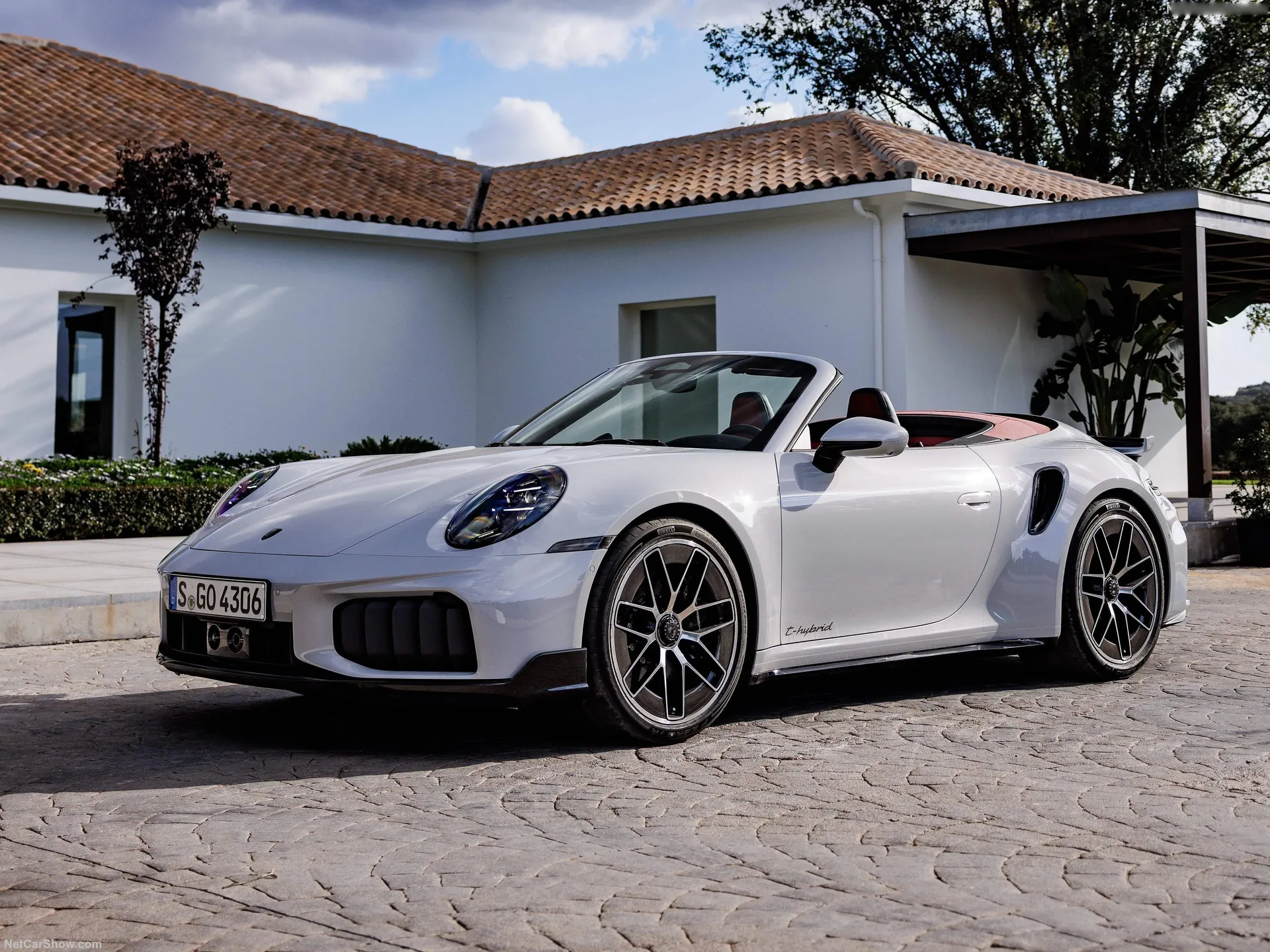
As with its predecessor, Porsche offered the car in Coupé, Targa, and Cabriolet variants and, from the 1993 model year, a Speedster version, which featured a chopped-down front windscreen. Joining the 911 Turbo widebody variant were the exceptionally sporty and lightweight Carrera RS models. For the US, Porsche developed the 911 RS America.
With the introduction of the 964, Porsche offered the all-wheel-drive 911 Carrera 4 from 1988. It also included an automatically extending rear spoiler, dual ignition, knock control and a three-way catalytic converter. Porsche launched its Tiptronic automatic transmission in 1989. From 1991, Porsche equipped all 911 models with driver and passenger airbags as standard. The Carrera 4 was the first passenger vehicle fitted with a metal catalytic converter as standard.
In redesigning the body, Porsche designers had no desire to compromise. The aim for the 964 was not to deviate too much from the G-Series in terms of appearance, but to look more modern and to deliver greater efficiency. In unmistakably 911 fashion, the headlights were positioned almost vertically in the tunnels of the wings. Meanwhile, the number plate, air intakes, indicators and fog lights were integrated into the front bumper for the first time. Porsche significantly improved the cd value, making the 964 the most aerodynamic air-cooled 911 to date. The lower drag was thanks to the aerodynamically shaped front and rear ends, as well as the sill covers and rain gutters. The completely smooth underbody and the electric rear spoiler that extended at speeds above 80 km/h also had a major impact.
To help customers distinguish between the models, Porsche called its rear-wheel drive variants of the 964 Carrera 2 and its all-wheel-drive variants Carrera 4. Both Carrera models were available in Coupé, Targa and Cabriolet bodystyles. Porsche initially offered the Turbo as a Coupé only, with a Cabriolet version joining the range from 1992.