Mazda 6 Sedan
All new-generation Mazdas have a special presence that forms a bond with their owners. Paving the way for other Mazdas, the 2015 Mazda6 intensifies this aura with a new maturity. And in doing so, Mazda has also heard what its customers have been saying.
This is why the experience behind the wheel of the latest version is truly inspiring. The new interior, based on the heads-up cockpit and featuring the latest human-machine interface, offers outstanding ergonomics to go with a new level of cabin quality. All in all, a sophisticated environment, smartphone internet connectivity included.
Also reassuring is the expanded array of active safety technology, which includes several clever new systems and Mazda firsts delivering added support for the driver, who is now more than ever able to choose the desired level of direct assistance.
Always a looker, the award-winning KODO exterior has been given added depth on the 2015 Mazda6 in the form of a more prominent signature wing and full-LED headlights with a sharper, bolder lighting signature.
The suspension, meanwhile, was restructured to smoothen out the road for greater ride comfort yet with increased stability and a better initial steering response. For the first time, the current Mazda6 generation is also available with company's intelligent all-wheel drive technology, which features a unique front-slip detection warning system. As for powertrains, the 2015 Mazda6 retains the same unconventional combination of outstanding performance with top-class fuel economy.
The elegant refinement of the 2015 Mazda6 demonstrates that Mazda's flagship has indeed arrived at a special new level. The evolution continues...
When it was first launched in 2012, Mazda's gorgeous new flagship was aiming for the top of its segment. A little over two years later, the 2015 Mazda6 is even more striking - and more mature.
Recognition for the new-generation Mazda6's harmonious KODO - Soul of Motion forms and textures wasn't long in coming. As one of three finalists for 2013 World Car Design of the Year, it was in the company of cars costing several times as much as itself.
Sales, too proved that it has what it took to attract the broad customer appeal obligatory for C/D-segment sedans and wagons in Europe. And the Mazda6 has been delighting customers with a combination of superior build quality and functional, practical beauty that one never tires of looking at.
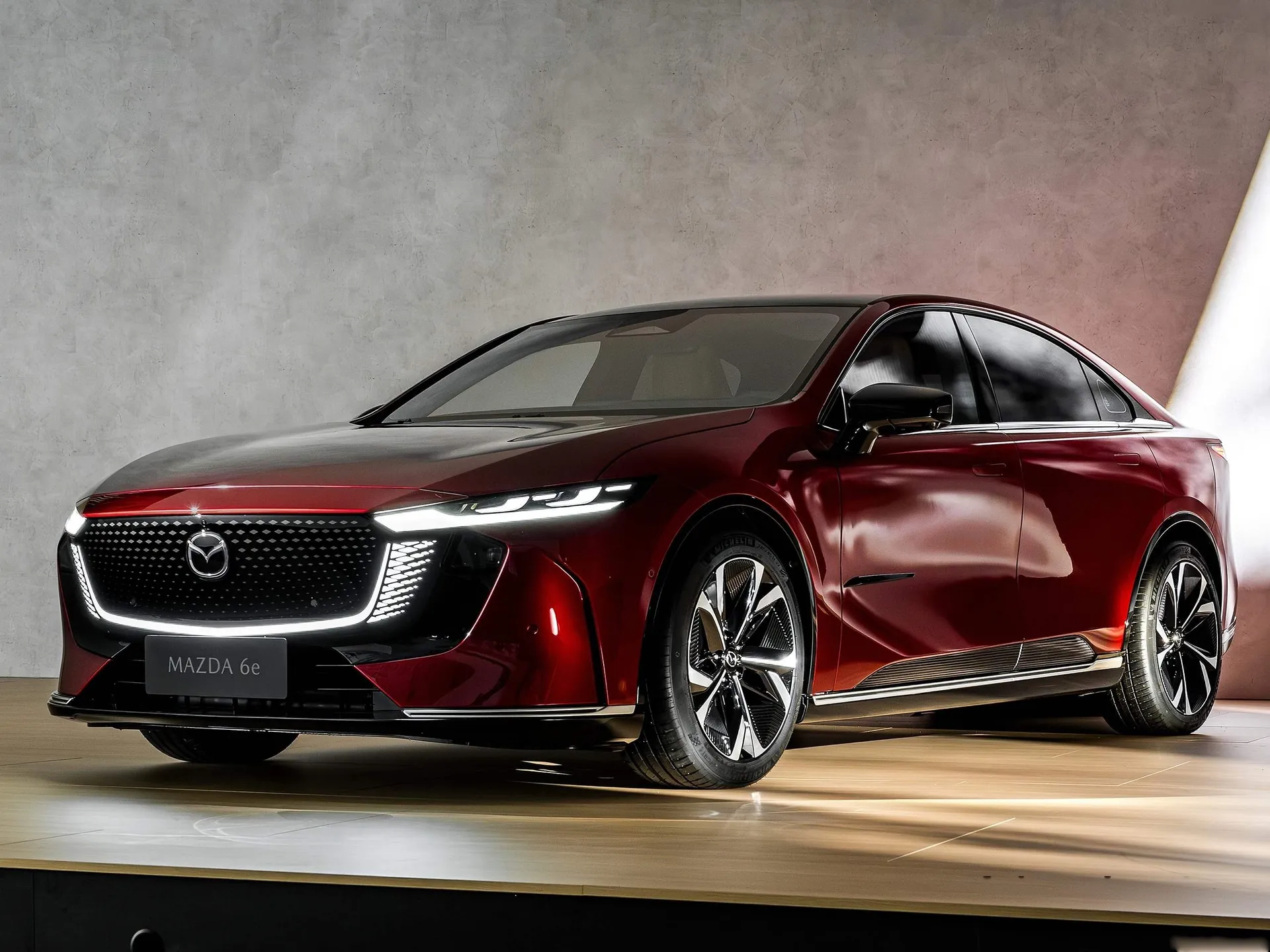
To keep the fires burning, the 2015 Mazda6 gets a bolder and more elegant expression while retaining KODO's sophisticated air and dramatic presence inspired by the movements of animals in the wild. Hence the stronger grille and a nose, evolved LED head- and taillight signatures, and redesigned high-gloss 19-inch wheels.
The distinctive family face clearly says "Mazda". The signature wings, a KODO trademark spanning from headlamp to headlamp through the bottom of the grille, get a more chiselled three-dimensional look. Matching fog light bezel trim emphasises this depth, while the redesigned grille's six distinctive grey horizontal lines add further power and a sense of bulk to what was already a prominent nose. Together with the glinting eyes, the front-end expresses an even more dignified sense of purpose.
The new LED headlamps now feature a revised layout and a sharper LED lighting signature. The 2015 Mazda6's "glare" has a unified colour, as the fog lamps too get LEDs. It all adds to the sense of forward motion, speed and fearlessness. The rear combination LED taillights, meanwhile, stretch further towards centre of tailgate for greater depth and an expression instantly recognisable as a Mazda at night.
Sedan or wagon, the 2015 Mazda6 continues to combine a muscular anatomy and vitality with a level of quality that sets it apart. Dignity and purpose combined in the unorthodox Mazda way clearly set its flagship apart from the competition.
The 2015 Mazda6 retains the model's distinctive bodylines, imbuing different sensations - faster here, more relaxed there - depending on how the light falls. The interplay between light and shadows produces an effect that one never tires of looking at.
The wings flow into distinctive character lines on the sides of the car, as if it were ready to leap off the ground. The sedan's coupé-like cabin slides over the C-pillar into the short, powerful rear deck, stressing the firm footing. The wagon, meanwhile, adds practical utility to this lean, sporty stance. In either case, onlookers can feel just from looking at it what kind of a response to expect when behind the wheel.
The prominent fenders and compact-looking cabin set towards the rear highlight the large diameter 19-inch aluminium wheels, now offered with a darker polished finish for a deep three-dimensional metallic look that only adds to the car's composed exterior. The five sets of contoured spokes underline the sense of dynamism and light, effortless motion. And they don't just look good, either.
Engineers worked with designers to improve stiffness and thus resistance to deformation. The result is superior handling coupled with reduced noise, vibration and harshness.
Already a harmonious, uncluttered interior with tasteful coordination fitting a flagship, Mazda upped the level of quality with new shapes and materials, particularly in the front. A special effort was made to link the various components to achieve a handsomely integrated layout, for example with colour schemes fusing the cabin into a cohesive space.
Indeed, cohesive nicely describes the headsup cockpit concept first applied on the newgeneration Mazda3. It partitions the interior into a snug driver-oriented space and open, airy passenger area, yet at the same time unites these zones with the consistency of the cabin style elements.
The centre stack and console received special attention, aided by the addition of an electrical parking brake (EPB) - a Mazda first - eliminating the handbrake lever in favour of a switch located behind the gearshift. This extra room enabled a cleaner look with more space on the centre console - now entirely on one level - for things like the cupholders and storage box. The gearshift lever on automatic models gets a sporty manual-style boot shifter, which replaces the gate shift set-up on the current Mazda6. Above it, the sleeker centre stack features an elegant piano black climate control panel, while the 7-inch display is now located on top of the centre stack for safer viewing requiring minimal movement on the part of the driver.
Among other things, the instrument cluster hood, door armrests and soft centre console elements like the new padded knee rests feature elegant double stitching. The climate control louvres are a prime example of the attractive new materials used, and in a wider sense the coherently contrasting nature of the upholstery, chrome, polished aluminium and black elements of the 2015 Mazda6 interior. Minimising the use of hard plastics underscores the cabin's refinement, enhancing the expressions of motion, speed and stability - some of the Mazda6's traditional strengths. A freshly designed instrument cluster and rotary commander round out the changes.
As for the upholstery, pure white leather replaces off-white for a more vivid contrast with the black interior elements, while black leather interior gets deep red accents for the soft material on the instrument panel, door trim and floor console. Black fabric is also available.
Tastefully coordinated and expertly crafted, Mazda's interior designers achieved an instantly recognisable level of high quality and harmonious elegance befitting the sporty yet distinguished exterior. Inside or out, it's a style destined to uphold its appeal for years to come.
Mazda's lauded heads-up cockpit and cleverly safe connectivity technology has arrived in the C/D segment in the 2015 Mazda6, for a refined cabin experience that aims to please.
The intensely competitive C/D segment is crucial for automakers, particularly in Europe. It's where the cars best personify the reputation and the essence of a brand. At Mazda, that means fun to drive, efficient, safe and reliable. Having already lifted these qualities to a new level on the current Mazda6, the company exploited all the experience with cabin ergonomics it had gained since launching its new-generation flagship, also adding the latest in-car equipment. More pleasant to be in than ever, the 2015 Mazda6 puts the driver in complete control while completely relaxed.
The heads-up cabin concept maximises Mazda's trademark Jinba Ittai feeling of oneness with the car. The a snugly laid-out cockpit puts all driving-related controls in the ideal position for operation with minimal physical effort or eye movement on the part of the driver. The front passenger space, meanwhile, imparts a sense of space and well-being. Both sides have the benefit of the human-machine interface (HMI), redesigned for outstanding usability and enhanced blind operation. So the driver can focus on the road and passengers relax and enjoy the ride.
No small feat considering that the 2015 Mazda6's advanced on-board systems provide a lot of information. Top priority was given to letting the driver effectively and safely digest it. Hence the Active Driving Display, the first head-up display ever on a Mazda6. It shows real-time vehicle information in the driver's forward line of view at 1.5m in front of his or her eye point to minimise focal adjustment. This display presents three pieces of data at once, prioritised according to importance. Under normal conditions, the vehicle's speed would be at the top of the display followed by, say, turn-by-turn directions from the navigation system. But an urgent active safety warning would immediately displace this information, reverting once the danger had passed. Of course, all the usual vehicle data is also displayed on the instrument cluster, which was redesigned for enhanced visibility and a quality feel.
Offline is something occupants of the 2015 Mazda6 need never be again thanks to MZD Connect, which together with a smartphonedelivers safe access even when on the move to internet services such as Aha. The cloudbased internet platform features free webbased content that uses a radio-like audio format and is thus safe and easy to use in a vehicle. Aha offers a large and growing choice of broadcasts, including radio, podcasts and audio books, as well as social media and personalised location-based services.
MZD Connect bolsters the Mazda6's existing capabilities with voice recognition and handsfree functionality, enhancing the convenience of Bluetooth connectivity while expanding on email, SMS and navigation features. Listen to tweets or Facebook posts, for example, replying with likes or posting audio messages. Send and receive text messages, or set destinations on the navigation system based on internet searches. MZD Connect also offers Mazda's own applications, including fuel economy monitor, maintenance reminders and warning guidance. Top-quality audio is taken care of by the premium 11-speaker BOSE® surround sound system (see box). The new 7-inch display is the infotainment centre on the 2015 Mazda6. Located on top of the centre console, it's now easier and safer for the driver to look at. Operation takes place either via the rotary commander, which is located on the centre console behind the gearshift, voice command or on the touchscreen itself. Driving-related functions, in contrast, can be accessed using steering wheel controls.
The navigation system offers more accurate route calculations, added destination search features and display options as well as three years of free biannual updates for SD cardbased map data. And its supports up to 19 audio and 26 text languages. Directions appear on the Active Driving Display as well as the 7-inch display, with traffic data and as well as other information updated via the smartphone in real-time using RDS-TMC.
Mazda's goal with the 2015 Mazda6 cockpit was a space that works as an extension of its driver's limbs. The rotary commander, for example, is designed for blind intuitive operation. Like other cabin features, it keeps the driver alert and relaxed, even on longer journeys. The driver's seat is therefore equipped with elaborate adjustment functionality - a movement range of 260mm front-to-back, 50mm lift and 30mm tilt, and a 98 degree recline - for the easiest access possible to key driving-related components. The manual gearshift, meanwhile, is positioned in line with its shift stroke, while the steering wheel based paddle shifters on automatic models ensure optimal - but not accidental - access.
Stress-free control and a fun, safe drive necessitate a good overview of the surroundings, too. Designers made sure the driver would have a continuous field of view - front, side and rear - with minimal blind spots. The rearward position of the cabin and A-pillars increases the driver's horizontal viewing angle, which makes cornering easier and safer. The A-pillar location (and the gap between them and the door-mounted side mirrors) also improves the driver's vertical viewing angle, making it easier to see children or low-to-the-ground objects at intersections.
Convenience is essential to an enjoyable drive too, so the 2015 Mazda6 interior offers added storage opportunities. The door pockets are considerably larger, while the centre console profits from the absence of a hand brake lever. It has made way for a small switch to control the electrical parking brake (EPB) - another Mazda first and standard equipment. Designed with safety in mind, the EPB disengages automatically when the accelerator is pressed to pull the vehicle away, but only if the driver's seatbelt is on and the door closed, or manually when the engine is onand the brake pedal depressed.
As one of longest vehicles in its class, the 2015 Mazda6 is in a word spacious. From legroom and knee clearance to shoulder room, both the sedan and wagon offer extraordinary levels of comfort front and back, and are also easy to get in and out of.
The lightweight seats have been enhanced in the name of flagship ride comfort. Using a suspension mat rather than an "s" spring design, the front seatbacks conform better to the occupant's body while dispersing their weight over a wider area. So they're snug yet comfortable with superb hold and - like the positioning of cabin controls - promote good posture. Front and rear seat cushions, meanwhile, now have a special urethane foam to absorb unwanted vibrations. Heated rear seats are now available for the first time on a Mazda, with a three-stage temperature control on the rear armrest.
As powerful and uncompromising yet refined as the 2015 Mazda6 itself: The high performance 11-speaker BOSE® surround sound system should satisfy even the most discerning music lovers. More advanced than in the current model, it also weighs 20% less. And with circuitry that enables continuous low-power operation, it requires less cooling power, too.
This is the first Mazda audio system to feature BOSE® Centerpoint® 2 virtual surround playback technology, which analyses the frequency of the sound source to deliver a truly realistic virtual surround sound, even when playing back compressed signals or radio broadcasts.
BOSE® AudioPilot® 2, meanwhile, automatically compensates for the effects of unwanted sound from different road surfaces, varying driving speeds and even open windows. A microphone placed in the cabin continuously monitors ambient noise conditions, while a sophisticated BOSE® algorithm analyses the music signal and adjusts it to reduce the effect of unwanted noise.
Driven by ultra-efficient SKYACTIV powertrains, the 2015 Mazda6 guarantees an unconventional combination of brisk performance and frugal fuel consumption. With all four wheels are firmly on the ground.
The 2015 Mazda6 is available with one of five extreme compression SKYACTIV engines. The two clean diesels and three petrol powerplants - all Euro 6 compliant - efficiently provide power through six-speed SKYACTIV-MT manual and SKYACTIV-Drive automatic transmissions, the latter now with Drive Selection. An all-wheel drive option is even available or the first time on a Mazda6 diesel.
Press the accelerator, and the car responds immediately and with precision to the degree of pressure placed on the pedal, delivering strong yet refined linear acceleration. With the intake and exhaust tuned to eliminate undesirable high-frequency sounds while maintaining the vibrant low-frequency band, they sound good too.
The 2015 Mazda6 is as quiet as a refined C/D car should be at constant cruising speeds, erupting into a truly exciting resonance when accelerating. Mazda's i-stop idle-stop system and the company's unique i-ELOOP brake energy regeneration system work in perfect harmony. Together with SKYACTIV powertrains and the lightweight yet rigid SKYACTIV-Body and SKYACTIV-Chassis, they contribute to superb fuel economy and CO2 emissions. At Mazda, efficiency applies to all variants - and with no compromise to performance.
Petrol power is offered at three output levels, all featuring direct injection, natural aspirationand ultra-high compression. The most powerful is the SKYACTIV-G 2.5, the largest SKYACTIV engine to date, producing 141kW/192PS at 5,700rpm and 256Nm at 3,250rpm and, with the automatic, propelling the 2015 Mazda6 from 0 to 100km/h in only 7.8 seconds and a top speed of 223km/h.
Mazda overcame the NVH issues associated with this brawnier engine by adopting a balance shaft to offset vibration. The SKYACTIV-G 2.5 and SKYACTIV-G 2.0 share a special exhaust manifold setup, enhanced fuel spray characteristics and much more to deliver exceptional low and mid-range torque along with unprecedented fuel efficiency for petrol engines at these displacements. In the combined cycle, the SKYACTIV-G 2.5 uses 6.3l/100km, which corresponds to CO2 emissions of 148g/km.
The SKYACTIV-G 2.0 is available in two versions on the 2015 Mazda6. Both deliver 210Nm of torque at 4,000rpm, while maximum power output at 6,000rpm is either 107kW/145PS or 121kW/165PS. Despite not being offered with i-ELOOP, the former delivers top-class fuel consumption of 5.5l/100km (manual) and 6.0l/100km (automatic) with CO2 emissions of only 129g/km and 139g/km. It manages the 0-100km/h sprint in 9.5 seconds with the manual transmission or 10.5 seconds with the automatic and top speeds of 208 km/h and 207 km/h, respectively. The 165PS SKYACTIV-G 2.0, meanwhile, powers the 2015 Mazda6 to 100km/h 10.1 seconds (automatic) or 9.1 seconds (manual) and top speeds of 209km/h and 216km/h. Fuel consumption and CO2 emissions are only slightly higher at 5.9l/100km and 135g/km with the manual or 6.0l/100km and 139g/km for the automatic.
SKYACTIV stands for efficient internal combustion. And the diesels under the bonnetof the all-new Mazda6 defy convention, featuringa variable twin turbocharger and the world's lowest compression ratio. Since lower compression puts less strain on engine parts, it enables the use of lighter components.
Available in two power derivations, the SKYACTIV-D 2.2's low compression also makes it possible to improve combustion timing and efficiency. The standard version produces 110kW/150PS at 4,500rpm and 380Nm of maximum torque at 1,800-2,600rpm, while the higher output clean diesel serves up 129kW/175PS at 4,500rpm and 420Nm at 2,000rpm. Like the SKYACTIV-G 2.5, all SKYACTIV-Ds come with a balance shaft, which counteracts the added vibrations generated by these powerful diesels.
The 175PS diesel manages 0-100km/h times and top speeds of 8.4 seconds and 216km/h (automatic) or 7.9 seconds and 223km/h (manual). The 150PS unit does the 0-100 dash in 9.8 seconds (automatic) or 9.1 seconds (manual), topping out at 204km/h and 210km/h.
These figures are all the more remarkable when considering the diesel consumption: namely 3.9l/100 km and 104g/km (150PS manual); 4.8l/100 km and 127g/km (150PS automatic); or 4.5l/100 km and 119g/km (175PS manual); and 4.8l/100 km and 127g/km (175PS automatic). Combined cycle figures for the AWD wagon range from 5.0-5.4l/100km and 132-143g/km.
The highly-refined six-speed SKYACTIV-Drive automatic transmission available for all Mazda6 engine variants is extremely well balanced, delivering remarkably smooth shifting along with the direct feel of a manual. And it now features standard Drive Selection on all petrol engines, enabling the driver to change into "sport" mode at the flip of a switch next to the gearshift for faster downshifting and added torque in response to accelerator pressure - reassuring when merging onto a high-speed motorway, for example. The SKYACTIV-MT, meanwhile, brings the sporty, direct manual shifting of the legendary Mazda MX-5 roadster to the flagship. Lightweight and cleverly packaged, both contribute to the 2015 Mazda6's outstanding fuel economy.
Harnessing brake energy Short for "Intelligent Energy Loop", Mazda's fuel-saving i-ELOOP brake energy regeneration system is the world's first such passenger car technology to utilise a capacitor to store electricity recovered during braking.
Previously, the limited charging and power storage potential of the lead acid starter batteries typically used in automobiles was one issue that hindered the effectiveness of regenerative braking. Therefore, after analysing everyday driving conditions, Mazda focused on the recurring deceleration and acceleration cycle. Determining that a typical deceleration phase lasts only about 10 seconds, they adopted an electric double-layer capacitor (EDLC) rather than a dedicated battery to capture and temporarily store therecovered electricity quickly.
The system uses a 12V-25V variable voltage alternator to efficiently generate power from the moment the accelerator is released, fully charging the EDLC in as little as 7-10 seconds - well within a single deceleration cycle. Another benefit of EDLCs is that, unlike the lithium-ion batteries used in electric vehicles, they can be recharged again and again with minimal deterioration.
After recharging, the DC/DC converter steps down the voltage of the electricity in the EDLC to 12V to power components like the climate control and audio systems. Any surplus electricity goes to the starter battery. A full capacitor charge is enough to run the vehicle's electrical systems for long enough that there is no need to revert to battery power even when Mazda's i-stop system has shut the car off at a traffic light. During stop-and-go city driving, charging often resumes before the capacitor is fully discharged. As a result, i-ELOOP can produce most if not all of a vehicle's electricity needs, freeing up engine output normally required to drive the alternator.
i-ELOOP thereby improves fuel economy by up to 10% under everyday urban driving conditions. The system is standard on all diesel-powered 2015 Mazda6s and available for most petrol models, too.
i-stop is Mazda's innovative, intelligent idle-stop system. Standard equipment on the 2015 Mazda6 - and indeed all new Mazdas - it's the only idle-stop system available that uses combustion energy for the restart. In addition to saving fuel, this enables some of the fastest restarts in the industry: 0.35 seconds for SKYACTIV-G petrol engines and only 0.40 seconds on SKYACTIV-D diesels.
i-stop uses a refined control module to switch off the engine in the ignition/expansion stroke (petrol) or compression stroke (diesel), the optimum cycles for restarting. In fact, i-stop actually waits for the moment the cylinders are in the
ideal restart position. And this all takes merely a spilt second. Conventional systems only identify which cylinder is in the correct stroke position after an electric starter turns the crankshaft to begin the restart. So, whereas competingdiesel models won't restart until the second compression stroke or engine cycle, Mazda's SKYACTIV-D starts almost immediately during the first stroke. And in the meantime, Mazda drivers and passengers can still use the vehicle's electric-powered systems.
The 2015 Mazda6's SKYACTIV-Body and SKYACTIV-Chassis, including a reworked suspension and Mazda's new-generation all-wheel drive (AWD) system, turn going through a curve into a truly exhilarating experience. And now it's smoother and quieter, too.
Available for all diesel-powered wagon versions, the 2015 Mazda6 inherits the unique AWD technology - the world's first with a front-slip detection warning system - from the Mazda CX-5 compact SUV. The system uses 27 sensors to continuously monitor the road and the driver's intentions, transmitting power to the wheels that need it most. The system can detect slippery surfaces and react accordingly during, for example, a standing start on a snow-covered incline. And it even works under rapidly changing conditions like driving through a rain puddle on the highway. Its precision helps prevent wheel spinning and too much power being sent to the rear wheels. Together with a new low-viscosity oil, which prevents energy loss, particularly in very cold weather, it thus enhances real-world fuel economy.
The SKYACTIV-Chassis on the 2015 Mazda6 retains its unusually crisp handling with a front MacPherson strut and rear multi-link suspension system. Except that Mazda's engineers have raised ride comfort to a new level by enhancing the shock absorbers and revising the front lower arm bushings.
The front shocks feature a newly structured piston with a revised control valve and higher friction oil. As a result, they can be tuned to deliver more damping force at low piston speeds, meaning in response to small inputs, and less at high piston speeds, or input that causes sudden upward pressure. In addition, the front lower arm bushings were re-engineered to maintain their shape under load. This means smoother arm movement and with it increased stability when it comes to spring behaviour.
The rear shocks, meanwhile, now have wider pistons for more damping force earlier in response to even minute levels of input from the road. Mazda also reduced the jolt sensation and improved the ride quality by adopting a friction control seal andoptimising the shape of bottom valve, thus enhancing the damping response and highspeedstability. The upshot is a smoother, "flatter" bump-suppressing ride along with a better initial steering response and cornering stability.
Remarkably stable for being so lightweight, the SKYACTIV-Chassis delivers outstandingbraking. In fact, the shorter brake pedal stroke and optimal brake disk cooling help maintain the Mazda6's segment-leading stopping distances. It is just one of the benefits of Mazda's efforts in recent years to balance the fundamentally contradictory characteristics of refined, supple motion and light, agile motion. To enhance the linear connection between the driver and basic vehicle functions like accelerating, turning and of course stopping. To turn the car into an extension of its driver.
The 2015 Mazda6 combines exceptional low to medium speed agility and highspeed straight-line stability. Steering input from the driver always delivers a faithful response, and road feedback is immediate.
The column-type electric power assist steering system features a class-leading 14.2 gear ratio for agile steering without having to change hand positions on the steering wheel. This makes winding roads more fun and urban driving less tiresome. A range of sensors feed data to the system, which it uses to adjust steering sensitivity for nimbleness at lower speeds while suppressing disturbances for better stability on rough roads and at high speeds.
The lightweight yet highly rigid body, meanwhile, only serves to further support the strengths of its advanced powertrains while providing occupants with top-class crash protection. SKYACTIV Technology is clearly about achieving the best possible balances, and the SKYACTIV-Body is noexception. Like the SKYACTIV-Chassis, Mazda boosted strength and stiffness while shedding kilograms. High and ultra-hightensile steels accomplish both, so Mazda used them on 20% more of the body by weight than the previous generation model. A benefactor of the "gram strategy", Mazda's obsession with cutting weight, the sedan (1,300kg) and wagon (1,305kg) remain among the lightest in their segment. They're also among the most aerodynamic, too, with a drag coefficient of 0.26-0.28, depending on trim and body style.
Mazda paid special attention on the 2015 Mazda6 to making the cabin of its new flagship as tranquil as possible in terms of noise, vibration and harshness. Looking to block noise paths and concentrate soundabsorbing materials where most effective, the engineers filled in the spaces between door trim and panels, also adding sealant between the body and floor undercover. Together with additional insulation, new floor mats and better door seals, the cabin of Mazda's flagship is more peaceful than ever. This also means less vibration, particularly in conjunction with the improved suspension and seat structure.
Safety is an inherent part of driving fun, and that's what is behind the Mazda ProactiveSafety philosophy. The aims: Minimise the risksthat can lead to an accident and maximise the range of conditions under which the driver can safely operate the vehicle.
Mazda Proactive Safety offers various technologies to support the driver's cognition of the conditions on the road and judgment in dealing with them. i-ACTIVSENSE is what Mazda calls its advanced range of sensorbased active and pre-crash safety systems, which employ radar, laser and camera technology to detect hazards. The idea is not to seize control of the vehicle at every perception of danger, but rather help drivers help themselves, only taking autonomous action if an accident is imminent. These systems can thus help prevent one from happening or at least minimise the damage caused. And the philosophy is continually evolving, as demonstrated by the 2015 Mazda6. It gets all Mazda's latest offerings including Adaptive LED Headlights (ALH), Lane-keep Assist System (LAS), Blind Spot Monitoring (BSM) and Driver Attention Alert (DAA).
A brand-new camera-based system, ALH combines glare-free LED high beams and wide-range low beams. The former divides each headlamp into four LED blocks, which can be independently extinguished to avoided impairing the vision of oncoming or preceding motorists, yet still deliver superb nighttime visibility from the remaining high-beam blocks. The wide-range low beams, meanwhile, use part of the 2015 Mazda6 lighting signature as the headlights, broadening lowbeam coverage to greatly improve visibility at place like intersections. ALH, which alsoincludes an auto-levelling function in highway mode, takes over the function of High Beam Control (HBC).
To counter driver inattention or fatigue, Lane-keep Assist System (LAS) monitors the vehicle's position based on road markings. Camera-based like the Lane Departure Warning System (LDWS) it incorporates, LAS warns the driver of unintentional lane changes. It does so by vibrating the steering wheel, but goes much further in also providing steering torque assistance to return the car safely to the middle of the intended lane. There are two settings, one providing constant steering assistance and the other only when an unintentional lane change becomes inevitable. Operating at 60km/h and up, LAS recognises intentional lane changes when for example the signal lights are engaged.
The 2015 Mazda6 is also one of the first Mazdas in Europe with Blind Spot Monitoring (BSM), which takes over and expands upon the capabilities of the Rear Vehicle Monitoring (RVM) system featured on previous new-generation Mazdas. Like RVM, BSM used 24GHz radar to detect vehicles approaching from behind in adjacent lanes from up to 50m away at speeds of 30km/h or faster. But it also "sees" those following as close to 2m behind and up to 8m away on either side. If the driver activates the turn signal on the side of an advancing car, a buzzer sounds and an indicator flashes in the corresponding side mirror. Also new on BSM is Rear Cross Traffic Alert (RCTA), which used BSM's sensors and warning signals to keep tabs on the blind spots when the car is reversing.
A first for Mazda, Driver Attention Alert (DAA) monitors the driver's condition at 65km/h and higher. It does so by first observing the driver for 20 minutes, taking into account things like speed and the angle of steering wheel operation, and then recommending a rest break if it detects a significant change in behaviour (or automatically after two hours of continuous driving).
Smart City Brake Support Forward/Reverse (SCBS F/R), meanwhile, adds reverse gear functionality to the current SCBS system, which automatically applies the brakes if there is an increased collision risk to help prevent an impact or at least reduce the severity. The system works at 4-30km/h and uses a near-infrared laser to detect objects up to 6m away when moving forward; in reverse the ultrasound sensors have a range of around 2m and operate at 2-8km/h.
The 2015 Mazda6 carries over all its existing safety technology, including two systems that debuted in Europe on the current Mazda6. Smart Brake Support (SBS), an autonomous emergency braking system operating at 15-200km/h, uses 76GHz microwave radar to monitor vehicles up to 140m ahead, pre-filling and then (if the driver fails to respond) applying the brakes with a force corresponding to the level of danger. Mazda Radar Cruise Control (MRCC) uses the same radar to maintain a safe trailing distance to preceding motorists by adjusting throttle and brake pressure. ctivated from 30km/h upwards, MRCC can maintain the distance pre-set by the driver as long as the vehicle's speed does not exceed 200km/h or fall below 20km/h.
Hill Launch Assist (HLA), Emergency Stop Signal or ESS (which flashes the four-way hazards automatically during heavy braking), four-way ABS with electronic brakeforce distribution (EBD) and brake assist (EBA), dynamic stability control (DCS), and traction control (TCS) round out the 2015 Mazda6's i-ACTIVSENSE line-up. With the ergonomicsenhancing cockpit and human machine interface described in previous chapters, the driver is in the perfect position to take full advantage of all this technology.
There's no such thing as 100% security, however, and all this active safety technology won't necessarily help drivers prevent everysingle accident. But should one occur, the 2015 Mazda6 was designed to provide the utmost in protection.
Passive safety - what counts during an accident - starts with the SKYACTIV-Body. Lightweight but rigid thanks among other things to all the high-tensile steels (see chapter 6), it efficiently absorbs impacts from all directions and/or disperses crash energy to keep the cabin intact.
Frontal impact forces, for example, are absorbed by crush cans in the engine compartment and channelled through the SKYACTIVBody's multi-load paths. To create a larger crumple zone, the front suspension crossmembers are designed to detach from their mountings. Milder frontal collisions (up to 15 km/h) are absorbed by easy-to-replace bolted-on parts, preventing damage to pricier front frame and engine components.
Mazda's "triple-H" cage structure around the cabin, which links roof members, B-pillars and underbody members in uninterrupted ring structures, comes into play during a side impact. The enhanced size, shapes and strength of pillars and bars - the B-pillars and door impact bars, for example, are made from ultrahigh tensile steel - prevent the cabin from deforming.
And to protect occupants during a rear-end collision, the 2015 Mazda6's straight underbody members and cross-sectional rear frame effectively absorb and disperse crash energy. The rear bumper, too, has an innovative reinforcing cross shape to limit protrusion by absorbing added force over a shorter crumple space. The 2015 Mazda6 thus delivers worldclass safety - with no compromise to its stunning KODO looks.
Inside, a range of occupant-protecting features includes door armrests that split during a side impact to soften contact, rear seatbacks reinforced with high-tensile steel to enhance cabin integrity and prevent luggage intrusion, and anti-whiplash front seats. Infact, shear and tensile loads on the neck are top class for front occupants.
In addition to standard front, side and curtain airbags, the front seatbelts combine pretensioners, which tighten the belts during an accident, and load limiters to avoid excessive pressure to the chest. ISOFIX connections with top tether anchors for quick and secure child seat installation are also standard on the 2015 Mazda6.
Mazda is always striving to stay ahead of increasingly strict pedestrian safety standards. The 2015 Mazda6 is therefore equipped with bonnet hinges that yield downward (vertically) to help prevent head injuries, but without diminishing their longitudinal (horizontal) strength, which inhibits the bonnet from moving back towards the cabin. Mazda also used a special material on the bonnet and front suspension towers that gives during an impact with a pedestrian, but still resist deformation if for example someone leans on it. The body cowl and bumpers also a feature pedestrianfriendly design. Rated at with five Euro NCAP stars, the 2015 Mazda6 remains one of the safest in its class.