Volkswagen ID.7
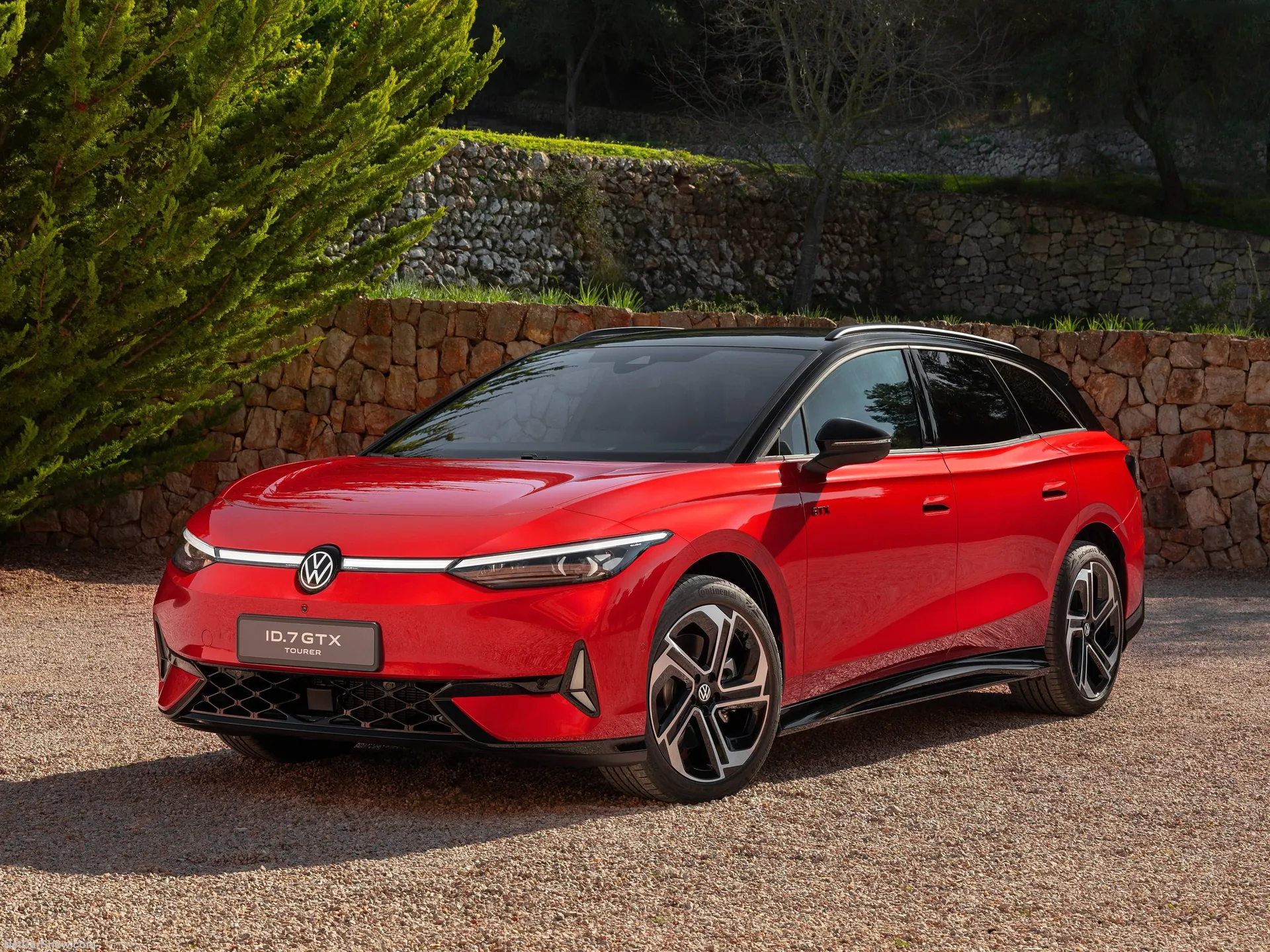
The ID.7 is a 4,961 mm-long fastback saloon with a large wheelbase of 2,971 mm and short body overhangs. The height of the longest and also flattest ID. model is 1,536 mm. Thanks to these proportions alone, the aerodynamic ID.7 with a width (without exterior mirrors) of 1,862 mm appears both elegant and athletic. The drag coefficient is 0.23 depending on the equipment fitted and the frontal area is 2.45 m2.
In the side view, the sporty, flat windscreen frame and the striking, coupé-like C-pillar immediately catch the eye. The roof and roof pillars are always finished in high-gloss black, while the roof frame strips have an aluminium look. A defining style element of the vehicle's elegant side design is a character line located below the window shoulder. This runs with a sharp undercut from the headlights to the muscular rear, thereby visually lowering the height and creating positive tension in the silhouette.
The charismatic design of the ID.7 is shown in particular by the sculptured bonnet and the LED headlights with their narrow LED strip for the daytime running lights and turn signals integrated at the top of the housing. A horizontal LED strip runs between the headlights. The side air intakes (air curtains) for the wheel housings are located low down in the bumper and have a distinctive look.
Horizontal lines emphasise the width of the ID.7 at the rear. The strongest line is a horizontal LED strip, which extends outwards into the wraparound LED tail light clusters. As another distinctive feature, the middle area of the LED strip is white and changes to red only when the light is activated. The separation edge of the large and wide-opening boot lid is an aerodynamic and eye-catching detail. A powerful impression is created by the bumper and the diffuser located underneath, which have a high-gloss black paint finish.
The fastback saloon welcomes the driver and passengers with an interior that has been designed from scratch. Thanks to the long wheelbase, the ID.7 offers extremely generous space in both the front and rear seats. The dominant detail in the interior of the high-quality ID.7 is the dash panel. Its horizontal layout is clearly structured. The trims, which are optionally illuminated by the background lighting, and the horizontal vent band are integrated into the linear design. In the ID.7 Pro, contrasting seams with optional piping are incorporated between the vent band and trims. When it comes to the interior design of the ID. flagship model, Volkswagen has broken the mould. How? This Volkswagen is the only vehicle in its class to be equipped as standard with an augmented-reality (AR) head-up display. It projects any information relevant to the journey into the driver's field of vision, so they no longer have to take their eyes off the road. At the same time, the new AR head-up display changes the cockpit architecture; this is because the traditional instruments have become a lot smaller as a redundant information level. This ID. display is not higher than the vent band and shows legally required standard information, such as speed and warnings. The small ID. display also means the driver's eyes focus on the AR head-up display and, as such, what is happening on the road. This is all the more valid given that the status bar in the AR head-up display also shows information such as the battery charge level and consumption. What is more, the augmented-reality area of the head-up display has a new feature: lane-level navigation, which can guide the driver into the right lane for a motorway junction at an early stage, for example. Another element developed from scratch is the standard infotainment system with a touch display that appears to be free-standing and enjoys an intuitive menu structure. The temperature and volume control touch sliders under the display are illuminated.
Via the AR reality head-up display, information such as speed, lane markings, distance warnings and turn arrows from the navigation system are blended into the driver's line of sight. Status displays containing information such as the current and maximum permitted speeds are projected into the close range (3.5 metres in front of the vehicle). In contrast, the system projects journey-relevant information and current instructions from the navigation system into the far range (about 10 metres in front of the vehicle). These symbols are positioned perfectly in line with the real world outside the vehicle - as augmented reality. The standard ID. Light function (strips of light under the windscreen) provides the driver with information that can be perceived intuitively.
New 38-centimetre/15-inch infotainment system
The central interface between human and machine is the large touch display for the infotainment system; the screen measures 38 centimetres (15 inches) across the diagonal. The graphic interface and menu navigation have been largely restructured. The aim was to make operation of all functions as intuitive and customisable as possible. For this purpose, the display has been divided into two permanently visible touch strips and the home screen.
Freely assignable direct access functions
A new direct access key on the left of the display's top bar lets the user open the main menu with an overview of all apps. Next to this is a button for the new Car Control Centre, which offers direct access to the most important vehicle functions and can be configured individually by the driver. The main menu and Car Control Centre are always accessible without having to close the active app. This makes the system easy to use. To the right of the Car Control Centre are five additional direct access keys, to which users can freely assign available apps. As a result, the driver and front passenger can quickly and easily switch between their favourite and frequently used apps.
The home screen in the middle combines the content of the most important apps on differently sized tiles. Alongside classic content such as navigation and radio/media, the tiles also offer new functions such as suggestions from the new online IDA voice assistant. The home screen can also be individually configured by the user. Here, the layout and number of pages can be adapted in addition to the content of the tiles.
The bottom bar on the display contains the air conditioning and seat functions and has a home button that lets the driver return to the central home screen at any time. This means the air conditioning menu, temperature settings for the driver and front passenger and configurable air conditioning functions can always be accessed directly.
In the ID.7, more functions than ever before can be operated with the new online voice assistant. This also includes the background lighting, driving profile selection or - for selected languages - cloud-based queries, such as weather forecasts. In general, the new IDA voice assistant interacts in a similar way to its counterparts on modern smartphones. As such, the IDA is like a genuine assistant that can, for example, research and answer questions about an array of topics. The online voice assistant can also interpret what is meant. The existing ID. models can already respond to statements such as: "I'm hungry," or: "I'm cold," by providing a list of suggested restaurants or increasing the interior temperature. The activation word for the voice assistant can be determined individually. Another new feature is the visualisation of the spoken commands - which allows the quality of spoken commands to be verified.
In the Phaeton luxury saloon, Volkswagen presented one of the best air conditioning systems in the world at the time. This offered practically draught-free ventilation, and the vents opened and closed automatically. A new air conditioning system now follows with the ID.7 and its active control of the vents. Smart air vents with electronically controlled vertical and horizontal motors open and close automatically and distribute the air quickly over a large area of the interior, using dynamic movements. What's more, provided the function is activated, cooling or heating already starts as soon as the driver approaches the ID.7 with the key. The air flows can be adjusted individually in the interior by corresponding settings in the central infotainment system display. A number of air conditioning functions can also be activated using the IDA voice assistant. The ID.7 responds to the driver saying: "Hello IDA, my hands are cold," by activating the steering wheel heating - warm air is also directed on to the hands at the same time.
The launch version of the ID.7 will be available with a new, highly efficient drive system, known within Volkswagen as APP 550. The new electric drive motor is the central module of this efficient drive unit. It is the most powerful and highest-torque electric drive motor in a Volkswagen ID. model so far. It forms a module that is integrated into the driven rear axle together with the dual-stage one-speed gearbox and pulse inverter - the intelligent drive control. The lithium-ion battery located in the sandwich floor is responsible for energy supply in the ID.7. On board the launch version of the ID.7 Pro, the battery offers a net energy content of 77 kWh (gross: 82 kWh). A second version of the battery with an even greater energy content is set to follow. The ID.7 Pro with its 77 kWh battery already underlines its suitability for long-distance driving with a combined WLTP consumption of 16.3 to 14.1 kWh/100 km and a WLTP range of up to 621 kilometres.
The ID.7 offers a highly dynamic drive. An indicator of this is its ability to accelerate from 0 to 100 km/h in 6.5 seconds. However, more significant is how spontaneously the 210 kW electric drive motor delivers the maximum system torque of 545 Nm to the drive axle. Its top speed is limited at 180 km/h.
As quickly as the ID.7 is able to accelerate, it can also absorb energy at the same rate: at DC quick-charging stations, enough power for up to 204 kilometres (according to WLTP) of driving flows into the battery in just 10 minutes with a charging capacity of up to 175 kW under optimum conditions. A battery with a charge level as low as 10 per cent can be charged to 80 per cent again in about 28 minutes. While the vehicle is on the road, a new charging and thermal management function makes sure the battery is pre-conditioned ahead of the next DC charging stop. Thanks to this pre-conditioning, the ID.7 is supplied with energy again as quickly as possible. The battery is brought to the optimum temperature ahead of the charging stop so that it can be charged at maximum power. This enables the charging time to be reduced by several minutes, particularly in winter. When route guidance by the navigation system with the Electric Vehicle Route Planner is active, pre-conditioning is started automatically on the way to the next quick-charging station. Without active route guidance, the function can also be manually activated using the charging menu in the infotainment system.
The essential elements of the particularly efficient drive are the electric drive motor (three-phase permanent magnet synchronous motor), the two-stage one-speed gearbox, and the inverter (power and control electronics). The increased power and efficiency of the electric drive motor in the ID.7 are the result of details such as a rotor with strong permanent magnets that offer a high thermal load capacity, a further-developed stator with a large effective number of windings in combination with maximum wire cross-section, a water heat sink for the outside of the stator, and a new, combined oil and water cooling system that also ensures higher thermal stability. The thermal stability is safeguarded by a new inverter generation, and the higher thermal load capacity is an elementary contributing factor to the increased efficiency of the new drive. Numerous gearbox components have also been friction-optimised and reinforced, and thus adapted to the high power and torque values.
Volkswagen developed the new inverter, including its software, entirely in-house. The module is multi-talented: for example, it converts the direct current (DC) stored in the battery into the three-phase alternating current (AC) needed by the electric drive motor. It also controls the complete energy flow between the battery and motor. Every acceleration or recuperation process is processed by this electronic brain of the drive. During recuperation, the inverter converts the generated alternating current into direct current that is then stored in the battery. It additionally monitors the temperature of the electric motor. This means the inverter - also referred to as the power and control electronics - has a decisive influence on efficiency, which is particularly high in the ID.7.
The ID.7 is a comfortable touring saloon; its balanced damping in combination with the long wheelbase offers a high level of comfort in all driving situations. At the same time, the ID.7 offers spontaneously available agility. The large spread between comfort and agility is possible thanks to the basic layout of the running gear, the enhanced adaptive chassis control (DCC) and an also adapted Vehicle Dynamics Manager. The comfort in the ID.7 is further optimised by new details such as specifically tuned, high-damping elasto-kinematic mounts on the rear axle. In addition, the Volkswagen's low centre of gravity due to integration of the battery in the vehicle floor also has a positive impact on handling.
The basic layout of the running gear consists of a MacPherson front axle and a five-link rear axle. The control system of the optional adaptive chassis control DCC has been refined. The DCC controller is equipped with new Volkswagen software and uses refined algorithms to control the shock absorbers. The system can therefore detect how the wheels and body are moving better than ever before. Thanks to DCC, the driver has the option of adjusting the running gear to a sporty or more comfortable setting by means of the selected driving profile (Eco, Comfort and Sport) and also in Individual mode by means of a slide control. In addition, a new setup of the Vehicle Dynamics Manager - which was also developed by Volkswagen - makes this large spread between comfort and agility possible in the ID.7. The Vehicle Dynamics Manager coordinates and optimises the lateral dynamics as the central control unit and continuously ensures maximum driving stability (when braking into a bend, for example). The steering system was also reconfigured for the ID.7. The new setup responds more directly from the centre position, allowing more precise vehicle control. This further improves Volkswagen's typical linear vehicle handling. With the optional progressive steering, more dynamic vehicle reactions are possible with smaller changes of the steering angle, delivering even more enjoyment behind the wheel.
The ID.7 will be launched with cutting-edge assist systems. One addition is the new spectrum of park assist systems. In the ID.7 Pro, Park Assist Plus and the memory function for Park Assist come as standard. Travel Assist has also been enhanced with assisted longitudinal and lateral vehicle control. The latest version supports assisted lane changes on motorways. Another new development is a standard exit warning system. Also on board as standard is the new-generation traffic hazard alert function. The Car2X system supports the driver by providing information on what is happening on the road and is therefore able to give an early warning of situations such as roadworks, accidents, the end of traffic queues or emergency vehicles. To achieve this, the ID.7 uses signals that are transmitted by other vehicles with Car2X or the traffic infrastructure. The new generation of this function now supports additional warnings from the traffic infrastructure such as poor visibility due to fog or obstacles on the road.
Park Assist Plus is a system that is already familiar from other Volkswagen models: it enables the driver to receive assistance when driving into or out of parallel or bay parking spaces. The vehicle takes over control of acceleration, braking and steering for this purpose. Furthermore, the new Volkswagen is equipped with the memory function for Park Assist. This is not intended for use in moving traffic on public roads, but for parking on private property. Thanks to the memory function, the system always records the last 50 metres of a journey and thus the parking situation. The parking manoeuvre can be saved by the driver when the vehicle has come to a stop. When the ID.7 then reaches the same location again - for example, the entrance to a carport or a parking space at the driver's place of work - it automatically offers to take over parking independently. Automatic driving out of a parking space is also possible with the memory function. A total of five parking manoeuvres can be saved at a wide array of locations.
The enhanced Travel Assist enables the ID.7 to drive with assisted longitudinal and lateral or lane centre guidance. In conjunction with Park Assist Plus and Side Assist, which are also included in the ID.7 as standard, Travel Assist facilitates assisted lane changing - when travelling on multi-lane motorways at speeds above 90 km/h. Adaptive lane guidance has been enhanced. When Travel Assist is active, it predictively integrates upcoming parameters, such as corners, roundabouts and junctions, into vehicle control and the displays. For instance, if there is a corner ahead and the set speed is too high for taking the corner, the system shows the message 'Corner ahead' along with a recommended speed. A new feature is Travel Assist's integration of swarm data from other vehicles. If swarm data is available, Travel Assist needs just one identified road lane marking to keep the vehicle in lane. Thanks to the additional integration of swarm data, the latest generation of Travel Assist offers particularly harmonious vehicle control.
As mentioned above, the latest version of Travel Assist offers another innovation: assisted lane changing on motorways. Here, Travel Assist visually offers the driver a lane change if this is permitted by the traffic situation. If the driver then activates the left or right turn signal, an independent lane change is performed in the corresponding direction within the limits of the system. Drivers must keep their hands on the steering wheel during this process.
When a vehicle door is opened, the new exit warning system warns passengers of vehicles of any kind approaching from behind - including bicycles - and can thus help to avoid a collision in a best-case scenario. This new function is a system enhancement of the Side Assist (lane change assist) system. The exit warning system detects objects in a defined area to the side of and behind the Volkswagen. There are two different warnings: a visual warning via the Side Assist LEDs in the exterior mirror and an acoustic one. The door opening process is delayed at the same time.
![Volkswagen Tiguan [US] (2025)](/media/ad/55/ad559c80f3ed9268625f3ee1bc69bdecd420294f4e3bc6dadb2d971e80713fe0.webp)