Volkswagen Polo GTI
Three letters, inextricably associated with Volkswagen: GTI. Gran Turismo Injection. Now a new GTI is picking up speed with the next Volkswagen Polo GTI. Power output of 147 kW / 200 PS, 6-speed DSG fitted as standard and a top speed of 237 km/h. From 0 to 100 km/h in just 6.7 seconds. Fuel consumption of 5.9 litres per 100 km reflects the drive system's efficiency. The new Polo GTI is another highpoint in the long GTI history. Climb in, adjust the sports seats, buckle up - an ergonomically made-to-measure connection between driver and machine. In the new Volkswagen Polo GTI the engine starter button becomes the trigger for a great driving experience, as the development team has created a style of dynamic handling that facilitates committed driving and yet integrates supreme safety and high levels of comfort. This alliance of dynamism, safety and comfort is the secret behind the success of the GTI concept and a core characteristic of the new Polo GTI. Key features: very agile drive system, low unladen weight (1,355 kg) and power-to-weight ratio (6.78 kg/PS), firm sports-oriented running gear that is also good for long-distance driving, assured front-wheel drive and an ergonomically ideal sitting position. This is all packaged in an expressive exterior and interior design. Topped off with classic GTI insignia such as the typical red stripe in the radiator grille, the GTI gear knob and the legendary 'Clark' plaid seat covers. Equipped with a connected and largely digitalised cockpit, the Polo GTI, always offered in four-door format, is thus ideal as the compact, affordable sports car of a new generation.
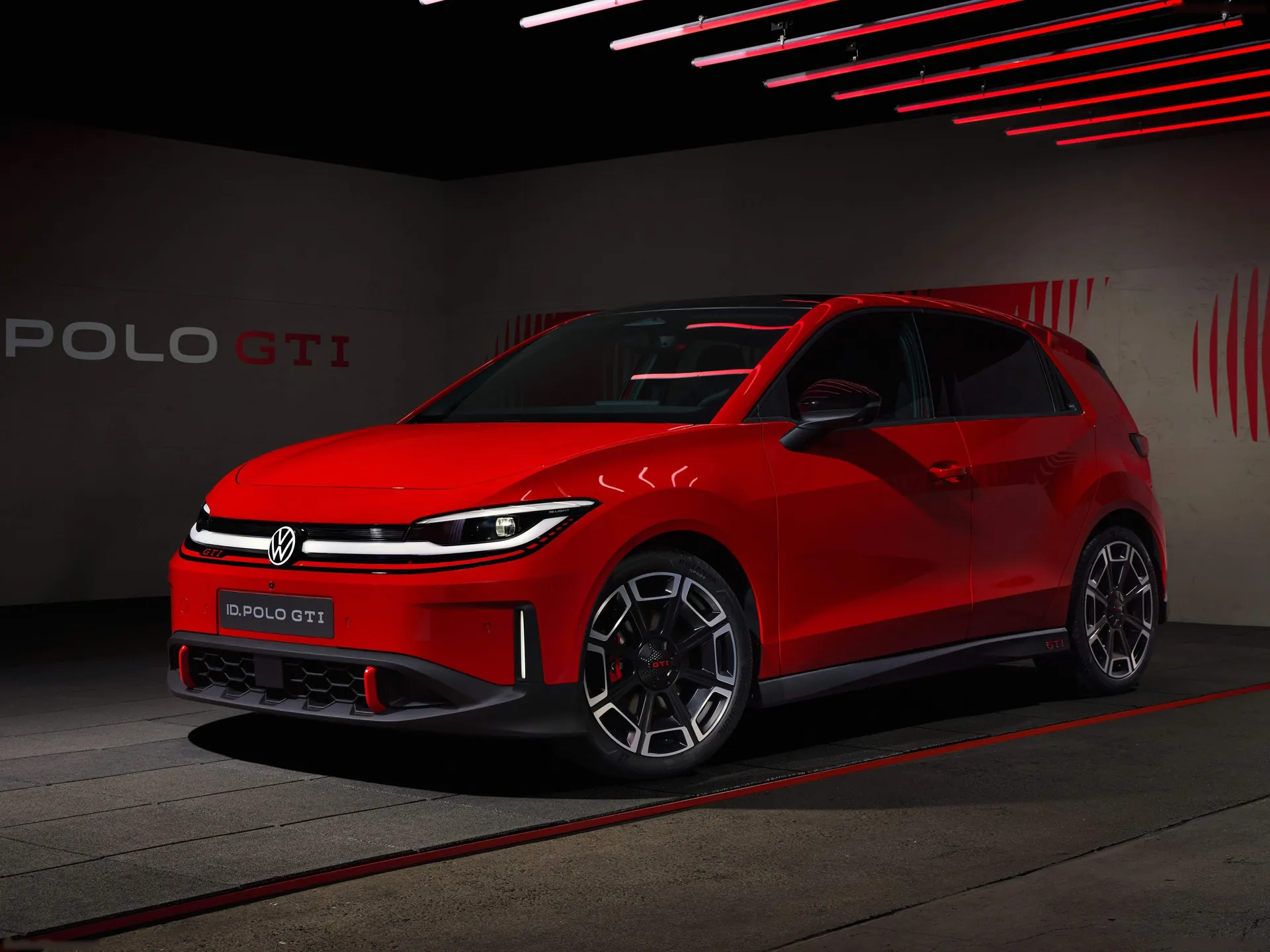
The exterior features of the GTI include a specific bumper with integrated spoiler lip and fog lights fitted as standard. Meanwhile, the red stripe in the middle of the radiator grille marks it out as a typical GTI. An exclusive feature in the Volkswagen Polo GTI is the optional LED headlights with red winglets; stylistically these are extensions of the red stripe in the radiator grille. Also part of the GTI insignia are, of course, the GTI logo and the classic honeycomb structure of the air intakes in the radiator grille and bumper. The new Polo GTI is also differentiated from the less powerful Polo versions by C-shaped black high-gloss panels in the bottom part of the bumper.
The most potent new Polo can also be identified by typical GTI characteristics at the rear. Black is a classic stylistic element here; a trait that has carried over from the first Golf GTI of 1976 to the new era. Black was used in places such as the frame of the rear window - a fact known in the late 1970s to every boy between the ages of 8 and 80. Today, the rear of the two-part roof spoiler is finished in black (gloss on top, matt underneath). Other GTI characteristics include a honeycomb structure, also painted black, in the bottom end of the bumper and the chrome dual tailpipes of the exhaust system integrated on the left-hand side. Located in a direct line above the tailpipes is the GTI lettering on the boot lid. Another standard feature of the Polo GTI is its LED tail light clusters that provide for a particularly distinctive light signature at night.
GTI insignia on the car's flanks include the newly designed 17-inch 'Milton Keynes' alloy wheels with 215/45 tyres. The inner areas of the high-sheen wheels are offset in black. They are colour coordinated on the sides with the Volkswagen Polo GTI's matt black sill extensions. As an option, the GTI can, for the first time, be ordered with exclusive 18-inch alloy wheels (tyres: 215/40). The wheels in 'Brescia' design are also high-sheen; their inner area is also painted in high-gloss black. Regardless of which of the two wheel types is specified, the powerful brake system's red painted brake callipers are always clearly visible through the aluminium spokes. Located on the front wings at the end of the eye-catching three-dimensional tornado line design feature is the red and chrome coloured GTI badge.
There are ordinary car colours, and then there are typical GTI colours. On the Polo GTI, the latter include Pure White, Flash Red and Deep Black Pearl Effect. In addition, the sportiest version of the sixth Polo generation can also be ordered in Limestone Grey Metallic or Reef Blue Metallic.
GTI insignia characterise the inside as well
A highlight of every GTI is its customised interior. The new Polo is no exception. Black, red, grey and chrome dominate visually here. Everything that is not upgraded with red, grey or chrome is always finished in black (trim colour: Titan Black). Therefore, the roof pillars and roofliner are also black. Red contrast stitching is another typical GTI characteristic in the interior. It is found around the standard leather multifunction sports steering wheel, the gear shift lever trim, the floor mats and the outer seat surfaces. The sport seats, which are suitable for practically any driver stature, feature the legendary 'Clark' plaid pattern on their inner surfaces (red, dark grey and light grey stripes and black squares). Black leather upholstery is available as an option. Numerous chrome details also upgrade the interior (including the steering wheel, gear knob, instrument surrounds, air vent tabs, climate controls, pedals and many buttons). Also exclusively coordinated for the GTI are the decorative trim elements of the dash panel, centre console and door trims. The dash panel can be ordered in Deep Iron Gloss or Velvet Red; the instruments in the upper dash area are always finished in black.
For the first time for the Polo and thus for the new GTI, Volkswagen is offering the option of digital instruments. The Polo is the first GTI to have the latest generation Active Info Display on board. The most powerful Polo gets exclusive GTI graphics with a red-white-black design named 'Sport'. Meanwhile, the infotainment systems with their 6.5- or 8.0-inch displays feature a unique GTI welcome screen. Instruments and the infotainment system are arranged on a single visual axis in the new Polo GTI, which makes them optimally visible and easy to operate. Digital interfaces for smartphones make it easier to bring the phones' apps and various online services on board. Not only can smartphones be charged by plugging them in, but as an option they may be charged wirelessly (inductively). The instruments and infotainment systems in detail:
Volkswagen interface designers have systematically further developed the Active Info Display (10.25-inch screen) and have elevated its high-quality graphics (133 dpi / resolution 1,280 x 480 pixels) and functional range to new levels. As a result, the display provides better graphic performance, greater pixel density, added brightness and contrast, more intensive colours and fewer conventional warning lights. Using a 'View button' on the multifunction steering wheel, the Volkswagen Polo GTI driver can now also switch between three basic layouts, easily and quickly. 1. A view with two instrument dials for engine revs and vehicle speed. 2. Digital view without dials. 3. Digital view without dials with supplemental information. Supplemental information can be configured via the infotainment system. Volkswagen has also adapted the graphics and colour scheme of the Active Info Display to the new Polo GTI - which favours black, white and red and graphics.
A new, digital and interactive cockpit environment has been created via the interplay of the Active Info Display and the infotainment system. Volkswagen is introducing the latest generation of infotainment systems in the Polo GTI with display sizes ranging from 6.5 to 8.0 inches. Specifically, these are the Composition Colour (6.5-inch radio-infotainment system) that comes as standard in the Volkswagen Polo GTI, Composition Media (8.0-inch radio-infotainment with CD player) and Discover Media (8.0-inch radio-navigation infotainment with CD player). The new Polo GTI brings connectivity to the driver and passengers more innovatively and more easily than ever before. In the Polo, they are 'always on', which is to say they are online whenever they wish. Available for this purpose are the Car-Net applications App-Connect (in addition to MirrorLinkÒ / Android, it also integrates Apple CarPlay™ and Android Auto™ / Google into the infotainment systems), Media Control and 'Guide & Inform' (providing a wide variety of online services).
The Polo is equipped with four doors, the Front Assist area monitoring system with City Emergency Braking and Pedestrian Monitoring, plus the Automatic Post-Collision Braking system. The new GTI also offers numerous other details as standard. Beyond the GTI-specific design features, these include additional head airbags front and rear, the XDS differential lock, driving profile selection, Composition Colour infotainment system, ambient lighting (white), sill panel trims with GTI logo, air conditioning, front fog lights and cornering lights, LED tail light clusters, a height-adjustable driver's seat, floor mats front and rear, electric windows all round with one-touch operation, and 'Plus' multifunction display. The Polo GTI can also be equipped with an exceptionally large range of optional driver assistance systems. Two other highlights of the available options are the largest panoramic sunroof in its class and a 300-watt sound system from Beats.
The heart of every GTI, and thus also of the new Volkswagen Polo GTI, is the engine. In recent times the GTI has been powered by high torque four-cylinder turbocharged engines. In the case of the new Polo GTI, it is a two-litre direct-injection petrol engine with an output of 147 kW / 200 PS. It develops 8 PS more than the 1.8 TSI of the previous model (141 kW / 192 PS). This means that, like the Golf GTI, the Polo GTI appears in the 2.0-litre turbo class for the first time. The 1,984 cc engine has a compression ratio of 11.65:1. The GTI unit delivers its maximum power between 4,400 and 6,000 rpm. This power plant of the third generation EA888 engine series transmits its maximum torque of 320 Nm to the front wheels at a low 1,500 rpm; this high torque figure stays constant up to a speed of 4,400 rpm - giving the GTI engine a torque curve that, rather than being traditional, features a sporty torque plateau.
The new Volkswagen Polo GTI's special technical features include an electronic valve-lift system on the inlet side, a dual injection system with TSI and manifold injectors (combined direct and manifold injection), three-part oil scraper rings, an engine controller with four core processors and a Miller combustion cycle.
The new Polo GTI launches with a 6-speed dual clutch gearbox (DSG). A version with a 6-speed manual gearbox will follow next year. The Polo GTI with DSG accelerates to 100 km/h in 6.7 seconds. Today's most powerful production Polo reaches a top speed of 237 km/h. Despite its high power output, the Volkswagen Polo GTI can be driven very economically thanks to efficient drive technology. The combined fuel consumption of the DSG version is 5.9 l/100 km (equivalent to 134 g/km CO2). The Polo GTI is fuelled with premium petrol (95 RON).
The Polo GTI is offered with two different running gear configurations. A sports running gear forms the base version, while the 'Sport Select' version with active dampers is available as an option. Like all Polo models, the GTI is also equipped with electromechanical power steering and Electronic Stability Control (ESC). Also on-board the GTI is the XDS differential lock (fitted as standard), which further refines traction when cornering quickly.
The 200 PS Polo, which like all GTI cars features front-wheel drive, has coil spring struts and lower wishbones with a track-stabilising scrub radius. The front running gear additionally features an anti-roll bar. The front suspension consists of coil springs with telescopic gas-filled dampers. The elements are integrated in the spring struts. The rear running gear consists of a semi-independent twist-beam suspension with an integrated anti-roll bar. Gas-filled dampers and separate springs provide sporty yet comfortable suspension at the rear.
The Volkswagen Polo GTI is the only model in the Polo line-up to be delivered with sports running gear as standard. The configuration includes special tuning of the springs, auxiliary springs, shock absorbers and anti-roll bars with the body lowered by 15 mm.
'Sport Select' running gear and driving profile selection
The Polo GTI can also be optionally configured with the 'Sport Select' running gear. Here the driver can vary the characteristics of the active dampers; and one of two modes - Normal or Sport - can be activated with the driving profile selection that is included as standard on the Polo GTI. The driving profile selection itself offers five modes: Normal, Sport, Eco, Comfort and Individual. Driving profile selection enables the driver to make individual adjustments, within a defined range, that have direct effects on vehicle handling. Along with its effects on the 'Sport Select' running gear, the profile that is selected also modifies the steering, engine characteristics and gearbox control. In addition to the active dampers, components included in the 'Sport Select' running gear include a larger anti-roll bar on the front axle, firmer steering rods at the front and firmer axle controls at the rear. Here too the car body has also been lowered by 15 mm.
This system can play a role in preventing serious accidents. It does so by utilising an LED symbol in the outer area of the exterior mirrors to alert the driver's attention to vehicles located in the blind spots on either side of the Volkswagen Polo GTI and to any vehicles approaching from the rear. As soon as a vehicle is detected, the symbol lights up. If the driver activates the turn indicator in the direction of the detected vehicle, the symbol flashes as an additional warning. Moreover, in this case the system generates a steering pulse that makes it harder to change lanes, thereby reducing the risk of a hazardous lane-changing incident. The system, which is automatically activated from a speed of 30 km/h, uses radar sensors to monitor an area of roughly 20 metres around the vehicle. When the Blind Spot Monitor is ordered, it automatically comes with Rear Traffic Alert, which makes reversing out of parking spaces much safer.
Rear Traffic Alert further enhances safety. It is offered in combination with the Blind Spot Monitor. Rear Traffic Alert takes much of the risk out of reversing from driveways and parking spaces that are at right angles to the road. What makes it really innovative is that the system not only 'recognises' stationary or moving vehicles directly behind the Polo, but also vehicles approaching from the side which are barely visible to the driver. The radar-based sensor module even detects objects at distances of up to 40 metres and recognises objects moving at speeds of 4 km/h or faster. If a collision is imminent, the system produces an audible warning. If the driver or other road user does not take action to correct the situation, or if there is a risk of immediate collision, the Rear Traffic Alert system automatically applies the brakes.
If the Driver Alert System detects that the driver's concentration is waning, it outputs an audible warning for a duration of five seconds and displays a message in the instrument cluster recommending a break from driving. If the driver does not take a break within the next 15 minutes, the warning is repeated once.
Around a quarter of all accidents that result in personal injury involve multiple collisions. The Automatic Post-Collision Braking System, which is included as standard, can help to avoid secondary collisions or reduce their severity. After an initial collision, the Automatic Post-Collision Braking System automatically initiates a braking action - within system limits - even before the driver can react. This can reduce the severity of the accident and ideally prevent secondary collisions.
If the proactive occupant protection system detects a potential accident situation - such as when hard braking is initiated by an activated brake assistant - the seatbelts for the driver and front-seat passenger are automatically pre-tensioned to ensure the best possible protection via the airbag and belt systems. If a highly critical and unstable driving situation is detected - such as severe oversteer or understeer with ESC intervention - the side windows are closed (except for a small gap), as is the sunroof. With the windows and roof nearly closed, the head and side airbags are able to provide optimum support and thus achieve their best possible effectiveness. As this system is offered in the Polo GTI in conjunction with the standard Front Assist area monitoring system, the proactive occupant protection system also detects situations in which the distance to the vehicle ahead is critical, and it helps to shorten the vehicle's stopping distance. In hazardous situations, the driver is given a visual and an audible warning and is also warned with a preventative braking jolt.
The system uses a radar sensor integrated in the car body and is currently offered in conjunction with a dual clutch gearbox (DSG). The driver can specify a target speed within a range of 0 to 210 km/h. ACC automatically adapts the car's speed to that of the vehicle driving ahead up to the maximum speed setting, while also maintaining a pre-selected distance. When the system is combined with DSG, this enables the Polo GTI with ACC to be automatically slowed to a standstill behind a stopping vehicle. After stopping, automatic ACC operation can be resumed if the driver re-enables it.
Front Assist uses a radar sensor integrated into the front end of the car to continually monitor the distance to vehicles ahead. The system assists the driver in critical situations by preconditioning the brake system, alerting the driver to the need to react by visual and audible warnings and, in a second stage, by a brief warning jolt of the brake pedal. If the driver fails to brake hard enough, the system automatically generates sufficient brake pressure to avoid a collision. If the driver does not react at all, Front Assist automatically applies the brakes to give the driver more reaction time. In addition, the system assists by informing the driver if the distance to the vehicle ahead is too short. The latest version of Front Assist being offered in the Volkswagen Polo GTI not only detects other vehicles, but also pedestrians who are moving across the driving lane. As soon as a pedestrian is at risk, the system warns the driver and, in a final stage, applies the brakes to slow down the Polo within system limits. One component of the Front Assist system is the City Emergency Braking function.
City Emergency Braking is a system extension of Front Assist. It monitors the zone in front of the Polo by radar sensor. The system operates at speeds below 30 km/h. If the driver does not react to an impending collision, the brake system is preconditioned as in Front Assist. If necessary, the City Emergency Braking System then automatically initiates hard braking within system limits to reduce the severity of the impact. In addition, if the pedal force applied by the driver is insufficient, the system intervenes by applying maximum braking force.
Here the driver can choose from a total of five programmes: Eco, Sport, Normal, Comfort and Individual. In the Eco driving mode engine management, the air conditioning unit and other auxiliary systems are regulated for optimal fuel efficiency. In addition, in vehicles with DSG, a coasting function can be used in Eco mode. If the driver releases the accelerator pedal - on downhill stretches, for example - the DSG disengages and the engine idles. This enables optimal utilisation of the Polo GTI's kinetic energy. In Sport mode, on the other hand, damping in the active dampers is increased (with the 'Sport Select' running gear), while engine response and DSG shift points are configured to be more dynamic.
Park Assist automatically guides the Volkswagen Polo GTI into perpendicular or parallel parking spaces and can reverse the car out of the latter as well. The system is activated by pressing a button on the centre console. Using the indicators, the driver selects the side on which the car is to be parked. If Park Assist finds a sufficiently large parking space (40 cm of manoeuvring room, front and rear, suffices), assisted parking can begin. The driver engages reverse gear and only needs to accelerate and brake (an automatic braking function assists in case of insufficient space). The car handles the steering.
The Tyre Pressure Loss Indicator utilises the wheel speed sensors of the anti-lock brake system (ABS). In case of tyre pressure loss, the rolling radius of the affected wheel decreases, and the wheel turns faster at the same vehicle speed. This allows the system to detect insufficient air pressure, and it warns the driver. However, the Tyre Pressure Loss Indicator does not relieve the driver of the obligation to check tyre pressures.