Volkswagen Golf R Variant
Volkswagen has launched the sportiest all-round vehicle of the compact class in Europe: the new VW Golf R Variant. For the first time since the model range was established - the first generation made its debut in 2002 - the Golf R, the icon of four-wheel drive compact sports cars, is being launched as an Variant car. The exclusive model produces 221 kW / 300 PS of power. The turbocharged engine of the Golf R Variant transfers up to 380 Nm torque to the permanent 4MOTION four-wheel drive system via its standard 6-speed dual-clutch gearbox (DSG). Distributing this drive power to all four wheels guarantees maximum traction, performance and active safety. Delivering pure dynamic performance are a sport suspension (lowered 20 mm), the innovative progressive steering system and "ESC Sport" - which can be fully deactivated for use on a race track. Optional highlights include the latest generation of the DCC adaptive chassis control system with a driving profile selector that features a Race mode.
0-100 km/h in 5.1 seconds and 7.0 litres per 100 km
The Volkswagen Golf R Variant accelerates from a standstill to 80 km/h in just 3.8 seconds and reaches 100 km/h in 5.1 seconds. The top speed of the sports car among Variant cars is electronically governed to 250 km/h. Its fuel consumption and emission figures show just how efficiently the turbocharged four-cylinder engine of the Golf R Variant operates. In the New European Driving Cycle (NEDC), the sportiest Golf Variant ever consumes just 7.0 l/100 km; this figure equates to CO2 emissions of 164 g/km.
The Golf R Variant is one of very few sports cars that do not throw in the towel when it comes to leisure activities that require lots of space or even transporting an entire family. With a storage capacity of 605 litres (loaded up to the rear seat backrest), this Volkswagen offers an impressively large luggage area - even with five people on board.
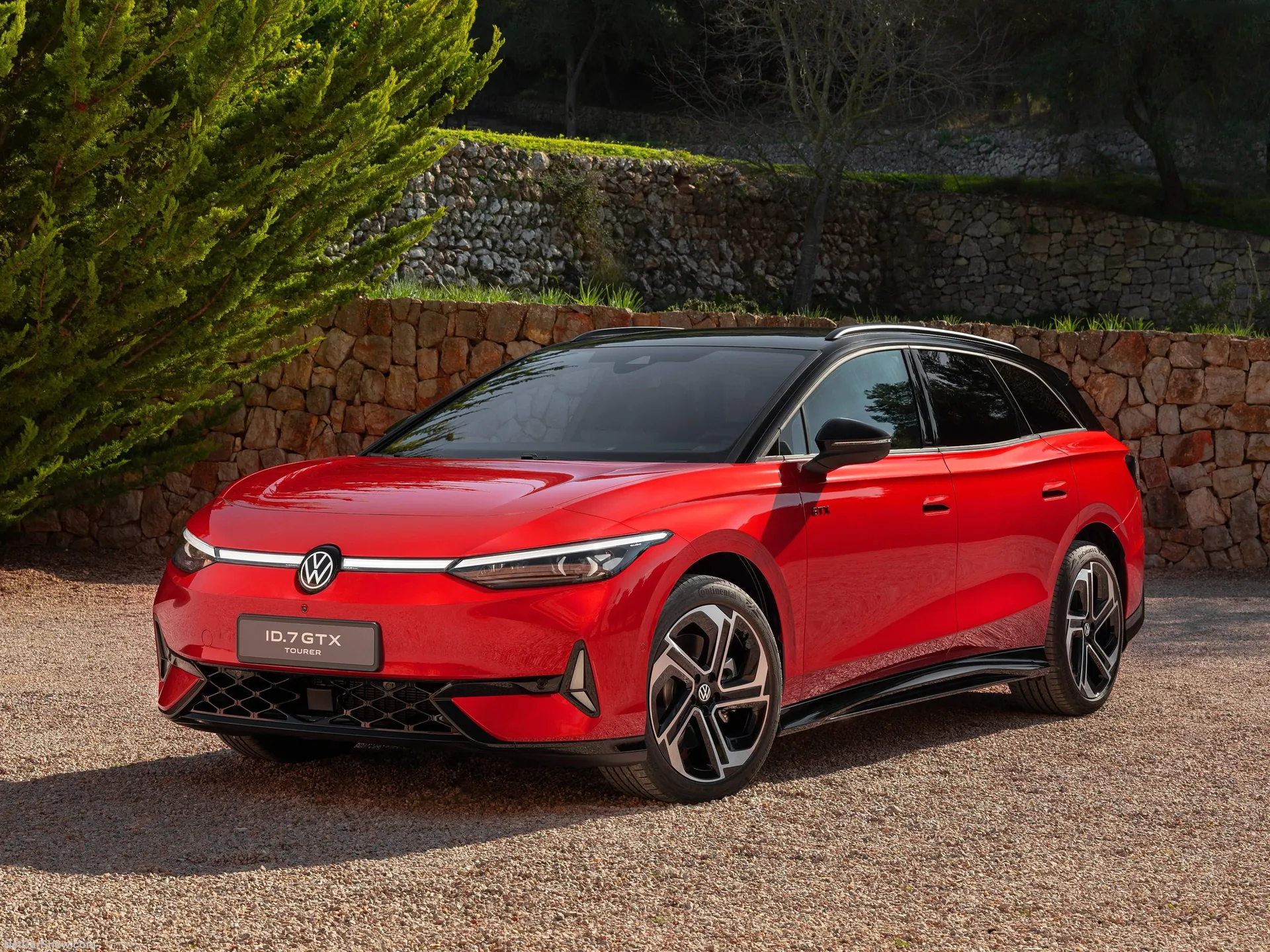
The exterior of the Volkswagen Golf R Variant follows the dominant lines of the hatchback model up to the B-pillars. Starting at the rear doors, special modifications outline the unique design of the Golf R Variant. At the rear, it is distinguished from the other Variant versions of the model series by a new bumper in "R" style, a high-gloss black diffuser, four chrome-plated tailpipe trims of the exhaust system, so-called "aero flaps" on the D-pillars and LED number plate illumination. Another standard feature in the VW Golf R Variant are the dark-red tail lights.
At the front, the Golf R Variant can be made out by the likewise R-specific bumper with very large air inlets, a unique radiator grille (with "R" logo) as well as standard bi-xenon headlights with integrated R-specific daytime running lights. The LED daytime running lights create a distinctive dual "U" pattern beneath the dual headlights; they project a particularly striking light pattern both day and night.
From the side, the Volkswagen Golf R Variant is characterised by "R" style side sill panels painted in body colour, "R" logos on the front wings and "matt chrome" door mirror caps. The elegant black window trim matches the high-gloss elements at the front and rear. The 18-inch "Cadiz" alloy wheels that were specially designed for the R models have 225/40 size tyres; clearly visible behind them are the extremely fade resistant brakes with callipers painted in black (including "R" logo). The sportiest Golf Variant can also be ordered with optional 19-inch alloy wheels; Volkswagen offers "Cadiz" wheels in this size as well. In addition, "Pretoria" alloy wheels in motorsport design and the colours "grey metallic", "black", and "black with blue wheel flange" are exclusively available as 19-inch flow-formed wheels (exceptionally lightweight and sturdy).
Inside, the new Golf R Variant is fitted with top sport seats in a "fabric-Alcantara" material mix (seat covers in "Race" fabric, inner surfaces of lateral support panels in Alcantara with decorative stitching in "crystal grey" and "R" logo on the seat backrests), blue ambient lighting, automatic climate control and a radio-CD system ("Composition Touch"). One of the options offered by Volkswagen for the Volkswagen Golf R Variant is the Nappa Carbon leather upholstery, including heating for the front seats. Here, the inner side support panels and head restraints are all upholstered in a dark "Carbon" style leather. Meanwhile, the middle seat panels may be ordered in either dark or light "Nappa" leather ("anthracite" or "modern grey"). The decorative seams are "crystal grey" in the leather upholstery version as well. The three-spoke sport steering wheel in "R" style is also trimmed in leather. Integrated in the lower steering wheel spoke is another "R" badge. Here too, all leather elements are upgraded by decorative stitching in contrasting "crystal grey" colour.
The versatile rear seating system was adapted to the look of the front sport seats. As mentioned above, the Golf R Variant with five people on board has a cargo volume of 605 litres (loaded up to the rear seat backrests). When the storage space with its minimum width of 1,003 mm and minimum height of 936 mm is fully utilised up to the front seat backrests and to the headliner, it offers a volume of 1,620 litres. The cargo area is 1,055 mm long up to the backs of the rear seats, and 1,831 mm long up to the backs of the front seats.
The cargo floor in the luggage compartment can be varied in height or completely dismantled with just a few hand movements. Another standard feature is a bootspace cover designed as a roller blind. When it is not needed, the roller blind - like the net partition - can be stored under the cargo floor. Practical features are remote unlatching of the 60:40 split rear bench seatbacks and their folding mechanisms. The seatbacks are easily released by unlatching levers in the side walls of the luggage area; then the backrests automatically fold forward, creating a nearly level surface together with the cargo floor.
The decorative inlays of the dash panel and door trim panels feature "Carbon Race" design; standard ambient lighting is also integrated in the door trim panels. Also illuminated (in blue) are the door sill guards. As a standard feature, the pedals and foot rest on the driver's side are designed in stainless steel look. Customising extends all the way to the floor mats, which have upgraded piping in the contrasting colour "crystal grey". The instruments and the start menu of the touchscreen on the centre console were also modified. To give a sporty feel from the very start, when the ignition is switched on, the illuminated light-blue needles of the tachometer and speedometer sweep once across the entire scale to the end pin - in the case of the speedometer to the 320 km/h mark. The instrument pointers are also automatically illuminated as soon as the driver's door is opened. The infotainment system touchscreen shows the animated "R" badge as a start screen.
Like the two and four-door hatchback versions, the new VW Golf R Variant is powered by an advanced four-cylinder engine of the EA888 series. As mentioned, it has a power output of 221 kW / 300 PS (from 5,500 to 6,200 rpm) - making it one of the most powerful four-cylinder engines on the market. Its maximum torque of 380 Newton metres is available over a remarkably wide speed range from 1,800 to 5,500 rpm.
Innovative detailed solutions. The turbocharged petrol direct injection engine is characterised by details such as water-cooled exhaust gas routing through the cylinder head to the turbocharger (to efficiently reduce full-load fuel consumption) and a dual injection system with both direct injection and port injection. Thanks to its fully-electronic coolant control system, this TSI of the Golf R Variant offers very efficient thermal management with a shorter warm-up phase, which also leads to reduced friction losses and lower fuel consumption. Moreover, the TSI has variable valve timing with dual camshaft adjustment. In addition, the valve lift on the exhaust side can be switched over two stages. This solution enables optimal control of the charge exchange process for better performance, fuel economy and lower emissions.
Permanent 4MOTION four-wheel drive has always been an identifying feature of the Golf R. This is also true of the new Volkswagen Golf R Variant. In the Variant, the latest generation four-wheel drive system is combined as standard with a 6-speed dual-clutch gearbox (DSG) that performs gear changes automatically, but permits manual shifting as an alternative. The 4MOTION system, equipped with a Haldex 5 coupling, is activated even before any wheel starts to slip, eliminating, almost entirely, any loss of traction. Under low engine load conditions, or when coasting, the front axle is driven while the rear axle is decoupled. However, the rear axle of the Golf R can be variably engaged in fractions of a second whenever necessary. This is done by means of a Haldex coupling, which is activated by an electro-hydraulic oil pump. If necessary, nearly 100 per cent of the drive torque can be directed to the rear axle.
Four-wheel EDL as differential locks and XDS+
In addition to the Haldex coupling that acts as a longitudinal lock, four electronic differential locks (EDL) integrated in the electronic stability control (ESC) act as transverse locks. In the Golf R Variant, the electronic differential locks are implemented as what is referred to as four-wheel EDL at both axles. In addition, the Golf R Variant is equipped with XDS+ at the front and rear axles. This brakes the wheels on the inside of a bend during fast cornering, which optimises steering characteristics and reduces understeer. In technical terms, XDS+ is a functional extension of the electronic differential locks.
As in the Golf R hatchback, the Variant is also equipped with the "ESC Sport" function as standard. The system is activated by a two-stage switch on the centre console. When the driver presses this switch for around 1.5 seconds, ESC switches to the "ESC Sport" mode. In very fast driving with lots of bends - such as on a race track - ESC responds later and thereby enables even more agile handling characteristics. When the ESC button is pressed for longer than three seconds, the system is fully deactivated for professional use on the race track.
The Volkswagen Golf R Variant is equipped with progressive steering as standard. Drivers do not need to turn the steering wheel as much to turn a desired radius; therefore, they do not need to reach over the steering wheel as often in tight bends. With progressive steering, it takes 2.1 turns of the wheel to reach the end stop, while without this option it takes 2.75 turns. How it works: conventional steering systems operate with a constant gear ratio; the new steering of the VW Golf R Variant, in contrast, operates with a progressive steering gear ratio. This perceptibly reduces steering work when manoeuvring and parking. On country roads with lots of bends, and when making turns, the driver experiences greater dynamics due to the more direct layout.
The new Golf R can be ordered with the second generation of DCC adaptive chassis control as an option. DCC offers the three modes "Comfort," "Normal" and "Sport," which are selected and displayed via the touchscreen on the centre console as part of the "Driving Profile Selector" functionality. In "Sport" mode, even more dynamic handling properties are implemented.
Another exclusive feature on board the Volkswagen Golf R Variant is the Driving Profile Selector. This is normally optional but a standard feature in conjunction with DCC. A total of four driving programmes are available, and in conjunction with DCC five: "Eco", "Normal", "Individual" and the special "Race" mode that was specially tailored to the R models; when DCC is installed, there is also the "Comfort" mode. All modes were specifically tuned for use in the VW Golf R Variant. In "Race" mode, damping is increased (which further reduces movements of the body structure), and engine response and shift points of the DSG are configured to be even more dynamic. The opposite is the case in "Eco" mode: here, engine control, the air conditioning unit and other auxiliary systems are controlled for optimal fuel efficiency. There is also a coasting function in Eco mode, so when the driver releases the accelerator pedal - e.g. when slowing down on an approach to a traffic light or on route segments with descents - the DSG disengages and the engine idles. This enables optimal utilisation of the kinetic energy of the Volkswagen Golf R Variant.