Porsche Panamera Turbo E-Hybrid
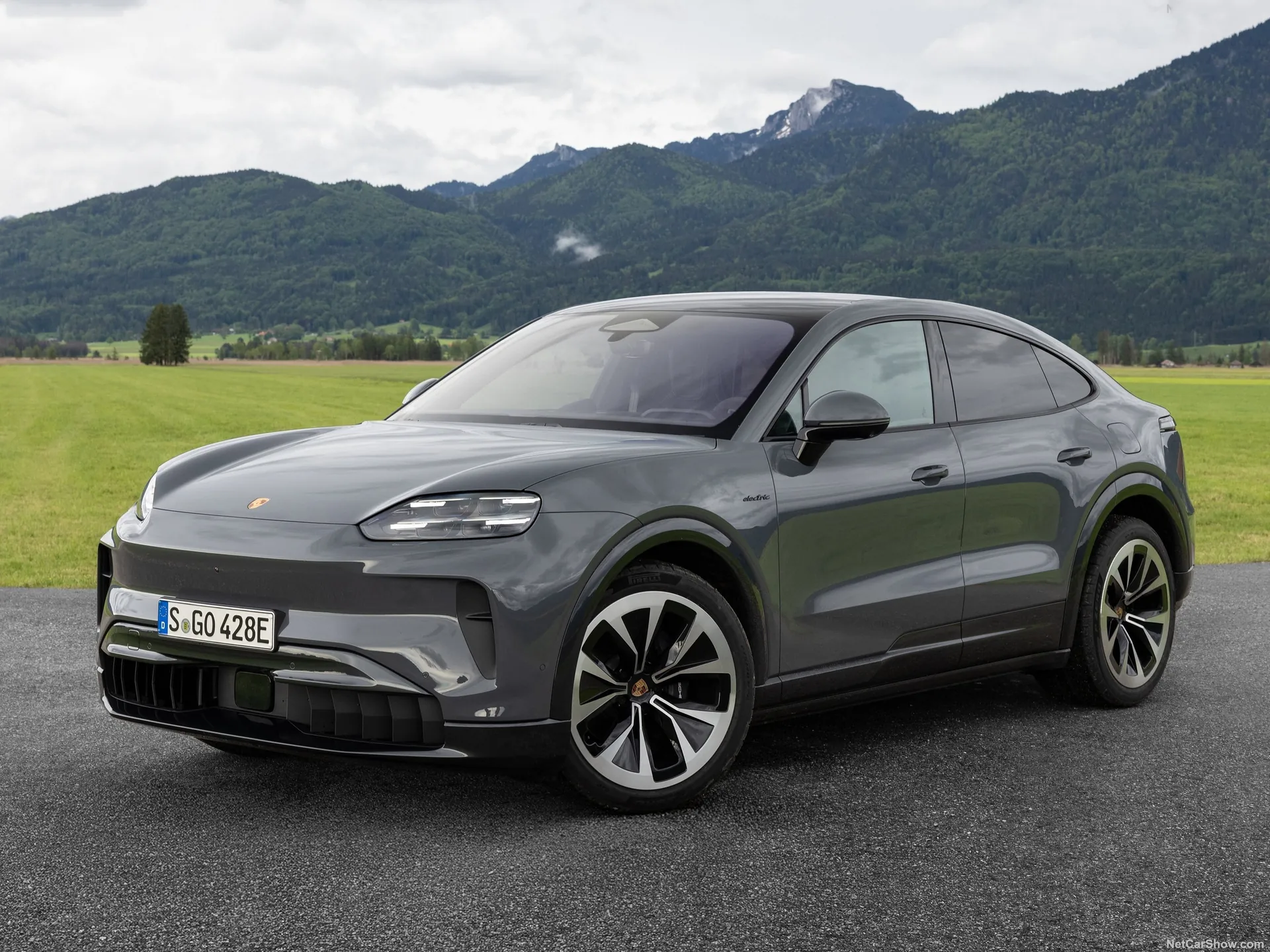
The design of the new Porsche Panamera has been systematically refined, giving it an even more commanding presence. Sharpened lines on the redesigned front and rear sections underscore the car's sporty character. The headlights are steeper than on the previous model, the wings are more pronounced and the bonnet is more clearly contoured. It all gives the new Panamera a fresh, technical and even more muscular look. Two filigree light guides in the three-dimensional, continuous rear light of the Panamera create an unmistakable look at the rear. Porsche has also sharpened the car's flanks in many areas. The redrawn window line emphasises the coupé-like line of the four-door sports car. All measures unmistakably identify the Panamera as a Porsche and give it an even more athletic and modern look. They put the stamp of the future on the classic silhouette and proportions of the Panamera.
The Porsche Panamera is one of the first models to hit the road with the carefully modernised Porsche crest. Following the revision to mark the '75 Years of Porsche Sports Cars' anniversary, the crest of the sports car brand is now cleaner and more modern, and the rearing horse has been thoughtfully redesigned. The designers reinterpreted classic elements and enhanced the logo with innovative design elements such as brushed metal and a honeycomb structure. This clearly anchors the Porsche trademark in its history while further developing the design.
Greater athleticism and emphasis on width
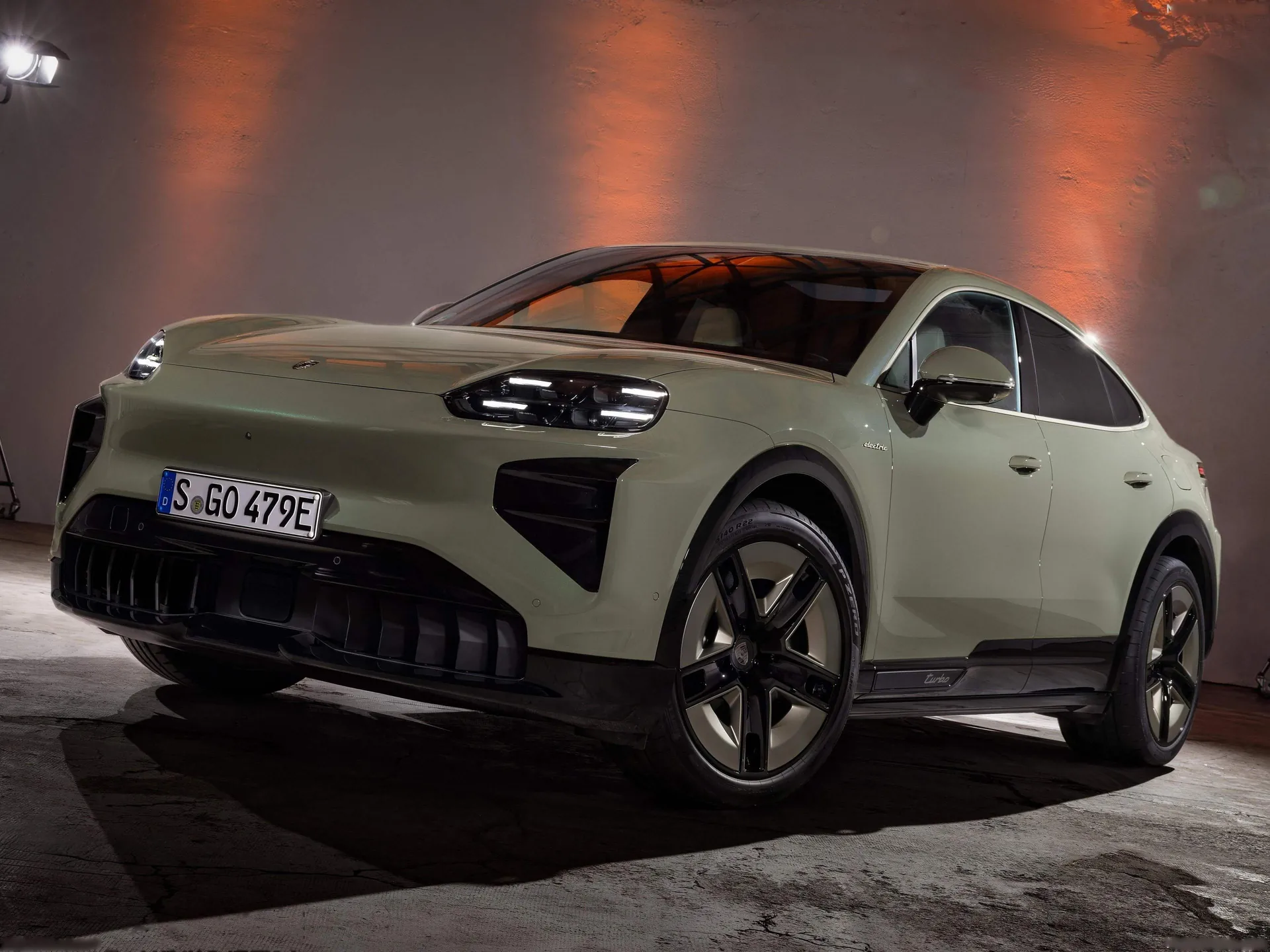
Directly under the modernised crest, there is a new, additional air inlet above the number plate holder. It takes into account the requirements of the new engines for an increased air flow and forms a single visual unit with the trapezoidal lower air intake. The large, rectangularly contoured side air intakes emphasise the width of the new Panamera. In the Panamera Turbo E-Hybrid, they only end at the level of the upper air intake and thereby signal the car's enhanced performance. In addition, the Turbo E-Hybrid is visually differentiated by precisely crafted Turbo front lights, vertical bars in the vehicle colour and side airblades. They lend the top-of-the-range model an even more commanding presence. In the case of the Panamera and the Panamera 4, vertical front lights now frame the front bumper at the sides.
An important design feature of the new Panamera is the more pronounced wings in front. The bonnet, by contrast, appears lower. This clearer reference to classic Porsche shapes also makes the Panamera look more striking and muscular. The more contoured central part of the bonnet continues the line of the new matrix LED headlights. They are steeper in the front of the new Panamera, emphasising the vehicle's width.
One particular highlight is the new, high-resolution HD matrix LED headlights (these are optional, though standard on the Turbo E-Hybrid). By dividing the main lighting functions into four almost squarely arranged LED modules, the characteristic Porsche four-point lighting graphics of the daytime running lights can also be seen at night in the new system for the first time - in both the dipped and high beams. This ensures an easily recognisable visual signature at night.
Characteristic features of the Panamera include the dynamic side view, which highlights its sports car genes. This flyline is even more striking on the new Panamera. The re-contoured window line rising at the rear of the vehicle, with its distinctive bend on the D-pillar, clearly identifies the new Panamera as a sports sedan. The air outlet integrated in the front wing is now more strongly flared and continues in boldly contoured form over the flank, giving the flyline a greater sense of tautness.
The three-dimensional rear light with the integrated PORSCHE logo emphasises the dynamic look of the car's rear. The continuous light strip spans the entire rear of the vehicle, while two filigree arcs produce a distinctive light signature. The illuminated and free-standing lettering is effectively highlighted by the three-dimensional integration of the tail light. The designers succeeded in integrating the rear hatch into the C-pillar without a visible gap. The frameless rear window gives the tail end of the car a fresh, elegant look. Sharper tear-off edges on the roof and on the adaptive extending rear spoiler, as well as the overall tighter lines, give the rear of the Panamera a cleaner and more athletic appearance. The new side tear-off edges in the rear part not only convey a high level of dynamism but also improve the aerodynamics. The same applies to the redesigned rear bumper. The exhaust system for the Panamera and Panamera 4 features two single-tube tailpipes on the outside left and right in brushed stainless steel.
More presence and new accents for Panamera Turbo E-Hybrid
Porsche now highlights the turbo variants even more clearly than before for the range-topping models. The Porsche Panamera Turbo E-Hybrid has a separate rear bumper with diffuser panels painted in the exterior colour and two double tailpipes in bronze on the left and right edges. Numerous other details distinguish the Panamera Turbo E-Hybrid from the Panamera and Panamera 4. Much like the GTS models, which signal their performance-focused orientation with accent colours in Carmine Red and Black, the Panamera Turbo E-Hybrid uses the Turbo-exclusive accent colour Turbonite. It features on numerous add-on parts and the wheels available for the Turbo E-Hybrid. Turbonite is an elegant, warm grey with a premium-feeling bronze undertone that sits well with all available exterior colours. Porsche uses Turbonite in the side air blades of the air intakes on the front end, as well as the side window trims, the 'Turbo' model designation on the tailgate, the 'E-Hybrid' lettering on the front doors and the strip in the rear bumper. Porsche also uses Turbonite for the Porsche crest on the bonnet and on the sides of the car. With the optional SportDesign side skirts in Black, the inlay stands out in Turbonite.
The new Panamera can be further individualised with a variety of new paint shades. The exterior colour palette has been redesigned. It is now divided into four colour schemes that meet different customer requirements and ensure a wider spread of colour options. They are called Legends, Dreams, Shades and Contrasts. The Legends colour scheme denotes extraordinary yet classical style. The paints are particularly high-quality and rich in nuance. Legends includes shades such as Aventurine Green Metallic and Copper Ruby Metallic. The heritage shade of Oak Green Metallic Neo is a nod to Porsche history. The range in the Dreams colour scheme is colourful, expressive and bright. In addition to the elegant Gentian Blue Metallic, there's the spectacular Madeira Gold Metallic. The Panamera Turbo E-Hybrid comes as standard with colour tones from the Dreams range. For a more discreet appearance, five metallic shades from Jet Black Metallic to Dolomite Silver Metallic and Carrara White Metallic make up the Shades colour scheme. The Contrasts category, which is based on a clear, purist aesthetic, works exclusively with black and white.
Centre-locking wheels available for the first time
A completely new range of wheels underlines the striking appearance of the new Panamera. The sports sedan can be adapted to your personal wishes with a total of eight new wheel designs measuring 19-, 20- and 21-inches in diameter. For the first time, this includes a 21-inch wheel with a centre lock, which is visually reminiscent of the classic Turbo Design wheel. The forged aluminium rim is available as an option and exclusively for the Turbo E-Hybrid. There are also new wheel designs to choose from for the other model variants. The optional 21-inch Turbo Design wheel remains in the programme.
With the model change, Porsche's latest driver-centred control concept is being introduced in the Panamera. The Porsche Driver Experience stands for a fully digital display, versatile individualisation and intuitive operation. The focus is entirely on the driver's line of sight: all controls that are crucial to actively driving are grouped directly around the steering wheel and are therefore directly accessible. This allows the driver to operate more quickly, more easily and ultimately more dynamically. Another feature of the new control logic from Porsche is striking the right balance between digital and analogue elements.
As usual with Porsche, the highest point on the dashboard is the instrument cluster, a digital, free-standing 12.6-inch display in a curved and free-standing design. It's divided into three areas. Depending on the specified equipment, driving information can be displayed in up to seven different views. This includes a 3D driver assistance display and a display based on Porsche's 'Classic' five-pipe design. An optional head-up display is also available. The driver can adjust the displays and the position of the head-up display directly from the sports steering wheel without taking their eyes off the road.
In classic Porsche fashion, the start button is located to the left of the steering wheel. The designers have positioned the significantly smaller selector lever for the automatic transmission to the right of the steering wheel, between the instrument cluster and the dashboard. Porsche has placed the standard mode switch for quick selection of the Normal, Sport and Sport Plus driving programmes as well as a toggle switch for quick access to functions of the instrument cluster on the multifunction Sports steering wheel. The mode button on the fundamentally revamped control lever for the assistance systems allows lightning-fast selection of driving assistance functions. Further settings can be made via context-related pop-ups in the instrument cluster.
The dashboard, with its elegant black panel design, integrates the high-resolution 12.3-inch central display and the optional 10.9-inch passenger display, which is available for the first time in the Panamera. The central display controls the functions of the Porsche Communication Management (PCM) infotainment system as usual. The Passenger Display gives occupants of the front passenger seat access to an innovative display and control interface of their own. It can be used, for example, to operate infotainment functions such as the radio or navigation system, display dynamic driving information and even stream videos. A special film ensures that the driver is not distracted.
The new position of the gear selector lever enables the complete redesign of the centre console and the climate control panel. It now features large touch-sensitive control surfaces with intuitive tactile feedback. The driver and front passenger control the temperature, the ventilation level and switch the air conditioning on and off via five physical climate switches. Directly below this is a mechanical rotary push-button that controls the volume of the audio system.
The new, louvre-less air vents also contribute to the new Porsche Driver Experience in the Panamera. They can be operated via pre-programmed automatic ventilation modes or adjusted completely electrically. This allows you to switch between draught-free air conditioning and rapid cooling with a single click.
The interior of the new Porsche Panamera features a stylish overall look made up of modern technical details, premium materials and delicate décors. The focus is always on operating efficiency with regard to dynamic driving. Characteristic of the Panamera are the steeply rising centre console and the width-emphasising black panel and its decorative elements, which also help to underscore a sense of width. It combines the central display and the optional Passenger Display into an elegant single unit, creating a calm and high-quality appearance. For the first time, Porsche has also implemented ambient lighting across the entire width of the dashboard in the new Panamera, which further enhances this effect.
The newly designed seat surfaces contribute to the clean, sporty, high-quality ambience in the new Panamera. Transverse seams and single fell seams on the contours of the seats create a restrained but clear visual structure.
Porsche has completely revised the colour and material options in the interior. Initially, two part-leather and six leather variants as well as two particularly high-quality club leather seat upholstery options are available. Particular attention was paid to a broad selection of two-tone designs. This creates extensive and precisely coordinated options to accentuate the interior appearance in terms of colour. The colour matching between the Sport Chrono on-board clock and the digital rev counter is a particularly lovely detail. In addition, there are other new décor and accent options that Porsche is offering together in various packages. The customisation options range from particularly high-quality to maximum sportiness. Due to popular demand, Porsche is also offering leather-free equipment in the Panamera for the first time, combining particularly sporty materials such as Race-Tex with faux-leather.
Traditionally, Porsche Turbo models are the range-toppers in their respective model lines. In the new Panamera, Turbo versions can be identified in the interior by several exquisitely designed accents in Turbonite. In combination with carbon elements, this Turbo-specific colour creates a particularly sporty ambience and can be found, for example, on the Porsche crest on the GT sports steering wheel, in the central rev counter in the digital instrument cluster, as the colour of the controls in the centre console and as an accent on the door panels.
Porsche Active Ride High-end suspension for E-Hybrid models
Porsche is offering a new premium suspension system as an option exclusively for the Panamera E-Hybrid models. Porsche Active Ride, which features active two-valve shock absorbers and single-chamber air springs, regulates the forces of each individual damper actively, individually and at lightning speed. In this way, it always achieves maximum driving comfort and performance for any given situation. The design is fundamentally different from regular adaptive systems and other active suspension concepts. Porsche Active Ride offers a unique driving experience that spans the entire spectrum of dynamic behaviour, from the gliding comfort of a luxury sedan to the directness of response that's typical of a sports car. It delivers top marks in the disciplines of pitch and roll support, body stability, slow-speed driving comfort and handling performance. It also provides extensive additional functions.
The Porsche Active Ride shock absorbers are each connected to an electrically driven hydraulic pump. They generate a volume flow in the damper as required, which is then regulated separately in both the rebound and compression directions. The volume flow enables the piston in the damper to be moved up or down at lightning speed, allowing each wheel to actively extend or compress individually. The wheels therefore actively follow the contour of the road surface - they are pushed into potholes, for example, and lifted going over bumps. This is always done with the aim of correcting the unevenness of the road and keeping the surface as far away from the body as possible. The dampers operate at up to 13 Hz, which means they can adjust the setting up to 13 times per second and therefore react at lightning-fast speed to the driving situation and the road surface at any given moment.
Porsche Active Ride also does not require traditional anti-roll bars, as their effect is provided entirely by the active dampers. The dampers also perform the function of electronic anti-roll stabilisation (PDCC Sport). Moreover, the new shock absorbers make it possible to replace the complex three-chamber air suspension of the previous model with a system that features lightweight and efficient single-chamber air springs. The air suspension is used for speed-dependent control of the vehicle's ride height to improve driving stability and aerodynamics, as well as for automatic self-levelling depending on the occupancy or cargo load condition. A lower or higher ride height can be selected manually in the Porsche Communication Management system (PCM).
In summary, Porsche Active Ride offers the following functions:
Standard two-chamber air suspension with two-valve dampers
A Porsche is always the most dynamic car in its class. Yet with its positioning as a luxury sedan, the requirements for an outstanding level of comfort are also particularly high in the Panamera. So Porsche has equipped the new Panamera with newly developed two-valve air suspension as standard. The two-valve technology enables the adaptive dampers to adjust the rebound and compression stages independently of each other. This considerably expands the breadth of chassis capabilities between that of a comfortable, gliding character and a decidedly high-performance setup. The technology makes it possible to switch from the tried-and-tested three-chamber air spring to a lighter two-chamber system with improved suspension performance. In addition, optimisations to the hydraulic mounts on the front axle, the rear axle beam bearings and the wishbone bearings on the rear suspension ensure noticeably increased comfort when driving over bumps.
With the new suspension, Porsche simultaneously achieves reduced body movements and improved body insulation. The four-door sports car pitches and rolls less when braking and when driving through dips or over undulations and crests. The result is a faster, more sensitive chassis response and noticeably smoother suspension behaviour. At the same time, the suspension has the potential to significantly increase the damping force in the rebound and compression directions depending on the situation, thereby optimising the car's performance. This is particularly evident in fast cornering. In addition, the new air spring with optimal valve control reduces the energy consumption of the suspension.
Porsche has deployed an electric brake booster in the new Panamera. All variants benefit from newly adapted brake pedal characteristics, which significantly improve pedal feel and brake precision. In the E-Hybrid models, engineers have also succeeded in smoothing out the transition between the energy regeneration braking effect (which is achieved via the electric motor) and the effect of friction braking (which is achieved via the wheel brakes). Although two braking systems complement each other in these variants, this gives the driver optimal control of the braking force. And no energy is wasted in the process: the electric motor generates current when decelerating to a standstill.
In the Panamera and Panamera 4, Porsche uses a brake system with six-piston fixed callipers and grey cast iron discs measuring 360 millimetres x 36 millimetres at the front. At the rear, there are four-piston fixed callipers and 330 mm x 28 mm grey cast iron discs. The standard-fit brakes on the Panamera Turbo E-Hybrid are 10-piston fixed callipers at the front and grey cast iron brake discs measuring 420 mm x 40 mm, with four-piston fixed callipers and 380 mm x 30 mm grey cast iron brake discs at the rear.
For the Panamera Turbo E-Hybrid, Porsche is offering a new 21-inch performance tyre as an option: the Pirelli P Zero Corsa improves track-driving suitability through increased grip levels, improved precision and higher temperature resistance. Its wet-weather properties have also been further optimised.
Panamera Turbo E-Hybrid with high electric performance
Efficiency and performance are core values for Porsche. With the new generation of the Panamera, Porsche is once again heightening this focus. The Porsche Panamera Turbo E-Hybrid is one of a total of four variants with a plug-in hybrid drive that Porsche will launch successively for the third-generation car. With a total output of 500 kW (680 PS) and torque of 930 Nm, the Turbo E-Hybrid makes its debut at the top of the model line, succeeding the previous Panamera Turbo S in its range-topping role. The extensively revised 4.0-litre V8 twin-turbo engine and a newly developed electric motor enable impressive driving performance and long-lasting electric performance. The Panamera Turbo E-Hybrid reaches a top speed of up to 140 km/h in pure electric mode with an output of 140 kW/190 PS and torque of 450 Nm from the new electric motor. If the Panamera Turbo E-Hybrid taps into its full power, it can accelerate from 0 to 100 km/h in 3.2 seconds and reach a top speed of 315 km/h.
The heart of the powertrain system remains a compelling combustion engine. Porsche's continually refined eight-cylinder engine meets demanding exhaust standards worldwide with further reductions in fuel consumption and emissions without losing any of its dynamic performance. The engine has new turbochargers that work according to the monoscroll principle. Compared to the twin-scroll chargers in the previous model, this shortens the warm-up phase of the catalytic converters. This allows them to work at full performance more quickly. It also raises the maximum permissible exhaust gas temperature. In addition, Porsche has increased the peak pressure in the combustion chambers to 140 bar. These measures substantially shorten the warm-up phase and increase efficiency during more vigorous use.
The upgraded powertrain dispenses with cylinder deactivation. Instead, it adjusts the valve lift to a low or high level with actuators on the intake camshafts. At low loads, the engine works with short opening times and minimal lift to achieve the highest possible efficiency. Under high loads, the valves open wide and for a long time in order to achieve a high cylinder charge and therefore achieve high torque levels combined with optimised CO 2 emissions. Special magnetoresistant camshaft sensors determine the positions of the camshafts in real time and thereby enable the engine control system to set the valve lift and valve opening times in the best possible way. By optimising insulation, engineers were also able to reduce unwanted background noise and heighten the exhilarating character of the charismatic engine note.
Electric motor integrated into the transmission housing
Porsche combines the 4.0-litre V8 twin-turbo engine in the Porsche Panamera Turbo E-Hybrid with a new electric motor. Rather than being a supplementary component of the drive package, it is deeply integrated into the design of the gearbox. Dispensing with an independent electric motor housing and placing it in the housing of the transmission itself saves around five kilograms in weight. An internal rotor, an electric motor in which the stator surrounds the rotor, is used. This design promotes a more spontaneous and dynamic response.
The design of the powertrain prioritises the electric motor. The engine decoupler is now open in the initial position, so by default the electric motor alone drives the vehicle. It is only when the power of the eight-cylinder engine is required that the decoupler closes and engages the engine into the rest of the drivetrain.
The electric motor is now also more efficient. By switching from water to oil cooling and integrating this into the transmission's ail circuit, Porsche also optimises the heat output of the electric motor. This allows a higher power output and increases the recuperation capacity of the electric motor. The Panamera Turbo E-Hybrid recuperates up to 88 kW of power - an increase of 19 kW. When decelerating, the vehicle's energy recuperation operates down to a speed of just two km/h.
A new high-voltage battery powers the electric motor of the Porsche Panamera Turbo E-Hybrid. This compact module is integrated into the rear of the vehicle to save space and has a capacity of 25.9 kWh. It enables an electric range of up to 91 km in the combined WLTP cycle or 83 - 93 km in the city cycle. Despite this increase in range of about 45 per cent compared to its predecessor, the space the new battery takes up is comparable with that of the previous generation. This is because optimising cell chemistry has resulted in a higher power density. And yet despite the larger battery capacity, the charging time continues to reduce: all E-Hybrid models are equipped with an 11 kW AC charger as standard. At suitable charging stations and wall boxes, the battery can be charged in roughly two hours and 39 minutes.
Porsche is also further refining the E-Hybrid driving modes of the Panamera and linking them more closely to the navigation. In E-Charge mode, the drive system operates in hybrid mode in city traffic below 55 km/h. Only at higher speeds in out-of-town driving does it use the engine's power to charge the high-voltage battery. In the Sport and Sport Plus driving modes, the Panamera now charges the battery to 20 and 30 per cent respectively. In the previous model, it was 30 or 80 per cent. This increases efficiency without compromising performance.
The rear-wheel-drive Panamera and the all-wheel-drive Panamera 4 are equipped with optimised and performance-enhanced 2.9-litre twin-turbo engines. They have been prepared for the fulfilment of future emissions standards with extensive internal engine measures. With a power output of 260 kW (353 PS) and torque of 500 Nm, they outperform their equivalents in the previous car by 17 kW (23 PS) and 50 Nm. The performance upgrade shortens the sprint from 0 to 100 km/h to 5.3 seconds (5.1 sec. with the Sport Chrono package) for the Panamera and 5.0 seconds (4.8 sec. with the Sport Chrono package) for the Panamera 4. The top speed increases to 272 km/h in the Panamera and 270 km/h in the Panamera 4. A newly developed sports exhaust system optionally intensifies the charismatic sound of the six-cylinder engines.
All variants benefit from the new eight-speed Porsche Doppelkupplung (PDK), which has been further enhanced exclusively for the Panamera. It improves interaction with the engine and enables particularly fast shift times or particularly smooth gear changes depending on the driving mode selected. Its design also takes into account the significantly increased drive torque of the new Panamera. And it can handle a torque of more than 900 Nm with aplomb.
Innovative lighting technology and new assistance systems
The new Porsche Panamera features newly developed matrix LED headlights as standard. Its appearance is characterised by four three-dimensional light modules. They generate the characteristic Porsche four-point daytime driving lights and are arranged around the central Bi-Matrix module for dipped beam and matrix high beam. The headlights automatically control illumination of the road based on camera and navigation data as well as vehicle speed. The system also uses the camera function to detect vehicles ahead and oncoming traffic. The distribution of the high beam is then controlled to provide optimal illumination of the road without dazzling other road users. For this purpose, the high-beam area is divided into 11 vertical segments that can be illuminated or dimmed according to the situation to prevent dazzling of oncoming traffic.
Particularly innovative and high-performance HD matrix LED headlights are available as an option in the new Porsche Panamera. The core element of the innovation is an LED chip that combines more than 16,000 individually controllable micro-LEDs on the surface area the size of a thumbnail. It all adds up to more than 65,000 LED elements for both headlights. The headlights with HD matrix technology therefore offer high-resolution and highly flexible light distribution that's up to two times brighter, as well as extremely homogeneous illumination.
In addition to four-point daytime driving lights and static cornering lights, each of the new headlights includes two of the new HD matrix modules and two bi-functional modules for courtesy lighting and the auxiliary high beam. These four main light sources are arranged in a four-point design that is characteristic of the brand. The new HD matrix technology also stands apart in terms of design: for the first time, the distinctive Porsche four-point headlight graphics of the daytime running lights can also be seen at night when the new system is used - with both low and high beams. Each of the two HD modules per headlight has specifically ground lenses made of optical glass and which produce different angles of illumination. The wide-angle lens of the outer HD matrix module ensures wide illumination. The inner HD matrix module with telephoto lens radiates the light in a very concentrated - and therefore much brighter - fashion. The light distributed by the two HD modules overlaps in the centre. In this way, the new headlight combines a wide area of illumination with a high intensity beam at its core.
Beyond the excellent illumination, the new HD matrix LED system is primarily characterised by the flexibility of the light distribution. The system is controlled using a wide variety of available data, such as from the front camera, the GPS module, the chassis sensors and available navigation data. This enables the implementation of new and optimised lighting functions for greater safety and comfort. One example is a new non-dazzling high-beam function in two-way traffic: large areas to the right and left of the anti-dazzling gap become significantly brighter. This improves the driver's visibility without dazzling the oncoming traffic. Other functions include brightening the driver's lane via a light carpet in front of the car on motorways and comparable roads as well as special settings for roadworks and narrow-lane lighting.
More comfort and safety when driving and parking
The range of functions of the standard and optional assistance systems in the Porsche Panamera has significantly increased with the model change. This noticeably improves the levels of comfort and safety. Porsche equips the Panamera as standard with the ParkAssist system, reversing camera, Lane Keeping Assist system including Traffic Sign Recognition, Warn and Brake Assist including pedestrian protection, and Active Speed Limit Assist. This system features a new limiter function that interacts with Traffic Sign Recognition. If the system is active, the vehicle will automatically not drive faster than the current posted speed limit. Of course, the system can be overridden with the accelerator pedal. The driver can also temporarily set a different speed via the control lever.
Numerous other assistance systems with an increased range of functions are available as options. Porsche InnoDrive with Adaptive Cruise Control now has Active Lane Keeping and Intersection Assist. The Active Lane Keeping automatically drives the vehicle within the lane markings. In traffic jams, the car automatically starts up again for up to 60 seconds after a standstill when the vehicle in front starts moving. Hands-off monitoring ensures that the driver continues to focus their attention on the road. The Intersection Assist function warns you when the car starts moving even though other road users are crossing or approaching.
Porsche supplements the Adaptive Cruise Control with an Evasion Assist function which helps steer the vehicle around obstacles in critical situations. Turn Assist is also new. It monitors oncoming vehicles when turning across the flow of traffic and performs emergency braking in dangerous situations. The active Lane Change Assist feature also offers new functions: when getting out of the car or pulling the car out into traffic, it monitors the road behind via the rear radar and warns if other vehicles are approaching.
Porsche has also introduced new and optimised functions in the ParkAssist feature. To better assess the surroundings, the intelligent ParkAssist calculates a prospective 3D representation of the surroundings from camera images. Active Parking Assistance independently detects parking spaces and is able to park automatically in parallel or perpendicular parking spaces after initiating the parking process.
The driver only needs to monitor this process, as they continue to be responsible for the parking process. However, with the new Remote ParkAssist function, the driver no longer has to be in the car. After the start of the automatic parking process, they can leave the car and supervise it entering or leaving the parking space via their smartphone. As long as the driver is pressing the corresponding button in the smartphone app, the Panamera continues the parking process. The function is available for parking and exiting processes for longitudinal and perpendicular parking spaces as well as for garages.
Deep integration of the personal digital ecosystem
The new Panamera offers significantly more digital and networking options than its predecessor: new infotainment functions ease operation and ensure an even more intuitive driving experience. Powerful hardware further enhances the multimedia experience. The new wireless charger with cooling function significantly reduces the charging time for smartphones, offering 15 watts of power. There are also two USB-C fast charging ports in both the front centre console and in the rear.
For the first time, the Panamera also offers the possibility of video streaming. The third-party application 'ScreenHits TV' can be used to access various popular streaming services, depending on the market. Videos are shown on the 10.9-inch Passenger Display, available for the first time in the Panamera, as well as the 12.3-inch centre display, albeit only while stationary in the latter case for safety reasons. Porsche uses a special foil on the passenger display to ensure that the driver is not distracted by the streaming service while driving.
Logging on with the Porsche ID is easier in the new Panamera. The driver only needs to scan the QR code displayed in the PCM with the My Porsche app. There is no need to enter the Porsche ID and password in the PCM. Also new: Porsche has integrated popular music streaming apps as native apps directly in the PCM system. This makes it easier to use as the apps are available when Porsche Connect is activated even when the smartphone is not connected to the car. In addition, Porsche has integrated the Apple CarPlay® service more deeply into the Panamera's displays and functions. This simplifies operation of many smartphone functions. The service is adapted to the familiar Porsche Connect design.
By integrating the My Porsche app into Apple CarPlay®, Porsche links the user's digital smartphone ecosystem even more closely to the car. This makes it possible to control vehicle functions directly from the user's personalised digital ecosystem. The Siri® voice service can be used, for example, to control the air conditioning, the ambient lighting and the massage function as well as to change the radio station. The voice service can be activated directly via the Voice Pilot button. It is also possible to share performance data from the last trip directly with contacts.
Even since its launch, the Panamera has combined the dynamic qualities of a Porsche with the comfort of a luxury sedan. In the new Panamera, Porsche has further refined this positioning with numerous sophisticated comfort solutions. This includes the new air quality system, which reliably protects occupants against particles and harmful substances. The system's standard equipment includes the fine dust filter and the GPS recirculation function. It uses predictive navigation data to automatically activate air recirculation when the car is about to enter a tunnel. This prevents odours and exhaust fumes that might accumulate there from reaching the passenger compartment in the first place. If route planning is activated, the system takes tunnels along the set route into account well in advance.
As an option, a fine dust sensor continuously measures the level of PM 2.5 fine dust particles in the interior air and the ambient air. If the air quality around the car decreases, the air quality system switches to recirculated air and cleans the air inside by passing it through the fine dust filter several times. An ioniser is also optionally available to remove germs and pollutants from the air, a boon to allergy sufferers in particular.
High-end sound systems with a new 'Driver' mode
As an alternative to the standard Sound Package Plus, Porsche is once again offering a Bose® surround sound system and a Burmester® 3D high-end surround sound system in the new Panamera. In both systems, a driver-focused setting called 'Driver' can be activated. It optimises the sound experience in the driver's seat. In both systems, new subwoofer technology is also used. The Fresh Air subwoofer produces low frequencies in an open housing and utilises the ambient air for this purpose. This saves both installation space and about 3.2 kilograms of weight while maintaining first-class sound quality.
As before, the Porsche Panamera offers a particularly sporty seating position compared to rest of the segment. Porsche equips the Panamera with four standard single seats, and the front seats are eight-way electrically adjustable. As an option, 14-way electrically adjustable comfort seats and 18-way electrically adjustable sports seats available in the front. In the rear, Porsche offers optional 4+1 seats as well as electrically adjustable comfort individual seats with memory function. New, improved seat foam materials increase seating comfort in all configurations.
In the Executive models (specific to certain markets), which feature a wheelbase extended by 15 centimetres, an improved rear seat system with flatter side bolsters and a flatter basic contour is part of the standard package. This shifts the seating position toward the rear, which benefits leg support and knee clearance. A new soft foam pad under the seat cover improves seating comfort, while new comfort head cushions add to the luxurious seating experience. All Executive models also come with four-zone climate control as standard, as well as the new 15-watt wireless charging function in the rear centre console.