Hyundai Ioniq 5
Hyundai Motor Company launched IONIQ 5, a midsize CUV and the first model in Hyundai's new IONIQ line-up brand dedicated to battery electric vehicles (BEV). IONIQ 5 sets the benchmark to redefine the electric mobility lifestyle with a range of sustainable and innovative features.
IONIQ 5 is built upon Hyundai Motor Group's dedicated BEV architecture called Electric-Global Modular Platform (E-GMP), enabling it to have unique proportions on an elongated wheelbase. With E-GMP, IONIQ 5 offers innovative interior design with eco-friendly materials in many touchpoints, strong performance mated with ultra-fast charging and a Vehicle-to-Load (V2L) function, as well as advanced connectivity and driver assistance features that will offer the ultimate in-car experience while also ensuring safety.
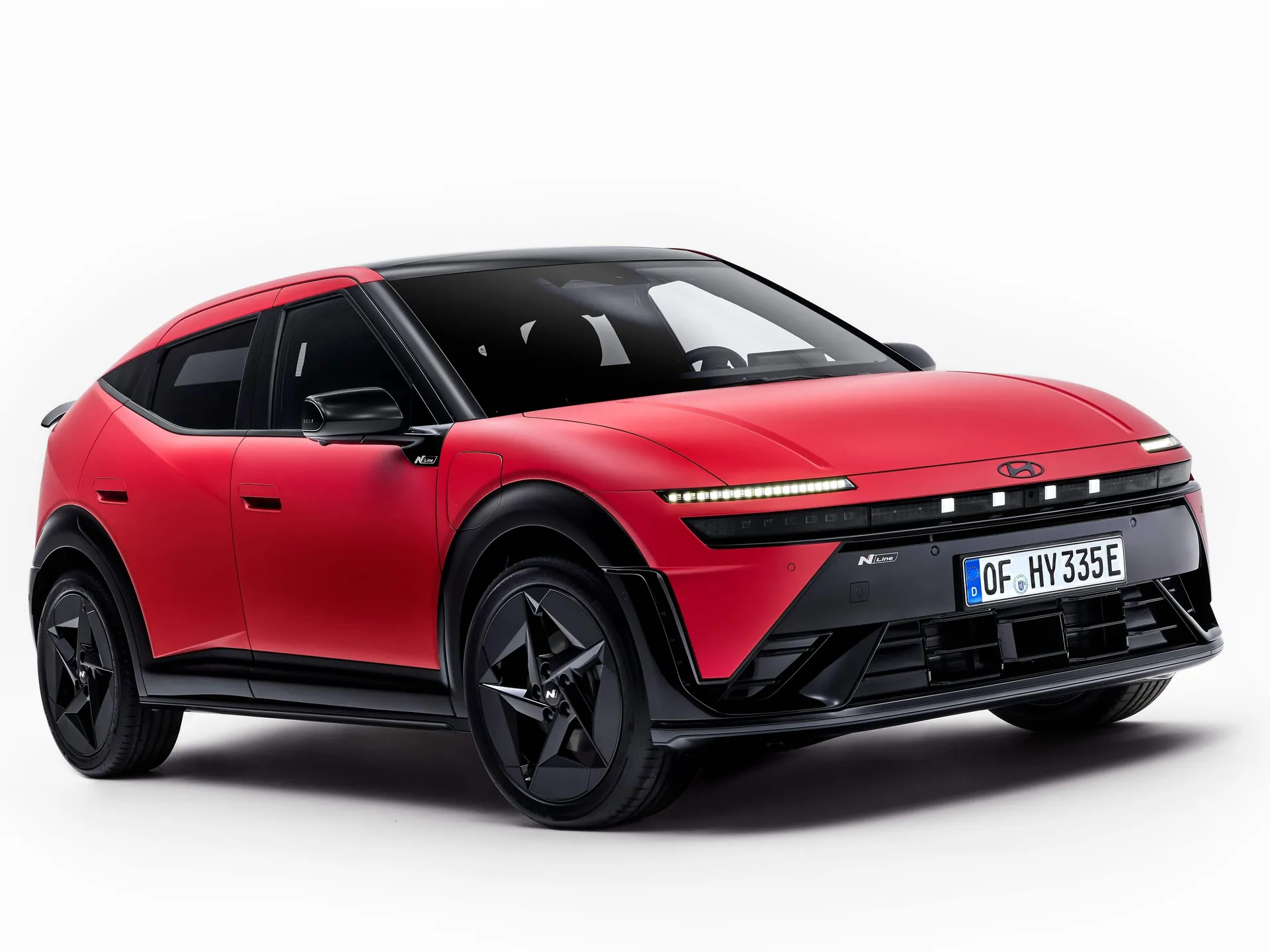
IONIQ 5's progressive design evokes the daring attitude of Hyundai Pony, the company's first production car. It offers a redefinition of timeless design, a theme that will expand as the IONIQ line-up grows.
The front of the car is equipped with Hyundai's first clamshell hood and eye-catching V-shaped positioning lamps. Meanwhile, pixelated headlamps incorporate distinctive daytime running lights (DRLs). These small pixel-like clusters also appear at the rear of the vehicle.
The front and rear forms of the vehicle merge together at its doors, offering another example of Hyundai's 'Parametric Dynamics' design first seen on the all-new Tucson.
On the sides, auto flush door handles provide clean surface styling and enhanced aerodynamic efficiency. The strong C-pillar shape, inspired by Hyundai's '45' EV concept, gives IONIQ 5 a commanding presence clearly identifiable from a distance.
Aero-optimised wheels further echo the Parametric Pixel design theme and are offered in a super-sized 20-inch diameter.
Customers can choose from nine exterior colours, including five nature-inspired hues exclusive to IONIQ 5.
The E-GMP provided IONIQ 5's designers with an unprecedented level of freedom to create an innovative and modular interior. The model's flat floor, where the model's batteries are stored, creates extra legroom and the spaciousness of a large passenger car in a CUV body type.
The long 3,000 mm wheelbase allowed Hyundai designers to apply a 'Living Space' theme to the interior, rather than a conventional car design theme. This includes the Universal Island, a moveable centre console that can slide back as much as 140 mm, allowing more freedom of movement inside the vehicle.
IONIQ 5 is also equipped with electrically adjustable front seats which can recline to the occupant's optimum angle to offer a weightless feeling and support for the lower leg. In addition, the model's electrically adjustable rear seats can slide up to 135 mm forward and backwards.
Many of the interior touchpoints - seats, headliner, door trim, floor and armrest - use eco-friendly, sustainably sourced materials. These include as recycled PET bottles, plant-based (bio PET) yarns and natural wool yarns, eco-processed leather with plant-based extracts, and bio paint with plant extracts.
IONIQ 5 is available with a range of power electric (PE) configurations to fit the mobility needs of every customer, with no compromises on performance. Customers can select from two battery pack options, either 58 kWh or 72.6 kWh, and two electric motor layouts, either with a rear motor only or with both front and rear motor. All PE variations provide outstanding range and deliver a top speed of 185 km/h.
When equipped with two-wheel drive (2WD), 72.6-kWh battery and 19-inch wheels, IONIQ 5's maximum driving range on a single charge is 481 km, according to the Worldwide Harmonised Light Vehicle Test Procedure (WLTP) standard.
Ultra-fast battery charging and Vehicle-to-Load (V2L) function
IONIQ 5's E-GMP can support both 400V and 800V charging infrastructures. The platform offers 800V ultra-fast charging capability as standard, along with 400V charging, without the need for additional components or adapters. With a 350-kW charger, IONIQ 5 can charge from 10 per cent to 80 per cent in just 18 minutes, and reach 100 km of range with less than five minutes of charging
IONIQ 5 also provides an innovative V2L function, which allows customers to charge electric devices such as electric bicycles, scooters or camping equipment using the vehicle's battery. The V2L function can supply up to 3.6 kW of power.
IONIQ 5 seamlessly integrates advanced technologies for an enhanced digital user experience. The wide, configurable, dual cockpit features a 12-inch, full-touch infotainment screen and a hoodless 12-inch digital gauge cluster that can be customised to meet customers' needs. For the first time in Hyundai, IONIQ 5 features an Augmented Reality Head-Up Display (AR HUD), essentially turning the outside world into a display. Drivers can choose to use AR technology to project relevant information, such as navigation, advanced safety and the car's surroundings, to their line of sight across the windshield.
Hyundai is offering the latest version of its upgraded Bluelink® connected car services that deliver a range of new features and allows customers to control their car with their smartphone or voice to make their drive more convenient and enjoyable.
IONIQ 5 is equipped with the next level of Hyundai SmartSense technology, the company's advanced driver assistance system, ensuring the highest levels of safety and convenience on the road.
IONIQ 5 is the first Hyundai model to offer Highway Driving Assist 2 (HDA 2). Using front view camera, radar sensors and navigation data, HDA 2 works to control the vehicle speed and following distance, while keeping the vehicle centred in its lane. It can also assist the driver when changing a lane.
Other active safety systems include Forward Collision-Avoidance Assist (FCA), Blind-Spot Collision-Avoidance Assist (BCA), Intelligent Speed Limit Assist (ISLA), Driver Attention Warning (DAW), High Beam Assist (HBA), and more.
Introducing Hyundai's new platform: E-GMP
IONIQ 5 is the first model to be equipped with Hyundai Motor Group's new dedicated battery-electric vehicle (BEV) Electric-Global Modular Platform (E-GMP). E-GMP will serve as the core technology for Hyundai's next-generation BEV line-up.
Designed exclusively for BEVs, E-GMP provides various advantages compared to the Group's existing platforms, which have each been engineered predominantly to accommodate internal combustion engines. As demonstrated by IONIQ 5, its benefits include increased development flexibility, powerful driving performance, increased driving range, strengthened safety features, and more interior space for occupants and luggage.
Maximising development flexibility through modularisation and standardisation
E-GMP reduces complexity through modularisation and standardisation, allowing rapid and flexible development of products which can be used across most vehicle segments, including sedans, SUVs and CUVs - such as IONIQ 5. Moreover, flexible development can satisfy various customer needs for vehicle performance.
In coming years, E-GMP will be highly effective in expanding the Group's EV leadership position as it will enable the company to enlarge its BEV line-up over a relatively short period through modularisation and standardisation.
Designed for driving performance, safety and maximised space
E-GMP is engineered to offer improved cornering performance and driving stability at high speed. This is due to optimal weight distribution between front and rear, a design which enables a low centre of gravity thanks to its low-mounted battery pack, and the adoption of electric motors located in the space previously occupied by an engine.
The high-speed electric motor raises the driving performance of E-GMP vehicles like IONIQ 5. A five-link rear suspension system, which is typically used for mid- and large-sized vehicle segments, and the world's first mass-produced integrated drive axle (IDA), which combines wheel bearings with the drive shaft to transmit power to the wheels, enhance ride comfort and handling stability.
The platform secures battery safety through a battery support structure made of ultra-high strength steel. Hot-stamped steel components surround this structure for additional rigidity. Collision energy can be absorbed efficiently thanks to energy-absorbent sections of the body and chassis, effective energy load paths, and a central section of the battery pack tightly bound to the vehicle body.
Moreover, by strengthening the structure of the load support section, located in front of the dashboard, engineers have been able to minimise collision energy to the power electric system and battery. The A-pillar's load distribution structure also prevents deformation of the passenger cell.
IONIQ 5 exhibits how E-GMP maximises interior space through its long 3,000 mm wheelbase, short front and rear overhangs and slim cockpit module. The slim cockpit was made possible through the rearrangement of HVAC components. With the battery pack mounted beneath the floor, the E-GMP creates a flat floor for the cabin. This provides more legroom for passengers, while enabling various arrangements for the front and rear seats.
The battery pack itself - mounted between the front and rear axles - is the most power-dense system that Hyundai Motor Group has ever created. This is partly thanks to its enhanced cooling performance, a result of a new separate cooling block structure which helps make it more compact. With energy density enhanced by around 10 per cent compared to existing EV battery technology, the battery packs in models such as IONIQ 5 are lighter, can be mounted lower in the body, and liberate more cabin space.
Multi- (800V and 400V) and bi-directional charging system
Most existing EVs and the fast-charging infrastructure provide 50 ~ 150 kW charging for EVs equipped with a 400V system; however, the development of 800V infrastructure, with up to 350 kW charging, will gradually enable even more fast charging.
E-GMP offers ultra-high-speed 800V charging capability as standard and is also capable of mainstream 400V fast charging without the need for additional components or adapters. In fact, IONIQ 5's multi-charging system is a world-first patented technology. Using the vehicle's inverter, a 400V charge is converted into 800V so that it can be stored in the battery.
IONIQ 5 is capable of achieving 481 km (WLTP) with a fully charged battery, thanks to the E-GMP. Moreover, with high speed charging, it can charge up to 80 per cent in just 18 minutes, which can add up to 100km of driving range in just five minutes.
Unlike previous BEVs, which were only capable of one-way charging, the E-GMP's charging system is more flexible. The E-GMP's newly developed Integrated Charging Control Unit (ICCU) represents an upgrade from existing on-board chargers, which typically only allow electricity to flow in a single direction from an external power source.
The ICCU enables the Vehicle-to-Load (V2L) function seen in IONIQ 5. V2L can discharge energy from the vehicle battery without additional components. This enables BEVs based on the E-GMP to operate other electric machinery (110 / 220V) anywhere, and the system can even be used to charge another EV. The new V2L function can supply up to 3.6 kW of power, which is enough to operate a mid-sized air conditioner unit and a 55-inch television for up to 24 hours.
E-GMP to underpin future EV sales growth worldwide
The E-GMP will underpin Hyundai Motor Group's plans to introduce a total of 23 BEV models, including 11 dedicated BEV models by 2024, starting with the three dedicated BEVs under the IONIQ line-up brand: IONIQ 5, 6 and 7. The company also plans to sell more than one million BEVs worldwide by 2025.
IONIQ 5's progressive design represents a departure from past norms, exploring a new design freedom offered by a dedicated BEV platform. By evoking the daring attitude of Hyundai Pony, the company's first production car, IONIQ 5 highlights Hyundai's 45-year journey to become a part of customer's lifestyles, creating a common thread from past to present and future. This is the redefinition of timeless design, a theme that will expand as the IONIQ line-up grows.
IONIQ 5's unique exterior design is characterised by clean and sharp lines, creating a sleek and sophisticated look. The BEV's precisely modelled surfaces and shapes give it an angular, almost geometric appearance. In addition, Hyundai's designers integrated cutting-edge Parametric Pixel lights on the front and rear. This unique design element signifies Hyundai's intent to fundamentally reinvent electric mobility with an EV-specific design that will carry over to future IONIQ models.
The front of the car is equipped with Hyundai's first clamshell hood that minimises panel gaps for optimal aerodynamics. The front bumper is defined by an eye-catching V-shape. Meanwhile, pixelated headlamps incorporate distinctive daytime running lights (DRLs) that provide an unmistakable light signature unique to IONIQ 5. These small pixel-like clusters also appear at the rear of the vehicle.
On the sides, auto flush door handles provide clean surface styling and enhanced aerodynamic efficiency. The front and rear forms of the vehicle merge together at its doors, offering another example of Hyundai's 'Parametric Dynamics' design first seen on the all-new TUCSON. The strong C-pillar shape, inspired by Hyundai's '45' EV concept, gives IONIQ 5 a commanding presence clearly identifiable from a distance.
Aero-optimised wheels further echo the Parametric Pixel design theme and are offered in a super-sized 20-inch diameter, the largest rims ever fitted to a Hyundai EV. These complete IONIQ 5's perfected proportions, made possible by Hyundai's E-GMP.
IONIQ 5's crossover body type achieves unique proportions and short overhangs due to its elongated wheelbase. Measuring 4,635-mm long, 1,890-mm wide and 1,605-mm tall on a 3,000-mm wheelbase, IONIQ 5 offers D-segment-like space in a midsize CUV.
Customers can choose from nine exterior colours, including five nature-inspired, new hues exclusive to the model. These include two options with a matte finish: the hero colour Gravity Gold Matte and Shooting-Star Gray Matte, along with Digital Teal-Green Pearl, Mystic Olive-Green Pearl and Lucid Blue Pearl.
IONIQ 5 sets itself apart from other midsize CUVs, especially those with internal combustion engines and conventional shift-by-wire systems, because the E-GMP enables a flat floor where the model's batteries are stored, allowing for innovative interior design and extra legroom.
IONIQ 5's 3,000 mm wheelbase offers spaciousness of a large passenger car in a midsize CUV. The long wheelbase allowed Hyundai designers to apply a 'Living Space' theme to the interior, rather than a conventional car design theme.
The 'Living Space' theme runs throughout the interior. One feature which embodies this is the Universal Island, a moveable centre console that can slide back as much as 140 mm. The Universal Island complements the simple centre fascia with gear selector located behind the steering wheel. The sliding console allows passengers to not only enjoy more flexibility, but also freely enter and exit the cabin on either side when parked in a narrow spot. Second-row passengers also can enjoy centre console features, such as cup holders, a fast wireless phone charger, and USB ports. The Universal Island truly redefines the centre console, offering greater functionality than a static storage box.
IONIQ 5 is also equipped with electronically adjustable front seats. When parked, the seats can recline to the optimum angle, offering a weightless feeling for the occupant. Hyundai reduced the thickness of the front seats by 30 percent, providing more space for those seated in the second row. This allows passengers to customise the interior space according to different needs and situations.
The optional Vision Roof of IONIQ 5 provides the interior with a greater sense of openness as IONIQ 5's ceiling consists of one large glass panel without any support materials.
IONIQ 5 provides 527 litres of cargo space, which increases to 1,587 litres when the second row seats are fully folded. For added versatility, the second row seats can slide forward up to 135 mm and can also be folded down in a 6:4 ratio. Meanwhile, customers can enjoy additional storage space with a "frunk" (front trunk) that offers up to 57 litres of capacity.
The model's modular dashboard includes a 12-inch full-touch infotainment screen free of single-function buttons, as well as a hoodless 12-inch digital gauge cluster. The cluster displays EV-related information while driving, such as battery status and the location of nearby charging stations. Adjacent to the digital gauge cluster is a metal insert that can accommodate a multi-purpose tray holder. As this is metallic, magnets can be used to pin objects such as pictures, for example. IONIQ 5's infotainment system is the first to integrate a new design theme called Jong-e Graphic User Interface that offers various interior ambience settings, such as "soft", "delicate" and "exuberant".
Customers can stay warm during the winter months by taking advantage of the heated steering wheel and heated front seats. IONIQ 5 also features a high-efficiency heat pump system, which improves climate control inside the vehicle. This ensures efficiency of heating when outside temperatures are low, and supports the regular cooling system when air conditioning is on.
The interior has three colour options. The base pack includes Obsidian Black and Dark Pebble Gray/Dove Gray, while the optional colour pack offers Dark Green/Dove Gray.
Sustainable, eco-friendly features accommodate lifestyles without limits
IONIQ 5's demonstration of environmental responsibility doesn't stop with electrification. It offers a bridge to the future of electric mobility that is technologically advanced, eco-friendly and plugged into today's customers' needs. Sustainability is at the centre of IONIQ's vision, which can be found throughout IONIQ 5 in eco-friendly materials and colours. This will redefine electric mobility lifestyles.
Many of IONIQ 5's interior touchpoints - seats, headliner, door trim, floor and armrest - use eco-friendly, sustainably sourced materials. These include recycled PET bottles, plant-based (sustainable PET) yarns and natural wool yarns, and eco-processed leather with plant-based extracts.
IONIQ 5's crash pads and door trim contain sustainable materials extracted from sugar cane. Sugar cane is also included in the sustainable PET carpet, floor mats and headliner. Meanwhile, the door trims, switches and modular crash pads also include sustainable materials from a plant-based oil extracted from rapeseed and corn. The doors also feature the Paperette as décor. Paperette is a durable, lightweight material made from recyclable components and an example of Hyundai's designers utilising the circular economy.
IONIQ 5 can also be equipped with an optional solar roof, which improves energy efficiency by providing an additional power source. This can prevent battery discharge and therefore extend the driving range by more than 1,500 kilometres per year, depending on the local sun exposure where the customer lives.
Hyundai's commitment to marine protection with Healthy Seas: supporting local communities to help them develop in a sustainable way through the circular economy
Hyundai Motor recently partnered with the ocean conservation organisation Healthy Seas to combat ocean pollution, nurture sustainable marine ecosystems, and support a circular economy. Furthermore, Hyundai shows its commitment to the circular economy by cooperating with Healthy Seas' partner Aquafil, and plans to use ECONYL®, a regenerated yarn made from recycled fishing nets and other nylon waste, in its products.
As a company leading the way in clean and future mobility solutions, cleaning up and preventing marine pollution aligns with Hyundai's global strategy. Through this collaboration with Healthy Seas, the company will be not only be providing a cleaner environment for generations to come but also shaping sustainable futures for the communities it works with.
Healthy Seas' activities include recovering lost or abandoned fishing nets from the seas, organising environmental education programs in schools and collaborating with fishermen, fish farms and local communities to support the responsible disposal of fishing nets and other marine waste. Through its actions, Healthy Seas strives for a healthy marine ecosystem and a sustainable future.
Working with a network of partners, Healthy Seas ensures plastic waste is recycled into new materials in a circular economy. Reclaimed fishing nets and other nylon waste are transformed by Aquafil into ECONYL®, a regenerated nylon yarn that can, in turn, be used to make new sustainable products. IONIQ 5 features floor mats developed using ECONYL®. For future models, Hyundai is looking for even more opportunities to integrate eco-friendly materials into its models.
Hyundai's main role in the partnership is supporting Healthy Seas with funding, so complex clean-up activities can come to fruition. The first project recently took place in Ithaca, Greece, with Hyundai helping Healthy Seas with its biggest clean-up initiative in the organisation's history. During the event, several tonnes of abandoned fishing nets were recovered with the goal to leave nothing but clean seas and coastlines behind.
V2L, ultra-fast charging and charging networks
IONIQ 5's E-GMP can support both 400V and 800V charging infrastructures. The platform offers multi-charging capabilities, with 800V charging as standard, along with 400V charging without the need for additional components or adapters. With a 350-kW charger, IONIQ 5 can charge from 10 per cent to 80 per cent in just 18 minutes.
IONIQ 5 users only need to charge the vehicle for five minutes to get 100 km of range, according to WLTP.
IONIQ 5 provides an innovative Vehicle-to-Load (V2L) function, which allows customers to freely use or charge any electric devices, such as electric bicycles, scooters or camping equipment, serving as a charger on wheels.
The V2L function can supply up to 3.6 kW of power, enabling IONIQ 5 to operate other electric machinery (110 / 220V) anywhere. The V2L port is located under the second-row seats, and it can be activated when a vehicle is on. Another V2L port is located at the charging port on the vehicle exterior.
Hyundai Motor Group is a shareholder in IONITY, a joint venture that as of today operates 342 high-power charging (HPC) stations with a charging capacity of up to 350 kW throughout Europe. The company plans to increase this number to 400 HPC stations by 2022, including 45 currently under construction. Through its participation in this joint venture, Hyundai will drive the expansion of IONITY along Europe's highways, promoting the further adoption of zero-emission mobility.
The IONITY charging network uses the European CCS (Combined Charging System) charging standard. Since the network uses 100 percent renewable energies, thanks to IONITY, drivers of electric vehicles are not only able to travel emission-free, but also CO2-neutral. This is an important step when it comes to making electric mobility a success in Europe.
IONIQ 5 customers can enjoy a free one-year subscription to IONITY, through Hyundai's new pan-European integrated public charging service, Charge myHyundai. To claim their free IONITY subscription, IONIQ 5 customers must register for Charge myHyundai by March 31, 2022. Charge myHyundai offers access to over 230,000 charging points across Europe, including AC and DC connectors.
Charge myHyundai customers can access the Digital Charging Solutions (DCS) network via a single radio-frequency identification (RFID) card or an app. Users have real-time price information of the charging points in the app and have full price transparency of the charging service.
Users can enjoy a streamlined one-payment solution via a single card or an app for additional peace of mind. Thanks to eRoaming, customers can charge their vehicles across Europe without the need for additional contracts with other providers, as payments are made via a single monthly invoice.
IONIQ 5 customers can easily find available charging stations using the model's AVN system.
Charge myHyundai is initially available in ten European markets: the UK, Germany, France, Italy, Spain, Norway, the Czech Republic, Switzerland, Denmark and Sweden. Hyundai plans to extend the service to customers in more countries in the near future.
Advanced connectivity for the ultimate in-car experience
IONIQ 5 seamlessly integrates advanced technologies for an enhanced digital user experience. The wide, configurable, dual cockpit features a 12-inch, full-touch infotainment screen and a hoodless 12-inch digital gauge cluster that can be customised to meet customers' needs.
For the first time in Hyundai, IONIQ 5 features an Augmented Reality Head-Up Display (AR HUD) with selectable AR functions, essentially turning the windshield into a display screen. The AR HUD projects relevant information, such as navigation, advanced safety and the car's surroundings, to the driver's line of sight across the windshield. This allows drivers to process information quickly while keeping their attention on the road ahead.
Apple CarPlay and Android Auto allow IONIQ 5 customers to mirror the functionality of their iOS and Android smartphones in a simplified and convenient manner. Meanwhile, the centre console enables occupants to charge their smartphones with a wireless charging pad or five USB ports, for even more convenience.
IONIQ 5 also features a premium Bose sound system. Its eight speakers, including a subwoofer, are strategically placed throughout the vehicle for a high-quality listening experience.
Available audio and connectivity equipment:
With IONIQ 5, Hyundai is offering the latest version of its upgraded Bluelink® Connected Car services that deliver a range of new features and allows customers to control their car with their smartphone or voice to make their drive more convenient and enjoyable. New Bluelink® features include Connected Routing, Last Mile Navigation and a new User Profile feature.
IONIQ 5's cloud-based Connected Routing feature calculates driving routes on a powerful server inside the Bluelink® cloud environment. This ensures more accurate traffic forecasting, more precise times of arrival, and more reliable route calculation. With IONIQ 5, the database has been increased to show more charging stations on the map, showing availability and estimated charging time. By clicking on the station icon on the map, users can see whether AC, DC or ultra-fast charging, such as IONITY, is available.
The Bluelink® app displays the vehicle's range, battery state and charging times when plugged into public or private charging points. Customers can access an advanced battery management system in order to select charging times that best fit their schedule or their budget by making the most of off-peak electricity rates.
IONIQ 5 drivers can start and stop charging with the push of a button on their smartphone app. During colder months, Remote Climate Control allows users to schedule pre-heating of IONIQ 5 while it is connected to an external power source. Not only does this ensure comfort for occupants during the drive, it also saves battery power that would otherwise be needed to heat the vehicle on the road.
IONIQ 5's Online Voice Recognition system accepts simple voice commands to conveniently control cabin A/C, radio, hatch opening/closing, heated steering wheel, heated/cooled seats and other functions. The system can also assist with various points of interest (POI) and weather status updates.
Meanwhile, the Bluelink® app has also been overhauled with an updated digital environment to coincide with IONIQ 5's launch. This will be available from July.
IONIQ 5 is equipped with the next level of Hyundai SmartSense, the company's advanced driver assistance system, which ensures the highest levels of safety and convenience on the road.
IONIQ 5 is the first Hyundai model to offer Highway Driving Assist 2 (HDA 2), which combines Navigation-based Smart Cruise Control and Lane Following Assist and utilises Level 2 autonomous driving capabilities to make highway driving even more convenient. Using front view camera, radar sensors and navigation data, HDA 2 works to control the speed, direction and following distance. While Level 1 HDA (HDA 1) maintains a safe following distance and keeps the vehicle centred in its lane, HDA 2 can additionally assist the driver when changing lanes.
Other semi-autonomous driving features include Intelligent Speed Limit Assist (ISLA), which adjusts vehicle speed to match the speed limit, and High Beam Assist (HBA), which automatically turns high beams on and off to avoid blinding oncoming drivers.
IONIQ 5 is equipped with several driver attention-related functions to ensure safe driving at all times by detecting if the driver is drowsy or distracted. Driver Attention Warning (DAW) monitors the driver's attention level while driving and provides a warning when signs of driver inattentiveness are detected and will recommend a rest if needed. DAW includes the Leading Vehicle Departure Alert (LVDA) function, which sounds a warning if the vehicle remains stopped for a prolonged period (such as at a traffic signal) and the driver doesn't react quickly enough when the vehicle ahead starts moving.
Several functions work in tandem to help avoid collisions in a variety of driving situations. Blind-Spot Collision-Avoidance Assist (BCA) helps avoid collisions at the rear side of the vehicle by using radar to detect other vehicles and applies defensive steering or differential braking if necessary. BCA is particularly useful in situations such as changing lanes or exiting from parallel parking. Meanwhile, Blind-Spot View Monitor (BVM) uses a camera to show the driver views to the left and the right of the vehicle on the cluster screen if the driver indicates to change lanes.
Forward Collision-Avoidance Assist (FCA) can detect a vehicle, pedestrian or cyclist and can help avoid a collision with any one of them by autonomously applying the brakes in case the driver does not react to the warning (audible and in the cluster). FCA includes Junction Turning, Junction Crossing and/or Lane-Changing Oncoming. FCA with Junction Turning activates the brakes if it detects oncoming traffic when the driver is turning left at an intersection. FCA with Junction Crossing senses vehicles approaching from the side when the driver is going straight through an intersection. And FCA with Lane-Change Oncoming is a function to make switching lanes safer. If FCA senses an approaching car that has crossed the centre line when the driver is changing lanes, FCA automatically assists with avoidance steering, if there is no danger of secondary accidents. If a potential secondary accident is detected, FCA will only produce a warning.
IONIQ 5 also assures the safety of backseat passengers with Safe Exit Assist (SEA), which helps keep the rear door closed via electronic child lock if rear traffic passes by.
A variety of parking assistance features make parking in a variety of circumstances easier than before. Remote Smart Parking Assist (RSPA) allows the driver remotely park or exit a parking spot from outside the vehicle. This feature works for both parallel and perpendicular parking and can be activated via a button on the vehicle's smart key.
Surround View Monitor (SVM) utilises a series of strategically located cameras to give the driver a 360-degree view of the area surrounding the vehicle, making it easier to park in tight spaces.
Reverse Parking Collision-Avoidance Assist (PCA) works to help avoid collisions while backing up. If an obstacle is detected via the rear view camera or rear ultrasonic sensors, PCA will display a warning and, if necessary, apply the brakes. Similarly, Rear Cross-Traffic Collision-Avoidance Assist (RCCA) can display and sound a warning, or apply the brakes, when a car approaches from the left or right side and the driver does not stop.
For passengers' protection, E-GMP has an ultra-strong structure that disperses collision shock away from IONIQ's cabin and prevents it from deforming. IONIQ 5 is also equipped with additional safety features including seven airbags, with a driver seat centre-side airbag for additional passive safety, and eCall.
Performance: power electric systems to suit every customer
IONIQ 5 is available with a range of power electric (PE) configurations to fit the mobility needs of every customer, with no compromises on performance. Customers can select from two battery pack options, either 58 kWh or 72.6 kWh, and two electric motor layouts, either with a rear motor only or with both front and rear motors. All PE variations deliver a top speed of 185 km/h.
At the top of the electric motor line-up is an all-wheel drive (AWD) option paired with the 72.6-kWh battery, producing a combined power output of 225 kW and 605 Nm of torque. This PE configuration can go from 0 km/h to 100 km/h in 5.2 seconds.
When equipped with two-wheel drive (2WD) and the 72.6-kWh battery, IONIQ 5 produces a power output of 160 kW and 350 Nm of torque, and can travel from 0-100 km/h in 7.4 seconds.
The AWD and 58-kWh battery option produces a combined power output of 173 kW and 605 Nm of torque, and accelerates from 0-100 km/h in 6.1 seconds.
Meanwhile, the 58 kWh battery option paired with 2WD features a power output of 125 kW with 350 Nm of torque, travelling from 0-100 km/h in 8.5 seconds.
IONIQ 5's maximum driving range on a single charge is 481 km, according to the WLTP standard.