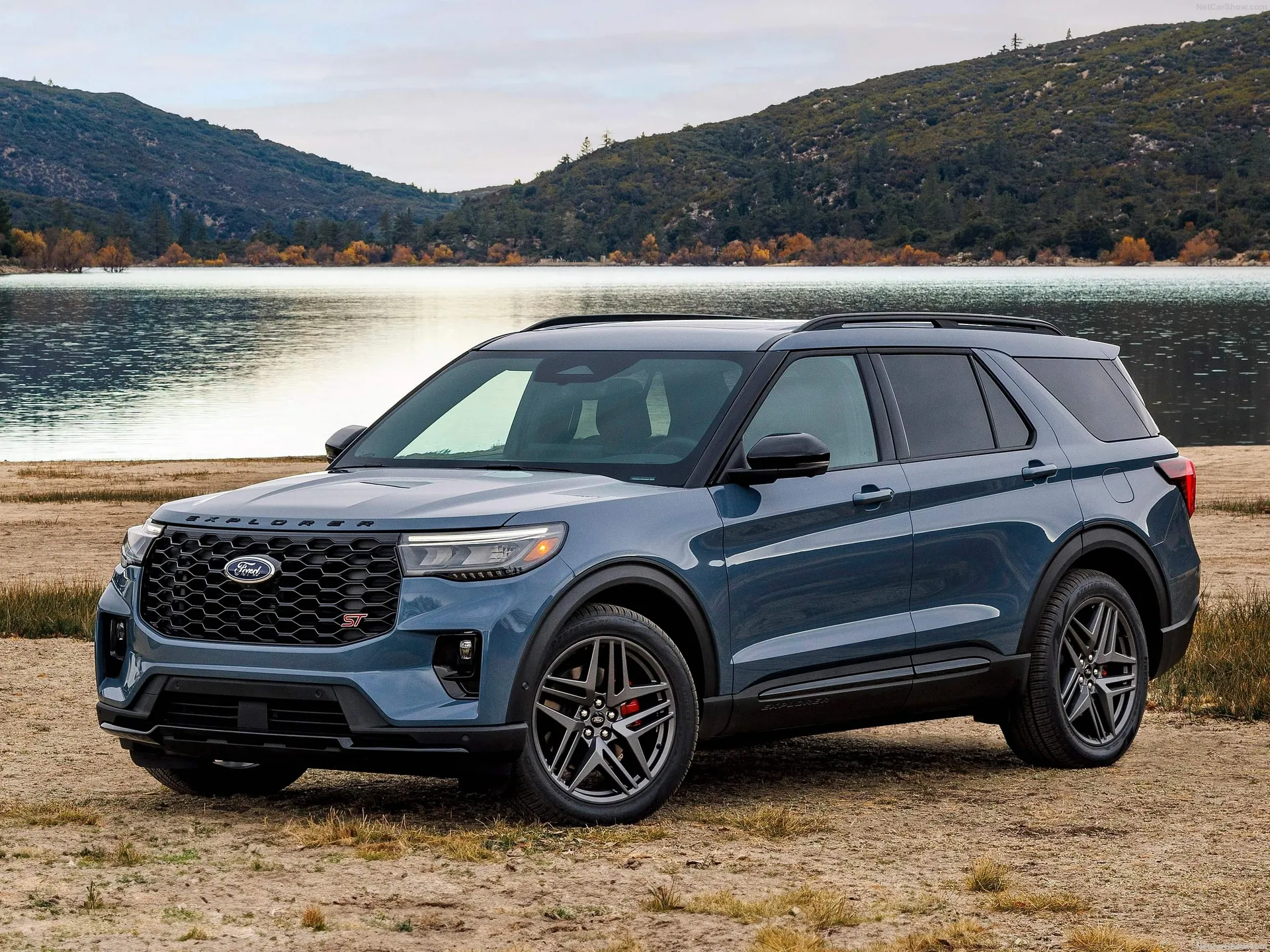
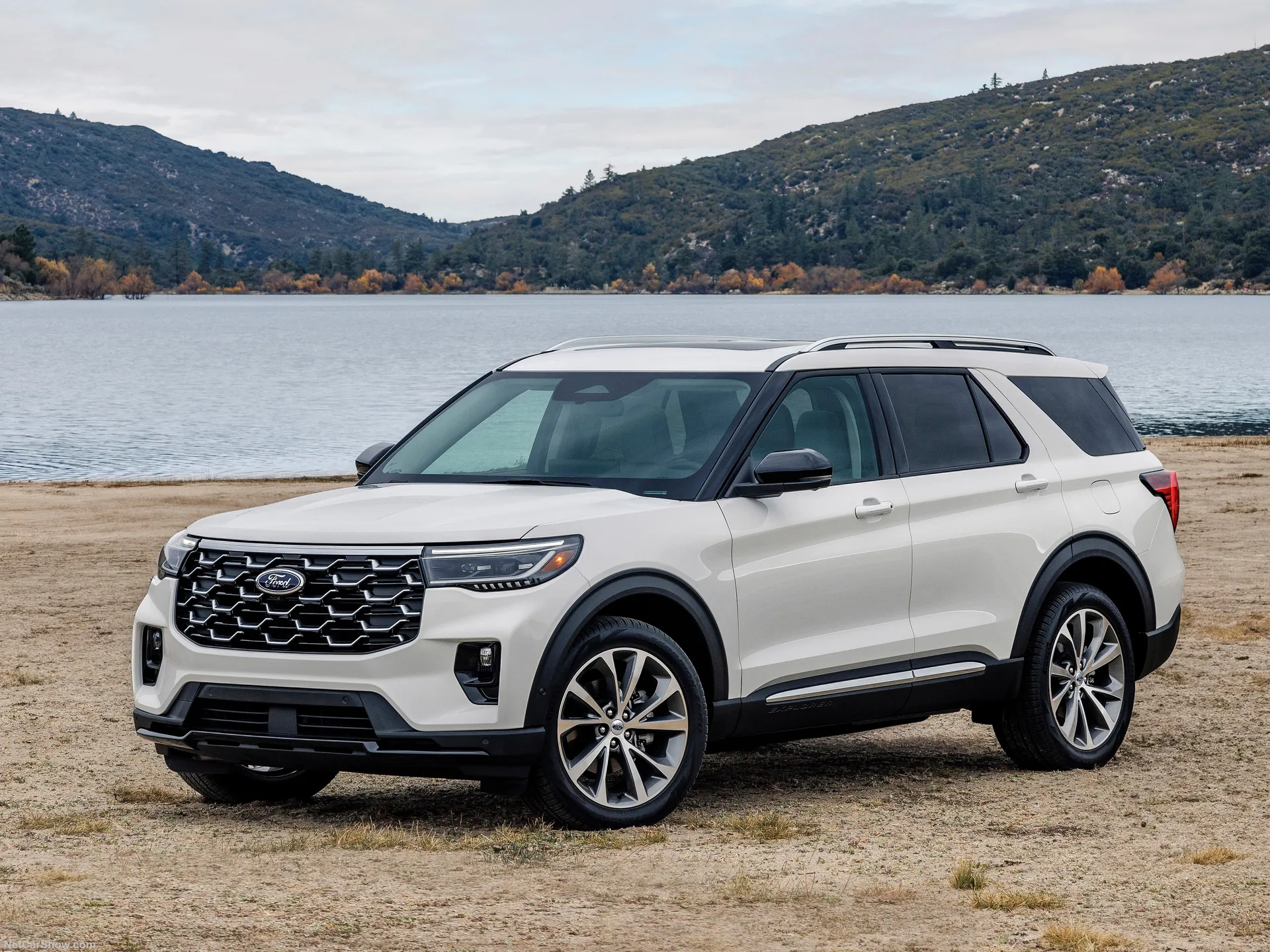
Ford Explorer Sport Trac
The 5-door Explorer and its companion the Mercury Mountaineer were redesigned entirely for the 2002 model year, gaining a similar appearance to its big brother, the Ford Expedition. The new design is frequently mistaken for the later second generation Expedition, having rounded wheel sockets and larger back lights along with a more rounded appearance overall. The previous generation's 4.0 L SOHC 12 valve V-6 engine carried over, however the Windsor V8 was replaced by the 4.6 L 2V SOHC 16 valve V-8. Though in the Sport Trac variant, the 4.0 L SOHC 12 valve V-6 was rated at just 205 hp (153 kW), 242 ft·lbf (328 N·m) of torque. The Explorer, Sport Trac, and Mountaineer all use the code U6 for rear-wheel drive, U7 for four-wheel drive, and U8 for all-wheel drive in the 5th and 6th positions of the VIN.
A third row seat became available for the first time, bringing total passenger capacity to seven. The Mazda 5-speed manual and the 5-speed Ford C3-derived automatic transmissions were available, but the 2002 model year was the last year the larger 5-door variant could be ordered with a manual transmission. Trim packages were now the base Sport Value, Sport Choice, XLS, Sport Premium, XLT, Eddie Bauer, and Limited, in order of luxury trim-offerings. The 2002-2004 models also saw stability control as an option, Ford's AdvanceTrac with Roll Stability Control system. The stability control system became standard for the 2005 model year.
For the third generation, Ford installed fully independent rear suspension in the 5-door Ford Explorer and Mercury Mountaineer - but not in the 3-door Sport model. This replaced the non-independent "live axle" rear suspension used in previous model year Explorers. With a fully independent rear suspension, each rear wheel connects to the rear differential via a half-shaft drive axle. This design offers increased ride comfort, on-road handling, and vehicle stability. Other vehicles have used this setup on both rear and four-wheel drive vehicles for many years. For example, the Hummer H1 and the Mercedes-Benz ML-Class use independent front and rear suspension. One reason for Ford's switch to independent rear suspension in the Explorer was due to the well-publicized vehicle rollovers and resulting fatalities that occurred with the previous generations of Ford Explorer. All of the Explorers involved in the rollovers had non-independent rear suspension and most of the vehicles had Firestone tires which Ford judged to be defective.
The suspension change drew some displeasure amongst fans of live-axle rear suspensions. One reason is that live axles offer the most efficient power delivery. Another complaint was of lower load handling capabilities. Also, the move to independent systems was not company wide. For example, the larger Ford F-Series still uses a non-independent rear suspension, due mostly to its power and load handling capabilities, most useful when towing large loads. Furthermore, it appears there is no evidence that the rollovers were caused by the use of a live axle setup. The larger Ford Expedition used non-independent rear suspension (2003 and up Ford Expeditions use independent rear suspension) and didn't have the same magnitude of rollover complaints as the previous model year Explorers. Many, including Firestone felt the tire failures were due to under-inflation of tires, likely due to Ford's specified pressure being too near to the low pressure fail point of the tire. However, the Firestone tires were in Fords view defective and to this day the Ford Motor Company refuses to use Firestone tires on Explorers or any vehicle it sells.
Third generation Ford Explorers, Mercury Mountaineers and Lincoln Aviators often acquire a single crack visible vertically on the plastic panel between the window and the rest of the lift gate, close to the center respective badge. This led to Ford switching to a more conventional one-piece lift gate design on the following generation.
The 3-Door Explorer Sport was redesigned in 2001 to a similar body style as that of the 5-door 2002 Explorer. Due to the decline in popularity of 3-door smaller SUVs, the Explorer Sport was discontinued after 2003. The Sport-marque was reintroduced as a performance variant of the 5-door fifth generation Explorer, which is actually now a full-size crossover utility vehicle. The U152 development program began in 1995, with the final design being chosen in 1997 and frozen for production in February 1998. Production began in November 2000 for a January 2001 launch.
This article is licensed under the GNU Free Documentation License . It uses material from Wikipedia .
![Nissan Navara [AU] (2026)](/media/9f/5e/9f5ed5b6f2370d0b49d8c177ace05151e74b54947957a2f8aaf8ac37f966a15f.webp)