Dodge Durango
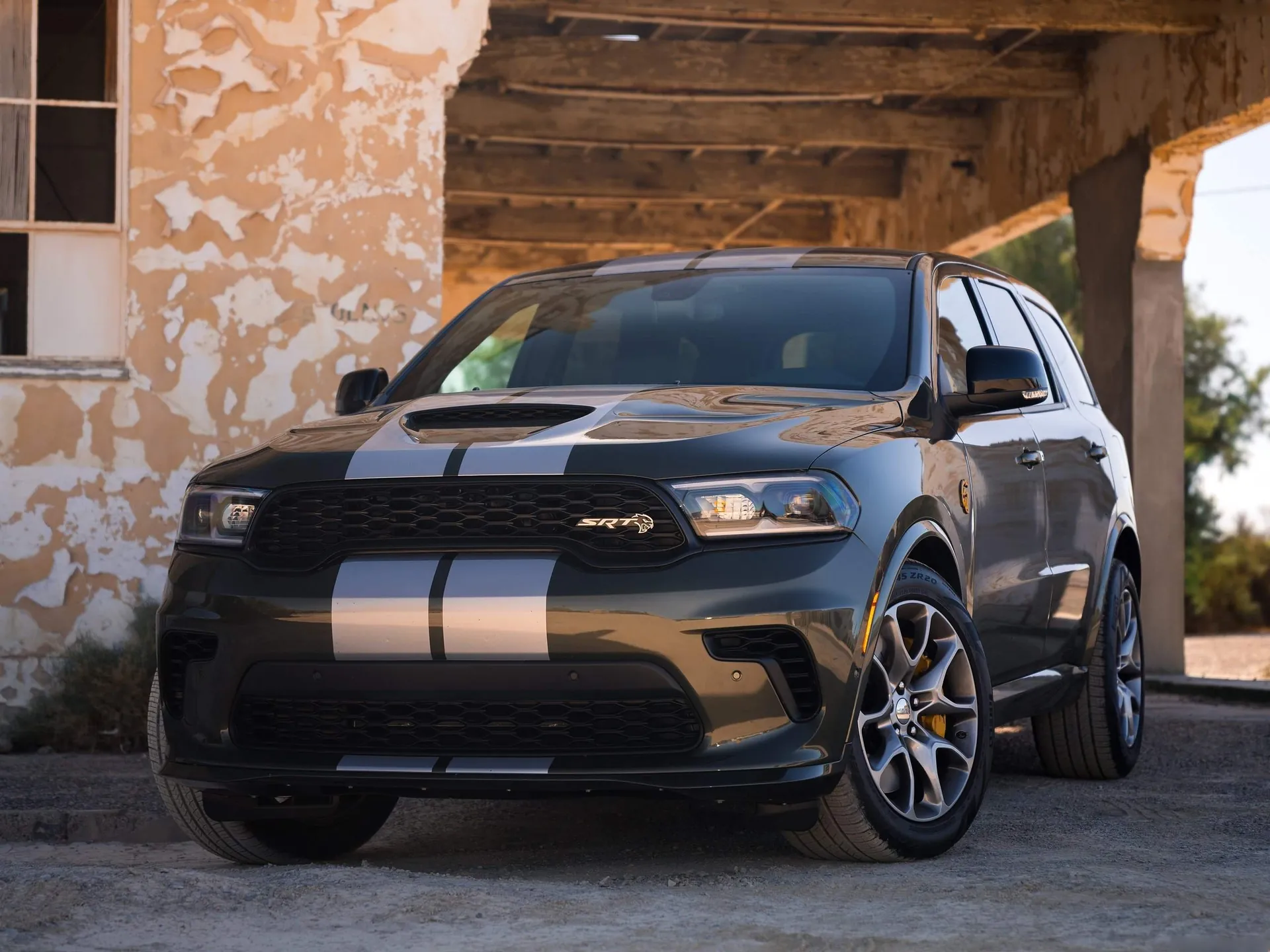
The Durango was marketed as a sturdy truck-based SUV designed to hold up to seven passengers and tow up to 7,500 lb (3,400 kg) when properly equipped. The Durango shared a front end, instrument panel, and front seats with the Dakota pickup on which it was based. Original designs of the eight-passenger Durango featured a rear-facing third row similar to many older station wagons. To make room for a more practical forward-facing third row, Dodge shortened the length of the front doors and raised the roof two inches beyond the front seats, allowing for stadium seating. The Durango's roof rack was designed to mask the appearance of the raised roof.
The 4.7 L Magnum V8 replaced the 5.2 L Magnum V8 engine for 2000; however, the 5.2 was still available in the early 2000 models. In that same year, a special AWD performance version called the R/T was released with a 5.9 L Magnum V8. In 1999 and 2000, a limited-edition Shelby S.P.360 version was offered that featured a supercharged version of the 5.9 L Magnum V8 engine. Output is 360 hp (270 kW; 360 PS) and 412 lb·ft (559 N·m) of torque. Exterior modifications include unique wheels, tires, suspension, and bumpers. It came standard with Viper blue paint with two racing stripes down the center of the truck. It boasted a 0 to 60 mph time of 7.1 seconds. The top speed was 142 mph (229 km/h).
For 1999, the Durango was made available with two-wheel drive. A 3.9 L Magnum V6 engine was available, but few were sold. Minor changes were made for the second year, two new paint colors and notable options available including 6 in × 9 in (150 mm × 230 mm) heated rear view mirrors and steering wheel-mounted radio controls. Leather seats became standard on SLT Plus models, and body-color wheel flares became standard on SLT Plus and four-wheel drive models.
The 2000 model year included a new 4.7 L Magnum V8 engine replaced the 5.2 L Magnum V8 as the standard engine for four-wheel drive models. The 3.9 L Magnum V6 engine was no longer available, leaving only V8s for the rest of the production run. The high-performance Durango R/T came equipped with a performance-tuned 5.9 L Magnum V8 and all-wheel drive.
For 2001, Dodge focused on interior upgrades as Durango's interior trim panels, dash mounted controls, instrument panel, overhead console, and steering wheel were all redesigned. The transfer case selector on 4X4 models changed from a manual lever on the console to a switch on the dash. The instrument cluster was updated and an electronic vehicle information center was incorporated into the overhead console. For improved rear passenger comfort, a dual-zone climate control system was added as standard equipment. Sound systems were improved on all models and now came standard with SX speakers. Other minor changes include door panels, revised seats, aluminium wheels, and minor changes to trim options.
In 2002, the new SXT version of the Durango was offered as the entry-level trim package. Optional side curtain airbags were added for safety. The 2003 Durango featured minor mechanical changes, most notable was the addition of four-wheel disc brakes.
The SLT, SLT Plus, and Sport trim levels offered the 3.9 L Magnum V6 engine as standard equipment (late availability starting in 1999), with the 5.2 L and 5.9 L Magnum V8 engines being available options, later switching to the 3.7 L Power-Tech V6 engine, with the 4.7 L Power-Tech V8 engines optional. The R/T and S.P. 360 trim levels included the 5.9 L Magnum V8 engine as standard equipment.
This article is licensed under the GNU Free Documentation License . It uses material from Wikipedia .