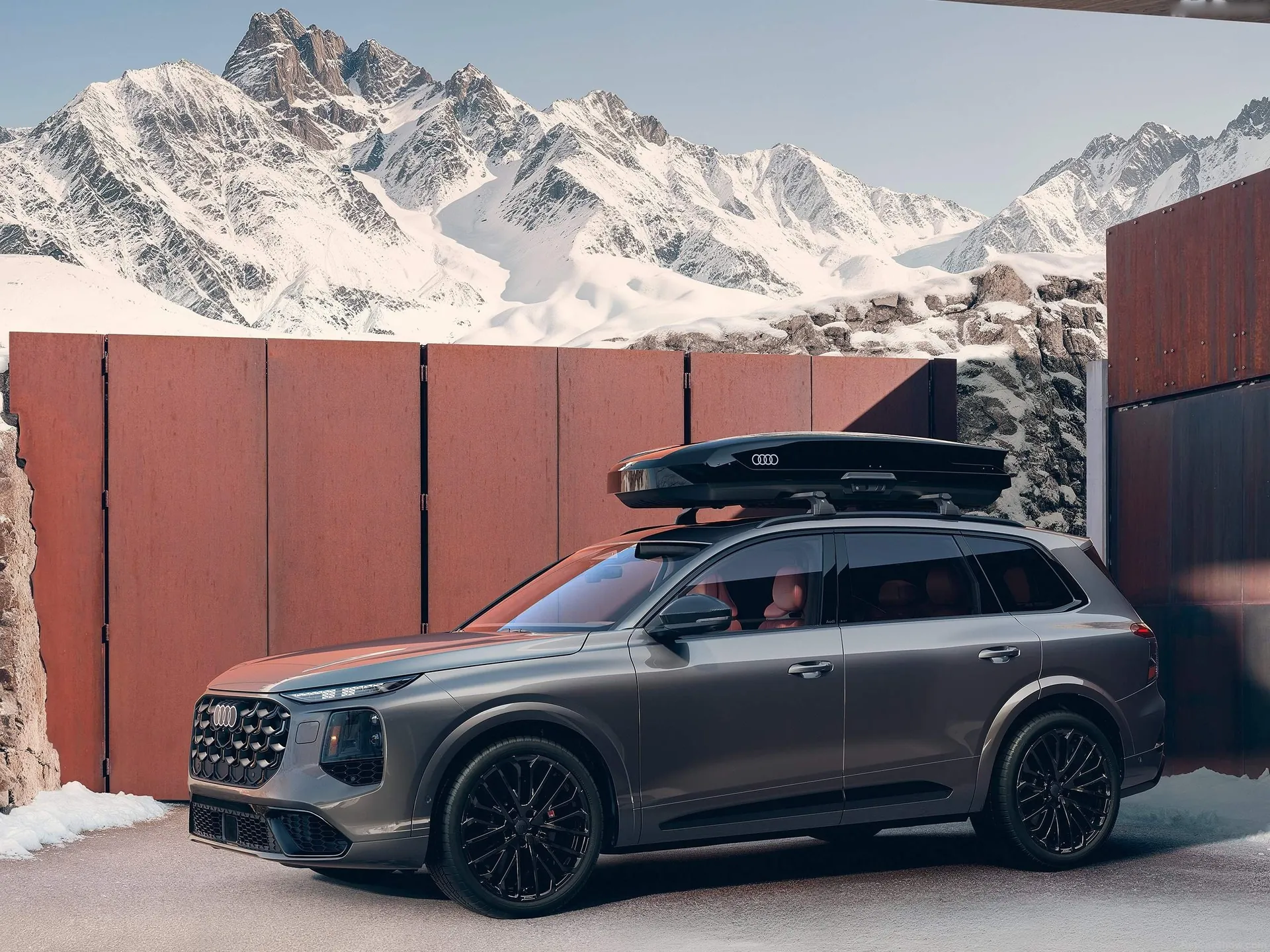
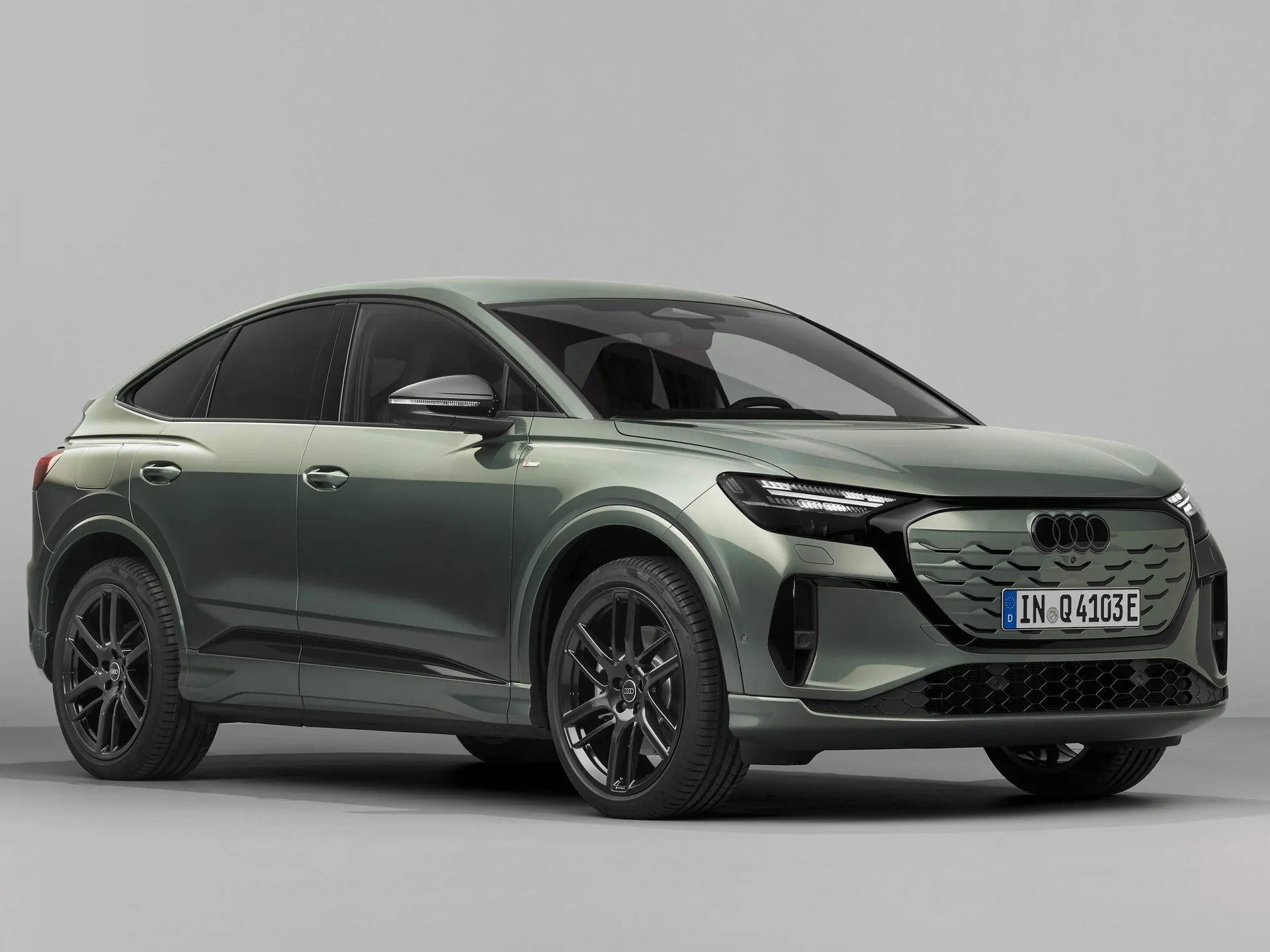
Audi e-tron S Sportback
Audi is showing consistency and continuing with its electric offensive - with the new Audi e-tron S and the new Audi e-tron S Sportback. Both of the S models with fully electric drive use three electric motors, two of which operate on the rear axle. Their intelligent drive control raises vehicle safety, and dynamic handling in particular, to a new level. In addition to the electric all-wheel drive, the vehicles are equipped with electric torque vectoring with active and fully variable torque distribution on the rear axle.
The driving experience that the two electric S models offer impresses with the kind of fascinating dynamism that only a superior electric drive can provide. If the driver selects the S gear and fully depresses the right-hand pedal, both cars accelerate from a standstill to 100 km/h (62.1 mph) in 4.5 seconds with almost no sound and great smoothness, as the full tractive power is available immediately. Top speed is electronically governed at 210 km/h (130.5 mph). The drive delivers its full boost performance for eight seconds at a time, even multiple times in a row, delivering an output of 370 kW and 973 Nm (717.6 lb-ft) of torque. The nominal values in the D gear, i.e. without boost, are 320 kW and 808 Nm (596.0 lb-ft).
In terms of handling, the electric S models impress with their excellent agility and traction and their extremely spontaneous response to the accelerator pedal. Their drive character has an even greater rear bias and is even sportier than that of the technical basis. If the ESC stabilization control is set to "sport" and the Audi drive select dynamic handling system is set to "dynamic" the drive layout facilitates a high level of transverse dynamics and, upon request, controlled drifts as well. The driving behavior is predictable at all times, and is characterized by an ultra-high level of safety and reliability.
The drive layout: three electric motors in volume production for the first time
Audi already used the concept with the two asynchronous machines (ASM) as a modular system with the e-tron and e-tron Sportback models. A third drive motor is now being added: The new e-tron S models are the first volume-produced electric cars in the world to have three motors.
An adapted design of the electric motor that powers rear axle on the e-tron 55 is installed here on the front axle. It is designed for an output of 124 kW or 150 kW with boost. The smaller front electric motor from the e-tron 55 with adapted design now operates at the rear together with a structurally identical counterpart. The tandem achieves an output of 196 kW and 264 kW with boost. Planetary transmissions with one stage transfer the power to the wheels.
Each electric motor is supplied by its own power electronics that converts the battery's direct current into three-phase current. The asynchronous motors can be overloaded and are extremely robust, and they do not produce any drag losses when they run along while deenergized, which is an advantage in terms of efficiency. The front electric motor is installed parallel to the axles for packaging reasons, while the electric motors at the rear axle are installed back to back coaxially. The rotor plate packages have been cast with light aluminum. Coolant flows through the rotor shafts; this coolant comes from a common coolant circuit that the electric motors share. The sophisticated cooling concept enables powerful performance even with high requirements.
95 kWh energy content: the battery system
The high-voltage battery system stores 95 kWh of energy, of which 91 percent (i.e. 86 kWh) is available for use. It operates with a nominal voltage of 397 volts. In the realistic WLTP cycle, the electric power consumption is 28.4-26.8 kWh per 100 kilometers (62.1 mi) for the Audi e-tron S and 28.1-26,4 kWh for the e-tron S Sportback. This allows for a range of up to 364 (226.2 mi) and 370 (229.9 mi) kilometers respectively. The battery is a flat block measuring 2.28 meters (7.5 ft) in length, 1.63 meters (5.3 ft) in width and 0.34 meters (1.1 ft) in height and is located beneath the passenger compartment. Its 36 modules are subdivided into two levels - a long one at the bottom and a short one at the top that occupies the space beneath the back seat. Each module integrates 12 cells.
The cooling system is made of flat, extruded aluminum sections that are divided into small chambers. It is installed beneath the cell space and maintains an even temperature of all modules, ensuring that they always remain in their optimum temperature window of between 25 and 35 degrees Celsius. The framework structure in the battery system's interior ensures that it is particularly rigid. Its housing consists of 98 percent aluminum, and a strong frame protects it from becoming damaged. 35 bolting points integrate it into the body in such a way that its already high level of rigidity is increased by another 27 percent.
New level of technology: 40 years of quattro competence from Audi
40 years ago, the brand with the four rings presented the Audi quattro at the Geneva Motor Show - it was the pioneer of a huge success story. With the e-tron S and the e-tron S Sportback, Audi is now raising the principle of four-wheel drive again to a whole new level of technology: In addition to electric all-wheel drive, cars are equipped with electric torque vectoring:
For reasons relating to efficiency, the rear electric motors in the Audi e-tron S and e-tron S Sportback provide propulsion when driving normally. The front electric motor is deenergized, but flashes into action when the driver demands more output, or predictively before slip occurs when driving on slippery roads or cornering at high speed. This electric all-wheel drive is now being enhanced with electric torque vectoring at the rear axle: Each of the two electric motors send their torques directly to the wheel via a transmission; there is no longer a mechanical differential.
Thanks to the spontaneity of the electric motors, electric torque vectoring, that is the distribution of the torque between the rear wheels, takes place within milliseconds. The time offset as compared to a mechanical system is shorter by a factor of four. It can also manage considerably higher torque: When the driver accelerates out of a corner at a sporty speed, the outside rear wheel is subject to 220 Nm (162.3 lb-ft) more than the inside wheel. Due to the gear ratio, the difference at the wheels is around 2,100 Nm (1,548.9 lb-ft). The yaw moment that is generated supports the steering characteristics and the curve radius can be retained with a smaller steering angle. Electric torque vectoring also offers great strengths in terms of pure traction: If one of the rear wheels is on very slippery ground during acceleration, e.g. a patch of ice or gravel, it receives no torque. Almost all of the torque is transferred to the wheel that has stronger traction.
A prerequisite for the high speed and precision with which the electric all-wheel drive and the electric torque vectoring work is the close linking of the following control units: the Electronic Stabilization Control (ESC), the drive control unit (ASG), the electronic chassis platform (ECP), and the control units of the performance electronics, which output voltage pulses up to 10,000 times per second. All software functions, apart from the ESC, are Audi in-house developments that benefit from the brand's roughly 40 years of quattro experience.
The ECP is the mastermind among the control units: It makes the crucial contribution to the management of the all-wheel drive and electric torque vectoring. It calculates the ideal distribution of longitudinal and transverse torque on the basis of the data from the sensors that continuously inform it on the car's driving condition and the driver's request. One of its tasks is wheel-selective torque control: At the dynamic limit, the unloaded front wheel on the inside of the curve is braked slightly via the wheel brake. This minor, almost unnoticeable intervention prevents slip and makes handling even more agile and neutral.
The recuperation system contributes roughly 30 percent to the range of the electric S models. It achieves high levels of efficiency, both when the driver releases the accelerator pedal and when they depress the brake pedal. The degree of recuperation can be selected in three levels via rocker switches on the steering wheel. At level 0, the car continues to roll free (coasting), and at the highest level, it decelerates with up to 0.13 g, which is accompanied by a noticeable one-pedal feeling. In the MMI control system, the driver can use the efficiency assist to set fully automatic recuperation.
Up to 0.3 g, i.e. in most everyday situations, the Audi e-tron S and the Audi e-tron S Sportback use the electric motors alone to decelerate. The electric motors even remain active in the case of heavier deceleration where the wheel brakes are involved. When braking from 100 km/h (62.1 mph), they can convert up to 270 kW of peak power, more than a formula E racing car, which achieves only around 250 kW. Depending on the driving situation, the brake control system decides - individually for each axle - whether the car decelerates only with the electric motors, only with the wheel brakes (in rare cases), or with a combination of both systems.
When the electrohydraulic wheel brake system assists with electric brake recuperation, the transition is smooth and homogeneous, and the pedal forces remain constant. Actuation and regulation are performed via a compact module that controls the pressure build-up electronically (by wire), reinforces it electrically, and actuates the brakes hydraulically. An electric motor with a spindle drive actuates the displacing piston, which presses the hydraulic fluid into the line, extremely quickly. The brake pads are in full-pressure contact with the disks after just 150 milliseconds, barely more than a blink of the eye. This can reduce the braking distance considerably as compared to a conventional system.
The fast pressure build-up allowed the developers to slightly increase the air gap between the brake disk and pads. This reduces the losses resulting from short-term unintentional contact between the pads and disks. The wheel brakes are powerful and durable: Six-piston calipers painted black with a red S rhombus and large disks with a diameter of 400 millimeters (15.7 in) are installed at the front axle. Audi delivers orange brake calipers with e-tron logos upon request.
Ideal conditions for dynamism: the suspension
All aspects of the suspension of the Audi e-tron S and the Audi e-tron S Sportback are state-of-the-art, and the same applies to the five-link suspensions all around. Their elasto-kinematics and damping rates are tuned specifically for the S models, with stronger stabilizers reducing rolling when cornering at high speed. The ratio of the progressive steering, which is already sporty, becomes increasingly direct as the steering movement increases. The drive layout also promotes dynamism: All the heavy components, in particular the high-voltage battery, are concentrated at a low level between the axles, bringing the axle load distribution close to the ideal value of 50:50.
The driver can exert major influence on the car's character at their own discretion. One of the instruments the driver can use for this is the Electronic Stabilization Control (ESC), which offers the "normal," "sport," and "offroad" programs as well as an off position. The Audi drive select dynamic handling system offers seven profiles: comfort, auto, dynamic, efficiency, individual, allroad, and offroad. It also incorporates the adaptive air suspension sport - the air suspension with adaptive damping can vary the level of the body by up to 76 millimeters (3.0 in).
When driving at high speed, it lowers the vehicle by up to 26 mm (1.02 in) compared to the normal level, and the range benefits from the improved surround flow.
If the driver selects offroad mode, the air suspension raises the body of the Audi e-tron S and the e-tron S Sportback by 35 millimeters (1.4 in). The ESC switches to a stability, traction, and brake regulation that is tailored to use on dirt roads. The standard hill descent control is also activated. It assists the driver by means of automatic brake interventions when driving down a steep gradient that exceeds six percent.
The S models are provided with 20-inch wheels as standard, and 21-inch wheels are available upon request. The even sportier 22-inch wheels will follow at a later time. The tire width is 285 millimeters (11.2 in) for all rims. This also contributes to the high transverse dynamics that are typical for the S models from Audi. While the e-tron S and the e-tron S Sportback are driving around the city, almost all the driver and passengers hear is the rolling noise of the tires. The body is carefully insulated to prevent the transmission of structure-borne sound. At low speed, a loudspeaker located in front of the right front wheel outputs a synthetic and legally prescribed driving sound to warn other road users. The wind noise level remains very low, even at higher speeds, as is typical of Audi.
Audi offers its customers two systems for charging their electric car in their own garage. The standard charging system compact can be used preferably with a 400-volt three-phase current socket, where it enables charging with an output of up to 11 kW. It is also possible to charge the car using a 230-volt socket. The optional charging system connect, which will be released shortly after the market launch, offers smart charging functions in interaction with a home energy management system, for example charging at times when electricity is less expensive or with solar power, provided that a photovoltaic system is installed. Audi customers can control the charging processes and timers as well as pre-entry climate control via their smartphone with the myAudi app.
On the road, customers can access more than 150,000 public charging points in Europe with the Audi e-tron Charging Service. All they need is a single card. There is a choice of two tariffs: The city tariff for occasional use in urban areas and the transit tariff for long-distance drivers. With the latter, Audi pays the base fee for the customers of its e-tron models for the first year. Customers also pay just 31 cents per kilowatt hour of direct current in the Europe-wide Ionity network - comparable to what they pay for charging their car at home.
The Audi e-tron S and the e-tron S Sportback can charge with up to 150 kW direct current at the HPC fast-charging stations (High Power Charging) that Ionity and other providers have installed. Here, their battery can charge from 5 to 80 percent in around half an hour under ideal conditions, with the charging process operating near the threshold to maximum performance up to this mark.
One important factor in this context is the thermal management of the electric S models, which cools and heats the battery, the electric motors, and the interior. It is comprised of four sub-circuits that can be connected in different ways as needed. During DC charging, it cools the high-voltage battery. The thermal management also enables the battery to have a reproducible drive performance and long life cycle. One of its functions is the heat pump that maintains the temperature of the interior in a highly efficient manner. It can draw up to 3 kW of heat power from the waste heat of the high-voltage components, thereby increasing the range by up to 10 percent depending on the outside temperature.
Almost five centimeters (2.0 in) wider: the exterior design
The powerful and sporty design of the Audi e-tron S and the Audi e-tron S Sportback is embedded into the brand's progressive design language, with strong contours highlighting the wheels. Features such as the octagonal Singleframe, which is for the most part sealed and painted light gray, transport the design into the electric era. Four bars in the lower section of the headlights display the e-tron-specific daytime running light signature if the customer ordered the optional matrix LED headlights.
The two S models with electric drive reveal their dynamic potential at first glance. The front bumper features a striking design and the integrated air curtains are larger and more expressive. The wheel arches on both sides are a full 23 millimeters (0.9 in) wider and the diffuser insert in the rear bumper extends almost across the entire width of the rear end. Silver elements add highlights all over the car, from the lip of the front bumper and the Singleframe and all the way to the diffuser insert. The door inserts and housings of the exterior mirrors are made of aluminum, and the front and rear end are decorated with S badges. Audi can paint attachments like the front lip, wheel arches and sill trims in a contrasting color upon request.
The striking design of the electric S models goes hand in hand with aerodynamics based firmly on new technologies. With the virtual exterior mirrors - cameras that transmit their images to OLED displays in the interior - the drag coefficients are just 0.26 for the Audi e-tron S Sportback and 0.28 for the Audi e-tron S.
The flow-optimized wheel arch trims at the front wheels are a further world innovation in large-scale vehicle construction. There are narrow horizontal strips in the cutouts in the front area. They guide the airstream cleanly around the wheels when driving straight ahead, thereby encapsulating interfering turbulence in the wheel arches. The design of the standard 20-inch wheels as well as the profile and embossing on the sides of the tires are also optimized in this regard. The flow-optimized wheel arch trims, for which Audi owns the patent, resolve the conflict of objectives between aerodynamics and a sporty look. They add roughly three kilometers (1.9 mi) of range, about the same as the virtual exterior mirrors.
An important element in the aerodynamics concept is the controllable cooling-air inlet with ducts to cool the front wheel brakes. It remains closed as often as possible in order to let the airstream flow over the hood with almost no turbulence. Last but not least, the fully covered underbody including the aluminum plate that protects the battery contribute significantly to increasing the aerodynamics.
The precision of a new era: the digital matrix LED headlights
The Audi e-tron S and the Audi e-tron S Sportback can brighten up the night with digital matrix LED headlights as an option - the brand with the four rings introduced them in volume production as a world innovation at the end of 2019. They use a technology abbreviated as DMD (digital micromirror device) that is also used in video projectors: The light is divided into roughly 1.3 million tiny pixels and can thus be controlled with a new level of precision, which opens up many innovative functions.
The most important of these functions is the lane and orientation light for highways. Here, the headlights emit a carpet of light that is up to 50 meters (164.0 ft) long. It illuminates the driver's own lane and adapts dynamically when changing lanes. Dark areas where there is no light show the exact position of the car in the lane. On narrow roads or on construction sites, the new light function helps the driver to stay in the center of the lane intuitively. In addition, the new technology can generate dynamic leaving home and coming home animations when locking and unlocking the car. They appear as projections on a wall or on the ground. This feature, where customers can choose from six variants, turns the space in front of the car into a well-lit stage.
The interiors of the electric S models are dominated by dark colors. A large arc connects the displays of the virtual external mirrors (option) with the hood above the Audi virtual cockpit. The instrument panel is driver-oriented, the middle tunnel's console rests on open side walls. Electrically adjustable sport seats come as standard. Their leather/Alcantara upholstery and the gear selector lever with the moving button feature the S embossing with a rhombus. The door sill trims and steering wheel are decorated with S badges. Audi can install S sport seats with pronounced side bolsters upon request. Their Valcona leather upholstery features a rhombus pattern and is available in black, rotor gray, or Arras red. The adjustable customized contour seats with perforated leather and climate control are available as an alternative. The decorative trims are made of dark brushed aluminum or, as an option, open-pore carbon; the inlays in the door sill are in aluminum look. The optional contour/ambient lighting package adds progressive highlights in the dark.
Like all Audi models of the full-size class, the electric S models have the digital MMI touch response control system on board. It is based on two large touch displays with acoustic and haptic feedback, which are located on black panels in the center of the instrument panel. It is just as easy to operate as a smartphone, which due in part to natural language voice control.
On the third display, the Audi virtual cockpit, the driver can select a special e-tron screen via the multifunction steering wheel. This screen moves the electric drive to center stage. An optional head-up display complements the displays.
All control and infotainment functions in the Audi e-tron S and Audi e-tron S Sportback are operated via the MMI navigation plus. Behind it is the new third generation modular infotainment platform (MIB 3) with its high processing power. It cooperates closely with the communication box, which connects the car with the environment via LTE advanced and with the passengers' smartphones via a Wi-Fi hotspot. After the vehicle is started, the MIB 3 with all of its functions, apps, and services boots up within a few seconds. The navigation has new features: It provides information on the traffic flow for a specific lane and can make predictive calculations on its development.
One of the online services in the broad portfolio of Audi connect is the enhanced e-tron route planner. When calculating the optimum route, it calculates the overall travel time, i.e. the driving time and the charging time, and takes forecasts regarding the traffic situation and occupation of charging points into account. In any case, it plans the sections between the charging stops such that the driver arrives at their destination as quickly as possible. To do this, it may suggest charging twice with high power instead of one long stop with lower power. The directory of charging points, which often includes detailed information on the charging capacity, is updated every day.
Audi connect also includes the Car-to-X services that connect the car with the environment. For example, they can help with finding free parking spots on the roadside or allow the driver to surf the green wave by communicating with traffic lights. The Amazon Alexa service provides access to many thousands of Alexa skills. Features such as the Bang & Olufsen 3D premium sound system round off the infotainment offering.
Even greater confidence: the driver assist systems
Whether parking, in the city or on a long-distance drive, there are many assist systems in the Audi e-tron S and the Audi e-tron S Sportback to make the journey even more relaxing and effortless. They are available in two packages. Behind them is the central driver assistance controller (zFAS), which continuously computes an exact model of the environment. Data for this is provided by up to five radar sensors, six different cameras, and 12 ultrasonic sensors.
The efficiency assist is on board as standard. It supports an economical driving style by means of predictive information and, if requested by the driver, automatic recuperation. In conjunction with the optional adaptive cruise assist, which assists with longitudinal and lateral guidance, the system detects the traffic environment and the course of the road by means of sensor and navigation data as well as Car-to-X information. In this way, it can decelerate and accelerate the car predictively.
The two electrically powered S models will be launched on European markets in fall 2020. In Germany, the base price for the Audi e-tron S starts at EUR 91,435.29; for the e-tron S Sportback, it starts at EUR 93,628.58.