Porsche Cayenne Electric
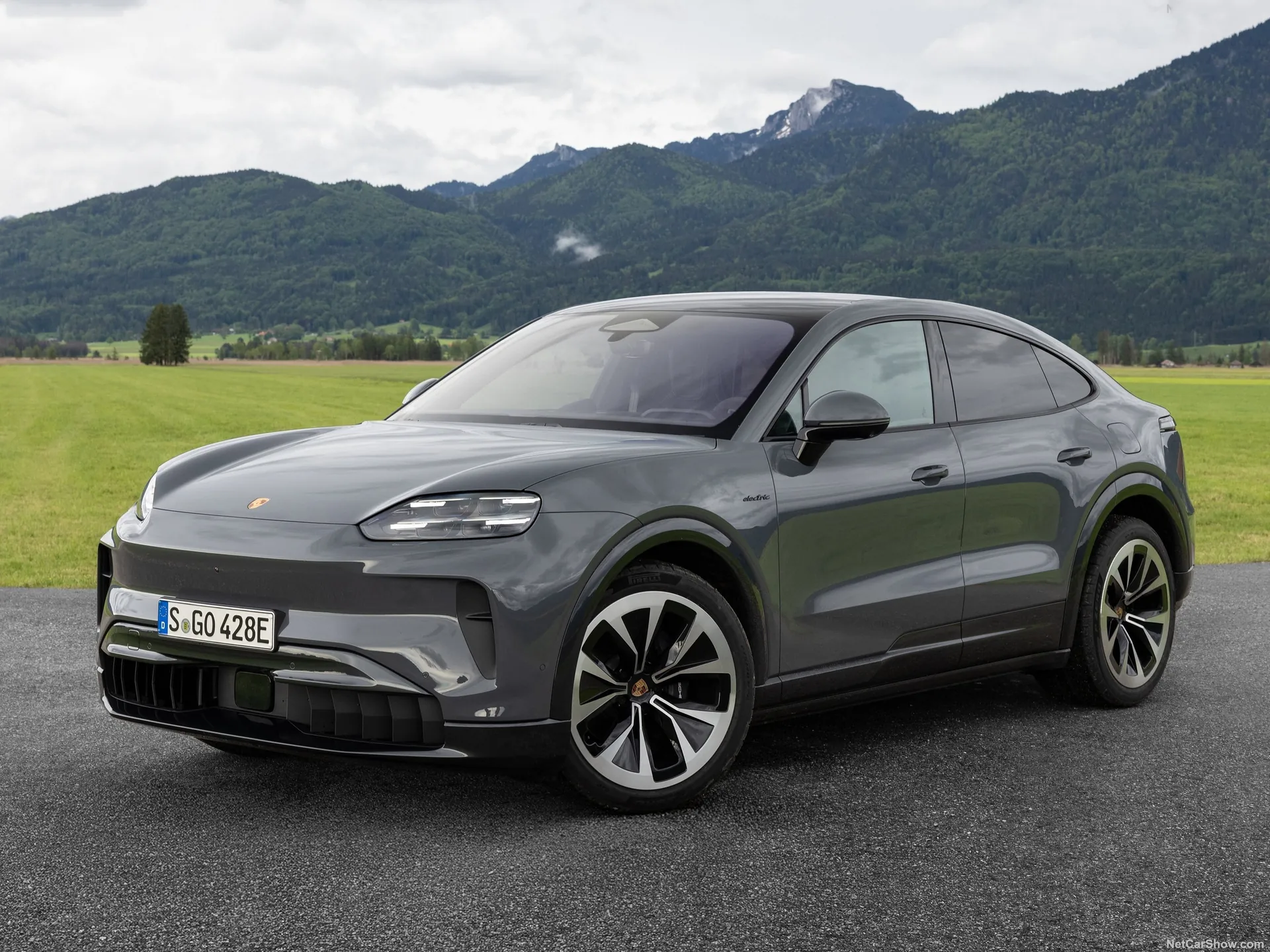
The Cayenne Electric marks the beginning of a new era for Porsche in the SUV segment. With electric super sports car performance, long range, exceptional charging power, innovative suspension, consistent digitalisation and high levels of everyday practicality, the Cayenne Electric defines the future of the model series. It combines sporty driving dynamics, comfort, versatility and technological excellence into a complete package that impresses in everyday life as well as over long distances and off-road - all while remaining a Porsche in every respect.
Two variants will be available at market launch: the Cayenne Electric and the Cayenne Turbo Electric - both with electronic all-wheel drive. The Cayenne Electric complements the existing range of combustion-engined and hybrid models and marks the technological pinnacle of the series. Porsche is thereby taking an open-minded approach in terms of drive technology but is setting new standards in performance, efficiency and digitalisation with the electric model.
At the top of the range is the Porsche Cayenne Turbo Electric with a system output of up to 850 kW (1,156 PS) and maximum torque of up to 1,500 Nm. It accelerates from 0 to 100 km/h in 2.5 seconds and reaches a top speed of up to 260 km/h. In normal driving mode, up to 630 kW (857 PS) is available, and an additional 130 kW can be activated for 10 seconds via the Push-to-Pass function. The central element is a newly developed electric motor on the rear axle with direct oil cooling, which is used exclusively in the Turbo model. The technology originates from Formula E and ensures continuous high performance even under repeated full load. The motor was developed in-house by Porsche. Silicon carbide inverters reduce switching losses and increase efficiency and power density. Power is distributed to both axles via a two-stage single-speed transmission. The weight distribution is slightly rear-biased, as is typical for Porsche, with a ratio of 48:52.
At the heart of the Porsche Cayenne Electric is a newly developed high-voltage battery with a gross energy content of 113 kWh. It consists of six modules with a total of 192 cells and is liquid-cooled on both sides. The combination of high energy density, predictive thermal management and efficient powertrain enables WLTP ranges of up to 642 km. When decelerating, the Cayenne Electric can recuperate energy at a rate of up to 600 kW - a value on a par with Formula E. Around 97 per cent of all braking operations in everyday use are covered purely electrically. The hydraulic braking system is only activated if an even greater rate of deceleration is required. The 'overrun' recuperation can be configured in three stages - from efficient coasting to more powerful deceleration.
Fast charging, bank charging and inductive charging
Thanks to its 800-volt architecture, the Cayenne Electric can charge at up to 390 kW on high-power chargers, and even up to 400 kW under specific conditions. The state of charge can be increased from 10 to 80 per cent in less than 16 minutes. A range of up to 325 km can be added in 10 minutes. To make optimal use of existing infrastructure, the Cayenne supports bank charging at 400-volt charging stations. In this case the battery is effectively divided internally to enable a high charging capacity even at conventional fast chargers.
Chassis: a balance between comfort and dynamics
Both models come with adaptive air suspension with Porsche Active Suspension Management as standard. Rear-axle steering with a steering angle of up to five degrees is available as an option. The Turbo is equipped with Porsche Torque Vectoring Plus (PTV Plus) as standard and can also be equipped with Porsche Active Ride. The premium active suspension almost completely compensates for body movements and combines exceptional comfort with high driving precision. The optional Porsche Ceramic Composite Brake (PCCB) ensures optimum deceleration even during highly dynamic driving. The wide range of suspension systems creates extraordinary breadth between sporty agility, long-distance comfort and off-road capability.
With a drag coefficient of 0.25, the Cayenne Electric is one of the most aerodynamic SUVs in its class. The almost completely enclosed underbody, air curtains, active cooling air flaps and an adaptive roof spoiler optimise airflow. In the Turbo model, active aeroblades are also used. Striking wings, frameless doors, a gently sloping flyline and an animated light signature underline the modern and unmistakable Porsche design language.
Interior: digital, intuitive, experience-oriented
The new Porsche Digital Interaction display and operation concept combines touch surfaces, physical controls and an ergonomic hand rest to create a driver-oriented user interface. The Flow Display, an elegantly curved and harmoniously integrated central screen, forms the focal point of the digital architecture. A new operating system enables streaming, gaming, app integration, and AI-powered voice control. Personalisable user profiles, widgets and themes create an individual user experience. Mood Modes combine ambient lighting, seats, displays, sound profiles and climate control to create holistic worlds of experience. This is all complemented by a new surface heating system, new massage functions and communication light.
The wheelbase, which is significantly longer than that of the combustion-engined Cayenne, creates noticeably more space in the rear. The standard electrically adjustable rear seat system allows flexible adjustments between additional space for rear passengers and maximum luggage compartment volume. With the rear seats folded, the load volume increases to up to 1,588 litres, and the total luggage space is supplemented by a 90-litre 'frunk'. The towing capacity of up to 3.5 tonnes, depending on the market and equipment, remains unchanged. A panoramic glass sunroof with Variable Light Control, parking pre-climatisation and fully integrated digital connectivity enhance travel comfort.
The Porsche Cayenne Electric offers an unprecedented range of customisation options: numerous exterior colours, interior worlds, wheel designs and accent packages. Through Porsche Exclusive Manufaktur and Sonderwunsch, truly bespoke designs can be realised, right down to one-off cars.
The Cayenne Electric combines the brand's signature proportions with a clearly evolved design language. Many unique features sharpen the identity of the individual Cayenne Electric models. Highlights include the low front bonnet with the slim Matrix LED headlights with optional (Cayenne) or standard (Cayenne Turbo) HD technology. These emphasise the width of the vehicle and combine all lighting functions in a single module. Typical Porsche features are the strongly contoured wings and the flyline, i.e. the iconic design of the gently sloping roofline.
The side view is characterised by frameless doors and a striking swage line in the door surface. The side skirts and wheel arch trims have an pronounced three-dimensional design and are finished in Volcanic Grey Metallic on the Cayenne and high-gloss black on the Cayenne Turbo. The two-tone concept emphasises the sporty proportions. The model-specific wheel arch trims emphasise the car's off-road character. Striking details at the rear, such as the light strip with a distinctive 3D look and animated graphics, as well as the illuminated Porsche lettering, underline the modern design language. The Cayenne Turbo features numerous contrasting elements in the exclusive Turbonite colour. These include the Porsche crests, the faces of the alloy wheels and the side window mouldings. Delicate Turbonite accents enhance the light strip and 'Porsche' lettering.
There are 13 standard colours to choose from for the Cayenne Electric, including three completely new colours that are celebrating their Porsche debut: Mystic Green Metallic, Monteverde Metallic and Napali Blue Metallic. Paint to Sample from Porsche Exclusive Manufaktur is also available for the Cayenne Electric. The already well-known Cayenne colour range will be continued for the electric variant. Together with the standard colours, this results in a choice of more than 100 shades.
Panoramic sliding roof with Variable Light Control: clear or matte at your fingertips
The large glass surface of the optional panoramic sliding roof with Variable Light Control ensures a particularly airy feeling of space and is bigger than any other panoramic roof offered by Porsche. The front part can be opened like a sliding roof.
Thanks to an electrically switchable film made up of liquid crystals, the panoramic sliding roof can change from clear to matte. This protects the occupants from glare but does not darken the interior. The roof is divided into nine segments, which can be switched individually. In addition to the 'Clear' and 'Matte' settings, two predefined patterns, 'Semi' (40 per cent matte) and 'Bold' (60 per cent matte), can also be selected.
Athletic accents: the Sport Design Package
The optional Sport Design Package gives the Cayenne a particularly striking appearance. It is optionally available in Black (high-gloss), Carbon or - exclusively to the Cayenne Turbo - Turbonite. All variants feature a distinctive front apron finished in high-gloss black, complemented by variant-specific inserts below the air intake in the exterior colour, Carbon or Turbonite.
The package also adds sporty accents to the side view: the wheel arch trims and the three-dimensionally shaped side apron are finished in high-gloss black and complemented by inserts in either the exterior colour or Carbon. The Cayenne Turbo also bears the 'Turbo' lettering. At the rear, a specific rear apron in high-gloss black with diffuser trim rounds off the appearance. The design of the trim varies, with the option to finish it in the exterior colour, Carbon or Turbonite.
Ready for any terrain: the Off-Road package
The optional Off-Road package enables the driver to tackle rough dirt roads and steep ascents and descents with even more confidence. The modified front apron allows a greater front approach angle of up to 25 degrees. Further details include reinforced side skirts with skid plates and horizontal cooling air flaps for additional air supply.
In addition, the Porsche Cayenne Electric with Off-Road package stands out due to its functional, robust design. The front and rear aprons, side skirts and wheel arch extensions are finished in matte black. The roof rails and an insert in the front section create an exciting visual contrast in Vesuvius Grey. An optional compass display on the dashboard and the display of tilt, incline and steering angles in the Flow Display support the driver when driving off-road.
With a drag coefficient of 0.25, the new Cayenne Electric is one of the most streamlined SUVs in its class. Particularly impressive is what is known as the drag area, i.e. the product of the drag coefficient and the frontal area: this cdxA value is 0.713 m². This puts the Cayenne Electric on a par with mid-size vehicles, which means noticeable advantages in terms of range and consumption in everyday use.
The basis for this excellent aerodynamic performance is the overall package of a lowered flyline, almost completely enclosed underbody and many detail optimisations. Indeed, the front was designed in such a way that the airflow hugs the vehicle as closely as possible. This made it possible to achieve minimal drag while at the same time maintaining a striking design language. In addition, the Cayenne Electric has been carefully tuned in the wind tunnel to exploit even the smallest improvement in the cd value. Every element of the body has been optimised in close collaboration between aerodynamics and design. The three-dimensional air curtain directs the air past the front wheels, thereby reducing unwanted air turbulence at the front, wheel arches and wheels.
Porsche Active Aerodynamics (PAA) precisely adjusts the aerodynamic properties to the respective driving situation and speed. In addition to an efficient control strategy for minimum drag in everyday use and on long journeys, the system also contributes to the brand's signature driving dynamics. These are the active aerodynamic elements in the Cayenne Electric:
Further aerodynamic details include special aero wheels and an optimised diffuser at the rear. The combination of these features results in a very low drag coefficient - a key feature for long range and high efficiency.
The interior of the Porsche Cayenne Electric is transformed into an experiential space where Porsche's sporting DNA meets digital innovation. "The aim was to combine the typical Cayenne characteristics with the newly created display areas and requirements of the new 'Porsche Digital Interaction' in a coherent overall concept - innovative, forward-looking and well considered down to the smallest detail," says Markus Auerbach, Head of Interior Design Style Porsche.
The new Porsche Digital Interaction display and control concept marks a milestone in digitalisation. At the heart of it all is the Flow Display - a curved OLED display that flows smoothly into the centre console, enabling a new and unique operating concept. Together with other screens, it forms the largest continuous digital surface in a Porsche.
The side air vents are arranged vertically in typical Cayenne fashion and sharpen the character. Above the Flow Display is another, slim vent. Another striking design element is the hand rest on the centre console. It elegantly completes the design of the Flow Display and enables particularly ergonomic operation. Because the heel of the hand rests securely on it, the hand remains steady even when driving on uneven surfaces or bumpy roads. This makes it much easier to control touch functions in particular.
"The aim of the redesign of the digital content on the screens was to create an even more immersive and intense connection between driver and sports car," says Ivo van Hulten, Head of Driver Experience at Style Porsche. Configurable widgets make operation more intuitive than ever before. The new Themes app can be used to customise the colour scheme of all digital displays in the interior. There is a choice of five predefined colour worlds that change the appearance of the Flow Display, the dash panel insert and the passenger display. As a result, the digital user interface itself becomes a design element in the interior. It adds a new, purely digital dimension to the classic options for material and colour selection.
Individual down to the last detail - and leather-free on request
Never before has it been possible to configure a Cayenne so comprehensively and individually as with the new all-electric model. Customers can choose from 12 interior combinations and, depending on the model, up to five interior and five accent packages. This opens up almost unlimited possibilities for customising the interior to one's own style - from understated and elegant to sporty and progressive.
The decorative inlays in the interior packages add specific accents to the centre console and door panels. The Cayenne Electric is equipped with the Lasershade interior trim package as standard. The new brushed aluminium Silverberry interior package and the Elmwood interior package are available as options. The vivid wood grain of the latter, along with its warm, dark colour, create a particularly natural atmosphere in the interior. The Cayenne Turbo features carbon inserts in an 'open-pore' format for the first time. This lends the sporty styling an even greater sense of modernity and is pleasant to touch.
The new attractive colours of the accent packages are tailored to the newly designed interior. The styling elements are subtle but visually effective throughout the interior and can be freely configured regardless of the selected interior colour or decor. In addition to the standard colour black, the colours Silvershade, Dark Copper and Deep Sea Blue are optionally available. Turbonite is reserved for the Cayenne Turbo.
Porsche has also developed new material variants for the Cayenne Electric. In addition to the traditional leather choices, the new colours Magnesium Grey, Lavender and Sage Grey are available. For customers who prefer a leather-free interior, there is a Race-Tex interior with a Pepita fabric option - a tribute to the iconic Porsche design of decades past.
Porsche Design's programme of custom-built timepieces has been expanded to in-clude the SUV model range. This means that Cayenne customers can now also order a watch from Porsche's own Swiss watch manufacturer that is tailored to their vehicle down to the last detail. The wristbands are made from original Porsche interior leather and yarn, while the colour ring around the dial is available in all Porsche exterior colours, including "Paint to Sample". The watch case is made from ultra-light titanium. All Porsche Design Timepieces are COSC-certified and meet the highest standards of precision.
Luxury and utility come together in a unique way in the new Cayenne. Compared to the combustion-engined model, the new Cayenne Electric has grown in length by 55 millimetres. The new SUV is 4,985 mm long, 1,980 mm wide and 1,674 mm tall. The biggest difference is in the wheelbase: 3,023 mm means an increase of almost 13 centimetres. In the rear, passengers can enjoy more space and comfort than ever before. The Cayenne's utility value is further underlined by its towing capacity of up to 3.5 tonnes.
Surface heating is available for the first time in the Porsche Cayenne Electric. This system enhances thermal comfort while consuming very little energy. Thanks to the extensive heating zones on the door panels and the centre armrest, it ensures quickly noticeable, draught-free warming of the interior even when the temperature outside is very low.
The surface heating is linked to the seat heating and is therefore also adjustable in three stages. The driver, front passenger and rear passengers can adjust their settings individually. Alternatively, the system can be decoupled from the seat heating via the flow display. With the parking pre-climatisation function the seat and steering wheel heating can be activated before getting into the vehicle. Control and programming of the system are easily carried out via the Flow Display or the My Porsche app, including personalised settings via the owner's Porsche ID.
Background lighting with Communication Light: informs, warns and performs
The Cayenne features extensive ambient lighting including communication light as standard. Drivers can choose their personal favourite from 30 colours. The animated light strip greets the passengers as they get in and visualises various vehicle situations, such as the charging process. When Launch Control is activated or a driving mode is changed, this is also highlighted in an emotive fashion. An LED light strip runs under the windscreen, and additional light elements are located in the lower part of the dashboard, in the door panels, the centre console and in the footwell.
In addition, the communication light works in conjunction with certain driver assistance systems, such as lane change assist, and can then issue location-specific warnings. For example, a pulsating band of light on the door panel warns the driver of danger if they open it while a cyclist is approaching from behind.
Mood Modes: a multi-layered experience in the interior
With the Cayenne Electric, Porsche is introducing Mood Modes. These holistically orchestrated programmes turn the interior into an experience space and further develop the connection between driver and vehicle. Depending on the driving situation and personal preferences, moods are staged in a variety of ways. There are up to nine different Mood Modes to choose from: Dynamic, Relaxation, Travel, Entertainment, Urban and Focus are always available. In combination with the optional massage function, the wellness modes River Journey, Summer Dream and Thermal Spring are also available.
Each Mood Mode configures vehicle functions in different ways to create a holistic experience. The interior components involved are:
A Mood Mode can be activated specifically for the driver and/or front passenger seats. Some customisation is also possible here, as the editing icon can be used to adjust the predefined settings. The Mood Modes are available both when the vehicle is stationary and while it is being driven.
Front seats offer significantly enhanced massage functions
The Cayenne comes with Comfort Seats in the front as standard, with electric eight-way adjustment, a memory function on the driver's side and seat heating. For even greater comfort, Porsche offers Comfort Seats with 14-way adjustment and memory function. In addition to the more extensive adjustment options, Porsche also offers seat ventilation. Another seat alternative is the Adaptive Sports Seats option with 18-way adjustment.
Porsche has also significantly expanded the available massage functions. Now, 16 air cushions with increased stroke in the driver and front passenger seats provide an improved depth and extend the pressure massage to the seat cushion areas. For the first time, a special vibration massage is possible, with two actuators in the cushion and four in the backrest. A total of five multi-level massage programmes are available to choose from.
Electrically adjustable rear seat - as standard
In the rear, passengers benefit from a new, electrically adjustable seat system as standard. Both the backrest angle and the longitudinal adjustment (150 mm) can be altered. This gives customers the choice between a particularly comfortable seating position or more space for luggage. If the second row of seats is in the most comfortable position, the luggage compartment volume is 553 litres. When the backrest is more upright, in the cargo position, this figure rises to 781 litres.
The rear seat system comprises two seats with a single seat and a middle seat. The backrests can be split 40:20:40 and can be folded down at the touch of a button from the luggage compartment or by using the seat adjustment switch on the rear seat. This increases the luggage compartment volume to 1,588 litres. Seat heating and ventilation are optionally available for the rear seats.
Multifunctional centre console with space for drinks and mobile devices
The centre console is something of a multitasker, combining design, ergonomics, functionality and sustainability. Its ascending shape reinforces the impression of sitting low and in a sports-car-like position in the Cayenne. At the same time, it has a confident design that underlines the car's SUV character. The cover is used as an armrest. It can be adjusted in length so that every driver can find their most comfortable position. The cushion can be customised with various high-quality materials, including leather. It is also part of the optional surface heating, contributing to a pleasant feeling of warmth in colder weather.
The large storage compartment contains two cup holders, which can be completely removed to increase capacity. They can also be fixed in two height positions. Their textile design, which enables them to adjust flexibly for different cup or bottle sizes, is another example of the high level of attention to detail inside the Cayenne.
A tablet holder and smartphone tray are also integrated into the compartment. Two smartphones can be charged wirelessly at up to 25 W or via two USB-C ports at up to 60 W. Two USB-C ports supplying 100 W each are also available.
A new dimension in digital user experience
With a modern look and feel, an emotive welcome animation and the extensive personalisation options thanks to the first-ever use of the Themes app, Porsche has already broken new ground in terms of operating and display concepts with the Macan Electric. Now, the next generational leap can be experienced in the all-electric Cayenne. The upgrades to the Porsche Driver Experience control and display concept are extensive. The most prominent highlight is the Flow Display, which transforms the user interface into an intuitive, visually 'flowing' operating experience.
Another new feature is the new Porsche Digital Interaction (Porsche DI) design language, which blends aesthetics and functionality. Clear graphic structures, minimalist icons and dynamic animations create a modern, uncluttered look.
This further development enables an even more immersive and intense connection between driver and vehicle. The sports car manufacturer thereby remains true to its philosophy of consistently designing the controls to the needs of the driver, enabling quick and seamless operation while driving.
With its software platform, Porsche pursues a blended ecosystem strategy, combining third-party and in-house developments. Android Automotive OS is used as the operating system, but Porsche also offers its own software features such as the Sport Chrono app and Navigation Plus, including Charging Planner.
The App Centre offers a wide range of third-party apps that customers can use to freely design their own digital ecosystems. This strategy allows Porsche to retain control over vehicle and customer data as well as the development direction of the vehicle's software.
Intuitive operation with Porsche Car App and widgets
The Porsche Car App bundles all important vehicle functions in one place and enables particularly intuitive operation. At its heart is a high-quality 3D model of the Cayenne, which is shown in the same exterior colour as the customer's actual car. The driver can use this vehicle icon to control functions directly, for example opening the luggage compartments or extending the rear spoiler. The Cayenne image can be rotated 360 degrees on the display, with smooth transitions from the front to the rear view, for example.
New elements of Porsche Digital Interaction are the widgets - small interactive applications. Just like on a smartphone, these controls provide quick access to various functions. These widgets allow preferred content to be shown directly on the Flow display, such as navigation, media, telephone or climate control. The widgets are visually appealing, interactive, and can be arranged freely according to personal preferences.
This creates a digital workspace in the Cayenne that is intuitive to use and reduced to the essentials. The Quick Access widget turns the electric SUV into a truly useful assistant; the system recognises which functions are particularly relevant based on the current driving situation. This could be a navigation link to a workplace or a suggestion for maximum cooling of the interior. These recommendations are context-sensitive and really personalise the driving experience.
Up to three screens are available in the new Cayenne. Their combined area is 50 per cent larger than in the combustion-engined Cayenne and bigger than in any Porsche before. With the Themes app, which can be found in the app launcher of the Flow Display, the colour of all digital surfaces in the interior can be personalised. Cayenne drivers can choose from five colour schemes.
Porsche is breaking new ground in terms of design and technology with the central screen of the new Cayenne; the ultra-thin Flow Display follows an elegant horizontal curve and flows seamlessly into the centre console. The climate control unit and an ergonomic hand rest complete the display at the bottom. Together with the optional passenger display, the new Flow Display forms a large, seamless screen unit. The curve allows the surface of the Flow Display to be virtually divided into an upper display and a lower control area. In the menu bar, which has now been moved from the left to the bottom, the most important controls are always within easy reach, while the display elements at the top are always in the driver's field of vision.
The Flow Display uses OLED (organic light emitting diode) technology. These screens generate light with pixel precision. Inactive pixels remain switched off and thus appear deep black. Compared to conventional LCD (liquid crystal display) technology, this results in outstanding image quality with higher contrast and more intense colour brilliance.
Fully digital instrument cluster with OLED technology and 3D driver assistance
On the driver's side, the Porsche Cayenne Electric has a new, fully digital instrument cluster, which, like the Flow Display, uses OLED technology. The display measures 14.25 inches diagonally. Porsche has retained the familiar 'tube-layout' look for the display. The centre tube is used for the power meter and navigation, the left tube for vehicle displays such as driver assistance systems and charging data, and the right tube is for infotainment and media. Drivers can use the toggle button and roller on the steering wheel to customise the screen content.
Another highlight is the 3D driver assistance. It displays a current three-dimensional model of the surroundings, including the route with bends and all relevant lanes, as well as up to eight other road users. If the driver uses Apple CarPlay® or Android Auto, the map appears in the centre. Navigation instructions and the call history are displayed in the right-hand tube.
Inspired by the Taycan, small control panels are located on the side edges of the instrument cluster to control the lights, suspension and parking functions as well as the Porsche Electric Sport Sound (PESS). A diamond key - or 'joker' button - can be configured according to personal preferences, giving quick access to menu pop-ups in the instrument cluster when pressed, depending on function.
Passenger display available for extensive entertainment programme
The optional 14.9-inch front passenger display features local dimming technology. This ensures that the image is particularly rich in contrast and evenly lit. With this technology, LEDs are not only located at the edge, but behind the entire screen area and can be dimmed or switched off individually.
The front passenger can also use the user-friendly widgets and pin them to the left side of the display for quick access when needed. In addition, they can adjust infotainment or navigation settings, use third-party apps and stream video content on their own screen.
Head-up display with AR projects important information directly onto the vehicle's surroundings
For the first time in a Cayenne, a head-up display with augmented reality (AR) technology is available as an option in the new electric models. Coloured AR content is projected onto the real view of the surroundings with precise location accuracy. For example, navigation arrows are displayed at intersections in the correct turning lane. The system uses environmental data and the position of the vehicle itself. It also supports the functions of some driver assistance systems, for example by displaying the recommended lane guidance as virtual dots on the road when adaptive cruise control is activated. Warnings from the driver assistance systems can also be displayed in the AR area.
This allows the driver to grasp information and instructions more quickly, further reducing the risk of distraction. The image on the head-up display appears to the driver at a distance of 10 meters and corresponds to the size of an 87-inch display. The status area below the AR surface statically displays the current speed, traffic signs and assistance and navigation symbols.
Porsche App Centre transforms the Cayenne into a jukebox or games console
The latest generation of infotainment uses Android Automotive OS as its operating system and starts up in the background as soon as the driver approaches with the (analogue or digital) key. Vehicle and infotainment functions are therefore immediately available and can be operated quickly and smoothly.
The Porsche App Centre is the central hub for all third-party apps and app updates. It is continuously evolving in line with market requirements and keeps the Cayenne up to date throughout its life cycle. In the Porsche App Centre, drivers and passengers can directly install and use their favourite third-party apps, just as they would on their smartphones. There is a wide range of apps from different categories available. In the European markets, these will include audio services such as Apple Music, Spotify, Amazon Music and Audible, the YouTube streaming platform, the DAZN live sports streaming app and the Home Assistant smart home app.
If desired, the App Centre can also transform the Cayenne into a mobile gaming console - both when the car is stationary, for example during charging stops, and while on the go. From music streaming and podcasts to gaming and movies, users have access to an ever-growing selection of third-party apps that can be seamlessly integrated into the Porsche ecosystem.
Games from Gameloft are available via the Porsche App Centre and can be controlled via touchscreen or Bluetooth controller. AirConsole brings a large selection of family games and gaming classics into the vehicle, which can be easily operated via smartphone. The driver, front passenger and rear passengers can play individually or together. The optional passenger display allows apps to be used in parallel even while the car is being driven, without distracting the driver. In combination with a Bluetooth headset, an undisturbed listening experience is possible.
Greater ease of use thanks to additional intelligence also applies to Navigation Plus including Charging Planner. The system offers fast route calculation with lane-by-lane navigation at manoeuvre points as well as extended functions for charging planning. This also means that customers can now favour or specifically avoid individual charging providers and stations.
Voice Pilot offers enhanced interaction through artificial intelligence
Thanks to the integration of artificial intelligence, voice control is smarter than ever before. The Voice Pilot now understands complex, related questions and recognises the context of statements. It handles multi-step questions just as confidently as spontaneous follow-up requests. There is no need to repeat the activation word. The system draws on real-time data, the current route and the Google-supported POI search. In the background, the Voice Pilot uses various language models, as familiar from popular AI assistants. The improved Voice Pilot makes the Cayenne a real conversation partner.
The Comfort Access feature, which is included as standard, includes the Porsche Digital Key, enabling vehicle keys to be integrated into Apple Wallet or a native wallet app on Android. This allows the Cayenne to be automatically locked, unlocked and started - either by keeping your iPhone, Apple Watch or a compatible Android device in your pocket or by simply holding it up to a reader. This is made possible by the combination of Near Field Communication (NFC), Bluetooth Low Energy (BLE) and Ultra-Wideband (UWB). Even if the smartphone needs to be charged, the functionality of the digital key in Apple Wallet or a native wallet app on Android remains intact.
In addition, customers can share their car keys with up to seven other users in Apple Wallet or a native Android wallet app via iMessage, SMS, WhatsApp, and more. Vehicle owners can also specify whether these users are only allowed to access the vehicle or whether they are also allowed to drive it. The Porsche Digital Key also makes it easy to open the luggage compartments, which can also be done via the My Porsche. These functions require the Porsche Connect package.
Sports car performance with new drive system and innovative cooling
As Porsche's most powerful production car to date, the all-electric SUV offers exceptional driving performance on a par with supercars. The all-electric Cayenne line-up initially includes two models: the Cayenne Electric and the Cayenne Turbo Electric. Both of which feature all-wheel drive and are therefore equipped with electronic Porsche Traction Management (ePTM). Porsche uses permanent magnet synchronous electric motors (PSM) on both the front and rear axles.
The Cayenne Turbo accelerates from 0 to 100 km/h in 2.5 seconds, reaches 200 km/h in 7.4 seconds and goes on to a top speed of 260 km/h. This outstanding electric performance is made possible by a newly developed drive system that develops up to 850 kW (1,156 PS) of power and up to 1,500 Nm of torque when Launch Control is activated. Direct oil cooling, an innovation carried over from motorsport, for the electric motor on the rear axle of the flagship model ensures high continuous output and efficiency. Featuring an electric motor with a diameter of 245 mm and a length of 190 mm, and combined with a 940-amp silicon carbide pulse-inverter, the rear-axle assembly of the Cayenne Turbo features what is currently the most powerful electric drive system from Porsche - developed in-house in Weissach and manufactured in Zuffenhausen. On the front axle is an electric motor with a diameter of 210 mm and a length of 150 mm, coupled with a 480-amp silicon carbide pulse-inverter. In the Normal drive mode, the Turbo delivers up to 630 kW (857 PS), and an additional 130 kW (176 PS) can be called upon for 10 seconds at the touch of a button with the Push-to-Pass function.
The entry-level Cayenne model generates an output of 300 kW (408 PS) in Normal mode. With Launch Control activated, the output increases to 325 kW (442 PS) and 835 Nm of torque. The Cayenne accelerates from 0 to 100 km/h in 4.8 seconds and reaches a top speed of 230 km/h. Its front axle motor, which has a diameter of 210 mm and a length of 100 mm, is combined with a 350-amp pulse inverter. An electric motor with a diameter of 210 mm and a length of 200 mm is installed at the rear, coupled with a 480-amp silicon carbide pulse inverter. This rear motor delivers significantly more power and torque than the drive unit at the front, emphasising the sporty, rear-biased setup of the Cayenne Electric.
In both Cayenne Electric models, the front electric motor is deactivated when power demand is low, and drive comes only from the rear electric motor, increasing efficiency.
Motorsport technology: direct oil cooling for the electric motor
A special feature of the electric drive unit on the rear axle of the Cayenne Turbo is the direct oil cooling. All the current-carrying components are cooled directly. Porsche brought this innovation to the racetrack in Formula E, and now this technology is coming to series production. Direct oil cooling enables very high efficiency, combined with high peak and continuous power output. In conventional electric motors, the coolant flows through a jacket outside the stator, while with direct cooling the coolant flows directly along the copper windings. In this way, the heat can be dissipated directly from where it is generated. To achieve the same efficiency and performance figures, a motor cooled using a water jacket would also have to be approximately 1.5 times larger. Thanks to direct cooling, the Cayenne uses a design that enables up to 98 per cent efficiency in real-world operation.
A synthetic, non-conductive oil is used for immersive cooling of the electric motor: Mobil 1 Therm Electric P, a special dielectric fluid developed by Exxon Mobil. It is non-corrosive and, crucially, has a very low viscosity. Its kinematic viscosity at 100 degrees Celsius is only 1.7 mm2/s which means that it is about five times freer-flowing than engine oil with a viscosity grade of 20 at the same temperature. About six litres of coolant are circulated, but an oil change is not necessary over the system's entire life cycle. Mobil 1 Therm Electric P and the gear oil for the single-speed transmission system flow in separate circuits but are circulated by a common oil pump, saving both space and weight.
Compact transmission and rear-biased weight distribution
Power is transmitted to the wheels on the front and rear axles via a two-stage single-speed transmission. This enables a compact and lightweight design. For the Cayenne, Porsche has further developed the 'performance rear end' that was introduced in the all-electric Macan. The drive unit is now mounted to the rear subframe, further increasing ride comfort. The position of the electric motor on the rear axle has been retained, which is set far to the rear, ensuring a slightly rear-biased weight distribution of 48 per cent front and 52 per cent rear.
Up to 600 kW recuperation power - equivalent to Formula E
The all-electric Cayenne reaches new standards in recuperation; energy can be recovered at a rate of up to 600 kW via the brake pedal, depending on the speed, temperature and the state of charge of the battery.
The level of recuperation in the Porsche Cayenne Electric therefore matches that of the Porsche 99X Electric, with which the sports car manufacturer competes in the Formula E racing series. Recuperation is also active during more dynamic driving, meaning that around 97 per cent of braking operations in everyday use are taken care of by the electric motors alone, without using the friction brakes. Depending on the particular braking manoeuvre, the recuperation can even be used to bring the car to a complete stop. As soon as the deceleration exceeds the recuperation limit, the friction brakes are applied - virtually imperceptibly to the driver.
The driver can also activate 'overrun' recuperation. The centre display can be used to select the three levels 'On', 'Off' or 'Auto':
ePTM enables impressive off-road capability
The Cayenne opens up a new dimension, not just in terms of longitudinal and lateral acceleration. Its off-road capabilities are also remarkable, giving even less experienced drivers a constant feeling of confidence and safety. Due to the nature of electric motors, the drive system offers high torque right from a standstill. When stopping or setting off on a hill, this torque can also be very precisely regulated. Roling backwards unintentionally is prevented by halting the electric motor in place, a function that has been specially integrated by Porsche.
The electronically controlled Porsche Traction Management (ePTM) reacts about five times faster than a conventional all-wheel drive system. Within five milliseconds, it responds to a variety of input variables such as acceleration, drive torque, vehicle speed and traction slip, and it can adjust the torque distribution to suit the particular driving situation as required.
The Porsche Cayenne Electric is an all-rounder par excellence and offers a wide range of everyday usability and quintessential Porsche performance, as well as excellent off-road and towing capabilities. The suspension plays a major role in this. At the front, the SUV is fitted with double-wishbone suspension with separate control arm levels. Its elastokinematic properties ensure excellent responsiveness, steering precision and straight-line stability. The multi-link rear suspension is mounted to the rear subframe, which is connected to the body with flexible mounts. In addition, the rear electric drive unit is attached directly to the subframe via three points (or four points for the top-of-the-range model). Separating the drive unit from the chassis, and instead mounting it to the rear subframe, directly benefits ride comfort while also minimising weight.
The Turbo model is also equipped as standard with Porsche Torque Vectoring Plus - an electronically controlled differential lock on the rear axle, with fully variable power distribution. The control strategy is tailored to the particular driving situation and ensures enhanced traction, driving stability and lateral dynamics. Steering response and steering precision are aided by targeted dynamic brake actuations on the rear axle.
The list of standard equipment also includes self-levelling adaptive air suspension and Porsche Active Suspension Management (PASM) electronic damper control. The system uses a wide range of information - including the vehicle speed; the rate of heave, pitch and roll of the body; longitudinal and lateral acceleration; drive torque; steering input and ride height setting - to continuously adjust the damping for each wheel and the body individually. Thanks to two-valve technology, the rebound and compression stages can be separately adjusted. The air suspension allows different levels of ride height to be selected to suit the ground surface. The three submenus of the off-road driving programmes - Gravel/Mud, Sand and Rock - allow the driver to adjust the driving dynamics according to the terrain. This is achieved with, among other things, different accelerator pedal maps. Another strength off-road: the electronically controlled differential lock, which is fitted as standard in the top-of-the-range model, increases traction even further and, in the various off-road driving modes, distributes torque in a manner to suit the particular ground surface in order to achieve maximum traction when pulling away.
Enhanced driving dynamics and increased ride comfort thanks to Porsche Active Ride
For the first time in an SUV, Porsche is offering Porsche Active Ride for the Cayenne Turbo Electric. This active suspension significantly broadens the spectrum between performance and ride comfort. Porsche Active Ride keeps the body parallel to the ground, even during periods of heavy braking, steering and acceleration, which noticeably increases ride comfort in the Normal drive mode. In off-road use, Porsche Active Ride enables a high degree of articulation of the axles thanks to the absence of mechanical anti-roll bars.
For the first time, the Cayenne features a Comfort drive mode. Intelligent ride-height control and comfort-biased damper control ensure maximum isolation of the body and passenger compartment from undesirable forces and vibrations, resulting in maximum comfort. In this drive mode, the additional 'cornering comfort' and 'pitch comfort' functions are active by default. This reduces the longitudinal and lateral forces acting on passengers during acceleration, braking and cornering through targeted compensation of roll and pitch from the Porsche Active Ride system.
Porsche Active Ride enhances driving dynamics during high-performance driving. For maximum traction, the body is kept level and dynamic distribution of wheel loads is intelligently controlled during cornering. Porsche Active Ride uses sensors to calculate and monitor the dynamic wheel load on each wheel and, as a result, the maximum grip level for each wheel. The system acts in real time by adjusting the distribution of power to each wheel, without slowing the forward drive. By adjusting the damper force, the load on a wheel can be either increased or decreased.
The Porsche Cayenne Electric's driving dynamics also benefit from the low centre of gravity that is typical of battery-electric vehicles. Compared to the combustion-engined model, the centre of gravity is 83 mm lower.
The new Cayenne is one of the world's first BEVs to offer a towing capacity of up to 3.5 tonnes, depending on the market and specified equipment. The fact that it can tow heavy trailers with ease while delivering the same impressive driving experience that it does when uncoupled is due, among other things, to the special use of Porsche Active Ride. The approximate mass of the trailer is determined electronically and then taken into account by the active suspension system. The throttle response is also adapted accordingly.
How Porsche Active Ride works in detail: all four active dampers are connected to a motor pump unit on each axle. In addition to their damping function, these also take on the role of performing as anti-roll bars. This means that, unlike with the standard air suspension, anti-roll bars could be omitted. During off-road driving, this offers the advantage of greater axle articulation. At the same time, the system also significantly increases ride comfort in the event that one side of the road is particularly uneven. The motor/pump unit generates the active actuating forces at the dampers on demand within milliseconds. The system is powered directly from the high-voltage battery.
Rear-wheel steering for a tighter turning circle and even greater high-speed stability
The Cayenne is optionally available with rear-wheel steering. It reduces the turning circle from 12.7 m to 11.6 m, thereby contributing to increased agility in urban traffic and while driving off-road. The required steering angle is reduced by 24 per cent, which means that the driver does not need to turn the wheel as far. The rear-wheel steering system also provides enhanced stability and driving precision on country roads and motorways. Another advantage is the precise, totally direct steering feel that is typical of the Porsche brand.
Depending on the vehicle speed and the driving conditions, the electromechanical actuator generates a steering angle at the rear wheels. At speeds below 100 km/h, the rear wheels turn in the opposite direction to the front wheels, providing an even more direct turn-in response. In addition, lateral acceleration is built up more quickly during cornering. The steering angle at the rear wheels is up to five degrees at low speed, which makes manoeuvring much easier. The virtual shortening of the wheelbase by means of rear-wheel steering also results in more responsive steering behaviour when cornering. Above 100 km/h, the rear wheels turn in the same direction as the front wheels, which further increases stability, for example when changing lanes on a motorway. The rear-wheel steering is accompanied by a 12.5-per-cent-more-direct steering ratio on the front axle in the all-electric Cayenne, further increasing agility.
The front-axle steering is designed in typical Porsche fashion, offering maximum precision, highly responsive dynamics and therefore optimal control during all steering manoeuvres. Porsche has also developed an intelligent power-assisted steering system that provides distinct, natural feedback, allowing the driver to feel the condition and current grip level of the road. This gives a true steering feel, which is especially important during periods of particularly spirited driving. Unwelcome vibrations and bumps, however, are eliminated and are not transmitted through to the steering wheel.
High-performance braking system: Porsche Ceramic Composite Brake (PCCB)
The Porsche Ceramic Composite Brake (PCCB) system is available as an option for the top-of-the-range model. Its ceramic brake discs are extremely resistant to heat and are significantly lighter than cast iron discs of the same performance level. This reduces the unsprung mass, further enhancing driving dynamics, comfort and braking performance. The front discs have a diameter of 440 mm, and 410 mm discs are fitted at the rear.
Battery technology of the future: intelligent, powerful, robust and efficient
The new Cayenne features what is referred to as a 'function-integrated' high-voltage battery. With this design, the battery becomes part of the body and performs other functions in addition to energy storage. This approach reduces weight and allows for a more spacious interior. At the same time, the integrated battery increases body stiffness and lowers the centre of gravity even further. This makes the Cayenne Electric even more direct and agile to drive. There are also benefits in passive safety: the battery modules have a special extruded profile that absorbs impact energy in a targeted manner in the event of an accident.
High energy density and double-sided battery cooling
The battery modules for the new Cayenne, which are manufactured in-house, were developed from the ground up by Porsche. This approach is in line with the company's commitment to developing key technologies of the future in-house. The high-voltage battery is much more than just an energy storage device - it shapes the performance, efficiency and everyday practicality of the entire vehicle.
The high-voltage battery has a gross energy capacity of 113 kWh. In combination with the 800-volt technology and the highly efficient drive system, this enables a range of more than 600 km - ideal for long-distance travel. In the Cayenne Electric, Porsche uses a lithium-ion battery with six modules and 192 cells. The cells themselves are of the type known as pouch cells. A flexible aluminium-polymer film surrounds the electrode stack. The anode consists mainly of graphite, with six per cent silicon. Graphite anodes offer high mechanical stability and strong deep-cycle stability. Silicon increases the specific energy density and improves the fast-charging capability. Nickel-manganese-cobalt-aluminium (NMCA) is used for the cathodes. In order to achieve the highest possible energy density, a particularly large proportion of nickel is used in the NMCA material, with a nickel content of 86 per cent. The additional use of aluminium increases the energy content and ensures better electrical stability, which in turn has a positive effect on the service life of the cell.
Intelligent thermal management significantly contributes to the high charging performance and long service life of the high-voltage battery. A key main innovation here is the cooling strategy of the high-voltage battery; in the Cayenne Electric, two cooling plates are used per module. They cool or heat the battery from above and below as needed, enabling the optimal temperature to be reached more effectively. The cooling capacity is roughly equivalent to the performance of about 100 large household refrigerators. The newly installed fans are particularly efficient. Compared to conventional suction fans, they require around 15 per cent less energy.
Integrated intelligence thanks to the Charging Planner and predictive thermal management
The Porsche Charging Planner ensures intelligent control of charging processes. Once route guidance is active, the system helps the customer to travel in a relaxed manner and without wasting time, especially on long journeys. In the new Cayenne, the system has become even more intelligent as the Charging Planner now also enables certain charging stations to be avoided or preferred charging locations to be saved. For example, it is possible to set the system to only use charging stations with Plug & Charge technology or high-power charging stations with capacities of more than 350 kW. To make optimum use of the available charging power, the Charging Planner is able to initiate preconditioning of the battery while on the go.
Porsche is now taking a big step further in this area; with predictive thermal management, the Cayenne Electric offers even more efficiency, performance and convenience. At the same time, the new function significantly extends the service life of the battery cells.
With predictive thermal management, all cooling circuits in the vehicle and their heating and cooling elements are networked with each other. Innovative software optimises heat flows, calculates the required cooling output and plays a key role in preconditioning as well as planning and performing charging processes. Almost all the high-performance computers in the electronic architecture are involved in the calculations.
When route guidance is active, it uses data from the driver's navigation, route plotting, departure time and driving style to predict the heating or cooling requirements in advance and satisfy them accordingly. Thanks to the underlying mathematical model, range predictions are even more accurate. Battery management and advanced charging functions are also influenced by predictive thermal management. The intelligent control system selects the appropriate strategy depending on the type of destination. For example, if the selected destination is a fast-charging station, preconditioning is carried out with a focus on maximum charging performance. If the driver instead plans to charge at home, then predictive thermal management ensures the best conditions for AC charging.
Due to the high charging rate of the Porsche Cayenne Electric, charging during very hot weather can lead to the cooling system producing a relatively higher level of noise. If quieter charging is desired in such a case, then customers can reduce the noise level by using the 'Quiet Charging' mode. This turns down the fans, and the charging power is adjusted accordingly.
Those who want to cover ground as quickly as possible on long journeys can rely on the Cayenne Electric's extremely high charging capacity. Thanks to 800-volt technology, the Cayenne can charge at up to 390 kW at a suitable DC charging point and, under specific conditions, a rate of up to 400 kW can even be achieved. The SoC (State of Charge) can be increased from 10 to 80 per cent in less than 16 minutes, and sufficient energy for an additional 325 km (Cayenne) or 315 km (Cayenne Turbo) of range can be added within 10 minutes. One of the main areas of focus during development was robust charging performance.
At 400-volt charging stations, the 800-volt battery is effectively divided into two batteries, each with a nominal voltage of 400 volts, using a high-voltage switch in the battery. This method, known as bank charging, enables particularly efficient charging without an additional HV booster - at an output of up to 200 kW. With typical household wallboxes, AC charging is possible with the standard onboard charger at up to 11 kW, and a 22 kW onboard charger is also available as an option.
The Porsche Cayenne Electric keeps its driver informed in real time about every active charging process. Charging time, range, charge level, charging rate and battery temperature are displayed in the Porsche Communication Management (PCM) system and the My Porsche app. If the full charging performance cannot be achieved, for example because the battery temperature is too low, then this is also clearly communicated to the customer. Information about the current charging status is also given via the LED indicator in the standard electric charging flap and the Communication Light in the interior, with a corresponding LED animation.
The Cayenne features Matrix LED headlights as standard. These headlights automatically adapt to the prevailing driving conditions to ensure optimum illumination of the road, based on camera and navigation data, supplemented by information on speed and the car's surroundings. A special highlight is the glare-free main beam, known as a matrix beam; oncoming vehicles or vehicles in front are selectively illuminated depending on the situation. For this purpose, the main beam area is divided into 11 segments.
State-of-the-art HD-Matrix LED headlights are fitted as standard on the Cayenne Turbo and are optionally available for the Cayenne. On request, they are also available in a tinted version or with the striking accent colour Glacier Iceblue. The primary advantage of the HD-Matrix LED headlights is a bright, homogeneous and high-resolution light pattern.
Two HD-Matrix modules form the heart of this high-resolution lighting system, and each one features about 16,000 pixels. The control module, which is comparable to a powerful graphics card, controls each LED individually, adjusting their brightness finely over more than 1,000 possible levels. The two modules differ in that one operates with a wide-angle lens and the other a telephoto lens. This provides extensive illumination of the entire main beam area while also enabling precise long-range illumination.
With the high-performance main beam, the HD-Matrix LED headlights generate a light output of about 2,500 lumens at an illuminance of more than 300 lux. This makes it possible to illuminate the road ahead for a distance of more than 600 m. By overlapping the illumination angles of both HD-Matrix modules, pixel-precise and accurate shielding of other road users is achieved in the field of the matrix beam. Both headlight types available for the new Cayenne greet and bid farewell to driver and passengers with an animation using the four-point daytime running lights.
Striking appearance day and night: the taillights
An eye-catching feature at the rear is the continuous 3D-look light strip with illuminated 'Porsche' lettering. The intricate, two-part LED taillights are finely framed in silver along the light strips and the lettering. On the Cayenne Turbo, these accents are finished in the exclusive colour Turbonite. For both Cayenne models, the rear lights are also available in a tinted version as well as in Glacier Iceblue.
The rear lights also feature a 'coming home/leaving home' animation with an emotive, three-dimensional light signature. The action of opening and closing the luggage compartment is also accompanied by an animated light sequence at the rear.
Driver assistance systems: greater safety, greater comfort
The Porsche Cayenne Electric features wide range of assistance systems as standard, making every kilometre safer. Its optional assistance systems are intelligently networked, react to a given situation and integrate seamlessly into the driving experience - on motorways, country roads and in city traffic.
Even in standard specification, the Cayenne Electric is able to automatically detect parking spaces and parking space markings and measure their size. Suitable parallel and perpendicular parking spaces are detected based on parking space markings between or behind parked vehicles. The system takes control of the steering and forwards and reverse motion of the vehicle.
The optional ParkAssist assistance package offers additional functions for even greater convenience and safety when manoeuvring:
The optional Drive Assist assistance system also takes the pressure off the driver through predictive longitudinal control and continuous steering support. Speed, acceleration, deceleration and cornering speeds are all adapted to the route. Drive Assist also reacts proactively to right-of-way rules, speed limits and bends. By linking the vehicle's navigation data, cameras and sensors, the route ahead and detected road users are represented in a real-time model that displayed in the 3D driver assistance display in the instrument cluster. In appropriate situations, the vehicle is able to perform lane-change maneouvres. The driver must initiate the manoeuvre by activating the indicator, keep their hands on the steering wheel at all times and monitor the situation throughout.