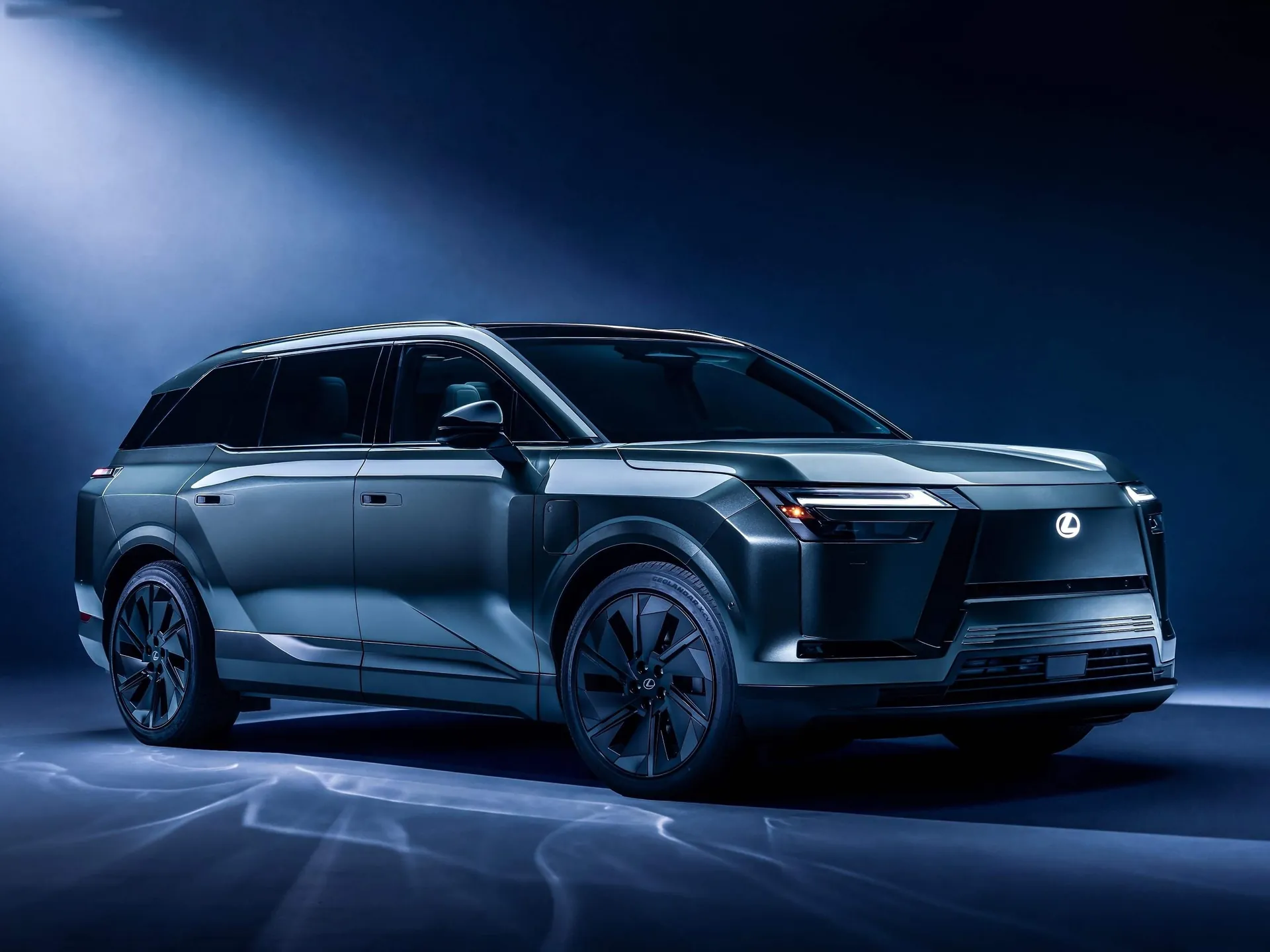
Lexus RZ
The introduction of the new Lexus RZ demonstrates Lexus' commitment to maximising the benefits of battery electric vehicle technologies, not just in terms of power and energy efficiency, but importantly in delivering a more rewarding experience for the driver and an enriched journey for every occupant.
The changes introduced in the RZ's significant update programme include improvements in battery and motor output and the detailed construction of components and vehicle structure. Charging performance has been enhanced, benefiting from Lexus' long-established expertise in electrified technologies.
The RZ also reinforces Lexus' status as a technology pioneer, being the first model to offer the combination of a full steer-by-wire system with a radical new-design steering wheel. This provides intuitive operation, good visibility, and ease of handling with responsive performance and reassuring feedback to the driver.
Furthermore, the new RZ F SPORT marks the debut of Lexus' Interactive Manual Drive, a virtual gear shift system that replicates the performance, sound and feel of a manual transmission in a fully electric vehicle.
As well as delivering more power across all models in the new range, the RZ also achieves higher efficiency, reflected in increased driving ranges and reduced charging times.
At heart, the RZ remains a vehicle that is rich in Lexus craftsmanship with details that reflect the brand's Omotenashi approach to on-board hospitality, making life as comfortable, safe, and convenient for driver and passengers alike. Dynamically, the latest enhancements reinforce the Lexus Driving Signature, giving the driver confidence, control and comfort at all times.
The new RZ range will be introduced in dealerships across Europe from late 2025.
Lexus engineers every model in its range to deliver the Lexus Driving Signature, a unified driving experience in which the driver enjoys comfort, confidence and control at all times. Strategic measures applied to the new RZ reinforce this quality, with the exhilarating performance characteristics that can be achieved with battery electric vehicle technology and engineering.
Structural rigidity has been increased with improvements around the front radiator support: increased plate thickness and strengthened joints. Meanwhile, the addition of a rear brace helps reduce localised torsional deformation. These measures support a clean and linear response to steering inputs.
The suspension system - front MacPherson struts and rear double wishbones - benefits from fine adjustment to the front and rear dampers and springs to promote dynamic performance and achieve a good balance between handling stability and ride comfort. The front bushing has been optimised to obtain more direct steering response.
Other new details include a weight-saving reshaping of the lower front suspension arm and new internal parts in the hub bearing, measures which help optimise the driving range. The steering gearbox mount has also been adjusted to render the system more rigid and responsive.
The performance of Lexus' DIRECT4 vehicle motion control technology has been revised, further enhancing the traction and stability performance of the new RZ all-wheel drive models.
The intelligent system automatically controls the distribution of power delivery to the front and rear eAxles, according to the driving conditions and driver inputs.
The range of torque distribution has been extended by increasing the output of the BEV system, so that at start-off and in straight-line acceleration, front/rear power distribution is controlled between 60:40 to 0:100, suppressing pitching and producing a direct acceleration feel. During cornering, the distribution ratio is optimised between 80:20 and 0:100, according to vehicle speed and steering angle, to match the driving conditions.
During turn-in, more power is directed to the front axle to achieve a smooth turn. When exiting a corner, torque distribution is in line with the load on each wheel, to maintain vehicle balance and allow for smooth acceleration. The result is a rewarding feel when cornering and precise line tracing.
When the driver selects Range mode to maximise efficiency, the front/rear balance is maintained at 50:50.
The adoption of Lexus' Vehicle Dynamics Integrated Management (VDIM, an option on Luxury AWD model and standard on F SPORT) contributes to a flatter, more comfortable ride, together with enhanced driving stability and emergency hazard avoidance handling.
A high level of body rigidity and connection throughout the entire body is key to achieving responsive performance, faithful to the driver's inputs. Original development of the RZ ensured a very rigid structure, helped by the placement of the battery low down, within the wheelbase, and making the battery unit itself part of the vehicle's frame.
Advanced construction techniques, including laser peening and laser welding technology, contributed to the rigidity, together with extensive use of high-strength adhesive and high-rigidity foam. Tower bracing and performance dampers further contribute to the car's impressively tight and stable feel.
Lexus has taken the opportunity to refine the degree of rigidity with additional bracing between the lower rear body and the rear wheel houses. The strength and rigidity of the radiator support at the side has also been increased, benefiting handling stability.
Lexus continues to use the purpose-built facilities at its new Shimoyama base in Japan to test all aspects of the RZ's performance. Here, the different product development teams work in close collaboration to produce effective, co-ordinated enhancements. As well as using advanced digital, computerised techniques, the teams are able to fine-tune vehicle performance and ensure delivery of the Lexus Driving Signature using the extensive on-site test tracks.
A UNIQUE DRIVING EXPERIENCE WITH LEXUS' FIRST STEER-BY-WIRE SYSTEM
The new RZ is the first model to adopt Lexus' new steer-by-wire system. Intuitive, easy and comfortable to use, it creates a stronger connection between driver and vehicle. It also transforms the traditional cockpit lay-out with a new-shape steering wheel that opens up more space around the driver.
The new system differs fundamentally from a conventional steering system in having no mechanical link between the steering wheel and front wheels. Instead, the driver's steering inputs are relayed by electric signals from a torque actuator to a control actuator.
Performance is safe, confidence-inspiring and highly responsive, with dynamic steering gear adjustment according to the vehicle's speed. This makes for easier manoeuvring at low speed; agile response for smooth driving on winding roads; and confidence-inspiring stability in high-speed motorway cruising.
On a conventional system, the driver may need to make two or three full turns of the wheel to move from lock to lock. On the new Lexus system, only a 200-degree turn of the new-shape steering wheel is needed to move from neutral to full left or right lock, so hand-over-hand/crossed arm movements are almost eliminated.
Although there is no physical connection between the steering wheel and the wheels, the driver enjoys appropriate and rewarding steering feedback - communicated by electric signals - with unpleasant vibrations filtered out. Performance ensures the driver receives important road information is still communicated to the driver. Safety is designed-in, with a full redundancy system in which each component is duplicated. An extra back-up power supply is also in place.
On RZ models which use the conventional electric power steering system, the unit's construction has been made more rigid to improve feedback. Measures have also been taken to reduce weight and operating noise.
The steer-by-wire system is intuitive, comfortable and easy for drivers to adapt to using a new-shape steering wheel. This dispenses with the upper and lower sections of the traditional "ring" and has a flat bottom, with curved finger grips to the left and right. This radical new design gives the driver a more open field of view and strengthens their dialogue with the car.
Being more compact in size - measuring 360 mm across and 197 mm high - it frees up more knee room for easier entry and exit to the car. An integrated heater is provided as standard.
The steering wheel switches are vertically arranged and include new combination switches for less frequently used light and wiper functions. This includes light control, fog light operation and auto wiper sensitivity adjustment. The steer-by-wire system is provided as standard on the RZ 550e F SPORT and is an option on the RZ 500e Luxury with all-wheel drive.
COMPREHENSIVELY REVISED AND ENHANCED BEV SYSTEM
The RZ's battery electric powertrain has undergone a complete revision, with a focus on enhancing performance, practicality and driving pleasure to take BEV performance to the next level.
The key changes include the introduction of a new high-capacity lithium-ion battery and revised eAxles with improved electric motor output and inverter efficiency, and a significant reduction in internal losses. There is also a new 22 kW onboard charger.
The introduction of a new, high-capacity lithium-ion battery pack is a key contributor to the enhanced performance of the new RZ. Capacity has increased to 77 kWh.
The construction of the battery cells has been revised and their number has been increased to enable higher output from the eAxles. This has been achieved without changing the pack's external dimensions, so that it remains located wholly beneath the vehicle floor.
The battery benefits from a new water-cooling system that helps maximise output and suppress cell deterioration, even under high-load conditions. This would include, for example rapid charging after repeated or lengthy fast acceleration, uphill driving, heavy trailer towing and off-road driving.
The cooling system's controls are efficiently co-ordinated with the RZ's air conditioning system, so that refrigerant or radiator cooling sources are used, in line with the external temperature. The cooler is placed in close contact with the battery and cools from the bottom to achieve efficient, uniform performance.
Charging performance has been improved thanks to the introduction of the new battery pack and the adoption of a more powerful 22 kW onboard charger as standard, replacing the previous 11 kW unit. This anticipates the wider availability of public fast-charging infrastructure.
To improve charging times in cold climates, the new RZ is equipped with a new battery pre-conditioning system. This can be used to bring the battery up to optimum temperature before charging starts. This is of particular value in cold temperatures, where a significant reduction in charging time can be achieved. Lexus estimates a 10 to 80% charge can be accomplished in 30 minutes using the pre-conditioning function, compared to 55 minutes without (at -10°C).
It can be operated manually, using a control in the multimedia system, or automatically when a charging location has been set as route waypoint or destination in the navigation system. A timer setting can also be used so that heating can scheduled for a specific journey.
The battery heater's performance has been improved by adjusting the location of the coolant heater and heat exchanger, helping reduce charging times in cold weather.
Detailed changes have been made to the RZ's eAxle to reduce internal losses and deliver higher motor output with quieter performance.
The unit's compact proportions help optimise the car's packaging, ensuring generous interior space. At the front, its shortened length provides better protection in a collision, while in the all-wheel drive models, the lower height of the rear unit allows for more load space and a flat floor. Its proportions also helped the RZ's designers ensure the battery could be fully accommodated beneath the vehicle floor. In the new RZ, the height of the rear eAxle has been further lowered by relocating the number two shaft.
Other new measures include using a ball-type bearing, allowing for a more compact three-shaft gear module, which helps reduce internal losses. Surface polishing of the gear teeth has also reduced energy losses while giving more precise and quieter operation.
Both front and rear eAxles have a revised lubrication system which has dispensed with the need for a mechanical pump.
The inverter adopts silicon carbide (SiC) semiconductors, which help deliver both higher output and improved efficiency.
Equal scrutiny has been paid to the electric motor construction. The rotor's size and weight have been reduced while adjusting its magnet locations has enabled both high rpm and output to be achieved. Fine-tuning of the stator coil has enhanced torque and reduced losses and power consumption.
The comprehensive technical revisions to the BEV system also deliver an increase in the new RZ driving range. The reduction of losses within the eAxle, the increase in the battery capacity and optimisation of the control systems make key contributions to the improved range capability.
Lexus' predicted performance figures show substantial increases compared to the current RZ's performance - up to an additional 95 km in the case of the FWD model with 18-inch wheels.
As a BEV, the RZ is a fundamentally quiet vehicle, but Lexus goes further to ensure the cabin is as well insulated as possible from noise and vibration to provide a calm, comfortable and cocooning environment.
Extra, detailed measures have been applied in the new RZ to achieve exceptional quietness. As a result, not only has the sound pressure level been reduced, but the texture and balance of the tone have also been improved in both the front and rear cabin, and the load compartment.
The latest adoptions include a new floor silencer behind the rear seats and the use of a new high-damping adhesive in the floor to reduce vibrations. There is also a new resin cover under the front moulding and higher-performance soundproofing material in the trims, garnishes and back door.
The detailed scrutiny of all the interior elements has also produced a change to the tonneau cover, which has an additional soundproofing felt layer.
These are in addition to the RZ's existing measures to combat noise and vibration, including an all-round bonnet seal, vibration-damping foam around the front and centre pillars and acoustic glass in the front and rear doors. The front-wheel drive models further benefit from a dedicated rear subframe design.
Vibration from the powertrain has been reduced with a new motor mount design with high damping characteristics.
Lexus has created the first interior trim to feature graphics applied by laser to Ultrasuede, an upholstery textile made from sustainable, 30% plant-based material. The technique is used to produce a new luxury expression with a pattern of flowing contours on the door cards.
Ultrasuede is provided on high grade models with other versions featuring a soft, supple high-quality synthetic leather.
Lexus has extended the function of the 64-colour ambient cabin lighting to combine light and shade in a dynamic shadow illumination effect. Three LED light sources are used to create overlapping lighting and dimming. This produces a relaxing effect with moving patterns playing across the door panels.
THE NEW RZ 550e F SPORT WITH MANUAL VIRTUAL GEAR SHIFTING
The new RZ introduces Lexus F SPORT performance and design to the range for the first time.
The RZ 550e F SPORT is the flagship of the line-up, its battery electric powertrain delivering an exhilarating and authentically sporty driving experience. A maximum power output of 408 DIN hp/300 kW enables acceleration from rest to 100 km/h in just 4.4 seconds and a top speed of 180 km/h. The expected driving range is up to 450 km (all performance data remain provisional prior to official homologation).
As standard, it is equipped with the latest, enhanced Lexus DIRECT4 intelligent all-wheel drive system.
Interactive Manual Drive - the sensations of manual gear shifting in a BEV
The RZ 550e F SPORT is the first model to be equipped with Lexus' new Interactive Manual Drive, a technology first that gives the driver the sensations and rewards of manual gear selection in a battery electric vehicle. They can enjoy a deeper dialogue and connection with their car, controlling drive force by using paddle shift controls on the steering wheel to select virtual gears.
The experience is heightened with real-time feedback through the throttle, G forces, reproduced motor sounds and a tachometer display with a curving bar read-out to indicate the virtual rpm.
The system is engaged simply by pressing an "M mode" switch on the centre console. The operation can also be used in conjunction with drive mode selection. . When Sport mode is selected, acceleration is more agile in response to accelerator inputs than in Normal mode.
Drive force output has an eight speed virtual gear set up, which allow swift and pleasing virtual shifting using the paddle controls. Virtual power source torque is calculated according to the driver's pressure on the accelerator and the vehicle speed; this is then multiplied by the virtual gear that has been selected.
A shift guide meter that combines information from the tacho and power meters helps the driver intuitively understand the vehicle's state at any time and optimise their up and down shifts, in line with their use of the accelerator.
Specific measures have been applied to ensure the F SPORT's extra power translates into rewarding handling and performance.
In addition to the steps taken to enhance the RZ's body rigidity, the F SPORT has additional bracing around the radiator support and an extra brace in the rear end structure. The sides of the radiator support are also more rigid with the use of a thicker panel and additional welding points, creating a strong joint between the support and the upper member. These measures strengthen the body and suppress deformation, helping sharpen steering and chassis response.
The suspension has been revised for sportier performance, with retuning of the shock absorber damping force and the spring rates.
The model also benefits from Lexus' Vehicle Dynamics Intelligent Management (VDIM). This co-ordinates operation of the ABS, brake assist, vehicle stability control, traction control and other braking control functions so the driver can enjoy the car's full handling potential.
The F SPORT stands apart from other models in the RZ range with powerful exterior styling details that express its performance profile while also enhancing aero performance, stability and cooling.
The functional features include air ducts in the lower front bumper that direct cooling air towards the brake callipers. The bumper moulding gains a fin-shape section, which directs air flow down the side of the vehicle, benefiting stability and steering response.
At the rear, the F SPORT gains an additional spoiler along the bottom edge of the back window, a dedicated rear diffuser design and pontoon shapes in the bumper. These combine to generate a rewarding feel of the car being firmly in contact with the ground, stable handling and prompt steering responses.
The F SPORT rides on 20-inch aero wheels that have an alloy frame and a resin cover. The lightweight construction is also aerodynamically efficient, helping maximise the car's power efficiency. Striking blue-finished F SPORT brake callipers are visible through the spokes of the wheels.
Colour options for the F SPORT will include a new Neutrino Grey, in both bi-tone and monotone finishes.
The F SPORT cabin is finished in black and dark grey, designed to evoke a sporty feel and quiet strength. The Ultrasuede upholstery has bright blue contrast quilt stitching, the signature colour of Lexus Electrified.
The F SPORT front seats are made using an integrated foaming technique which creates a more solid bond between the upholstery and frame, giving superior body holding performance. Both seats have eight-way power adjustment and lumbar support
F SPORT detailing includes stainless steel tread plates, steering wheel badging and aluminium sports pedals and footrest. The laser-processed pattern on the Ultrasuede door cards has a geometric design, contrasting with the flowing contours on other RZ models. The trim finish is also specific to the model, a film with a micro-geometric pattern.
The new RZ range offers three equipment grades, all benefiting from new technology features, sustainable and leather-alternative upholsteries and the LexusLink multimedia system.
Highlights of the Executive grade specification for the RZ 350e FWD and 500e AWD include new 18-inch alloy/resin wheels, single-LED headlights, ambient interior lighting (one-colour), Panoramic View Monitor, high-quality synthetic leather upholstery, power-adjustable heated front seats, LexusLink multimedia with 14-inch display, 22 kW on-board charger and Lexus Safety System + active safety and driver assistance functions.
The Luxury trim for the RZ 350e FWD model introduces 20-inch alloy/resin wheels, gloss black exterior styling details, digital rear-view mirror, head-up display, and memory settings for the front seats. The 500e AWD Luxury also features cornering lights, multi-colour ambient cabin lighting, Ultrasuede upholstery and heated rear seats.
The performance-focused F-SPORT (550e AWD) is equipped with 20-inch F-SPORT wheels, additional rear spoiler, steer-by-wire, Interactive Manual Drive, Active Sound Control, Vehicle Dynamics Integrated Management, F SPORT front seats, interior trim and tread plates, aluminium sports pedals and Ultrasuede upholstery with blue accent stitching.
Two new interior colour combinations have been added to the RZ range: Hazel with Solis White, which gives the cabin a clean and open feel, and Orage and Black, which has modern mature and luxurious look.
The panoramic roof is made from a new blue glass with a dark-dimming quality. This provides greater shading than the previous roof when dimmed and clear, sharp view out when switched to transparent. This is available as an option on the Luxury and F SPORT all-wheel drive models; a non-dimming roof is an option for the Executive and Luxury front-wheel drive versions.
Navigation with upgraded BEV route planning
The Lexus RZ gains more sophisticated navigation capabilities that combine route planning with monitoring of the state of charge of the car's battery.
When the driver programmes a journey, routes are planned with required stops for charging, with charging locations clearly shown as way points with a flash icon. The system can also show alternative charging locations, with a revised arrival time.
The route planning is dynamic, so if the system detects charging is required, it will alert the driver with a "range too low" message on the map display and provide a re-routing option, with a new charging location included.
![Audi RS5 Saloon [UK] (2027)](/media/e6/75/e6756f089c0c709a7555351650b1a4ee467100e2f77bd14cf3ff82ccaa29a864.webp)
![Audi RS5 Avant [UK] (2027)](/media/b8/51/b85153bdab7fd968e8187b11fbdd547838bca2fdcf94402de4a39b30453bfdcb.webp)