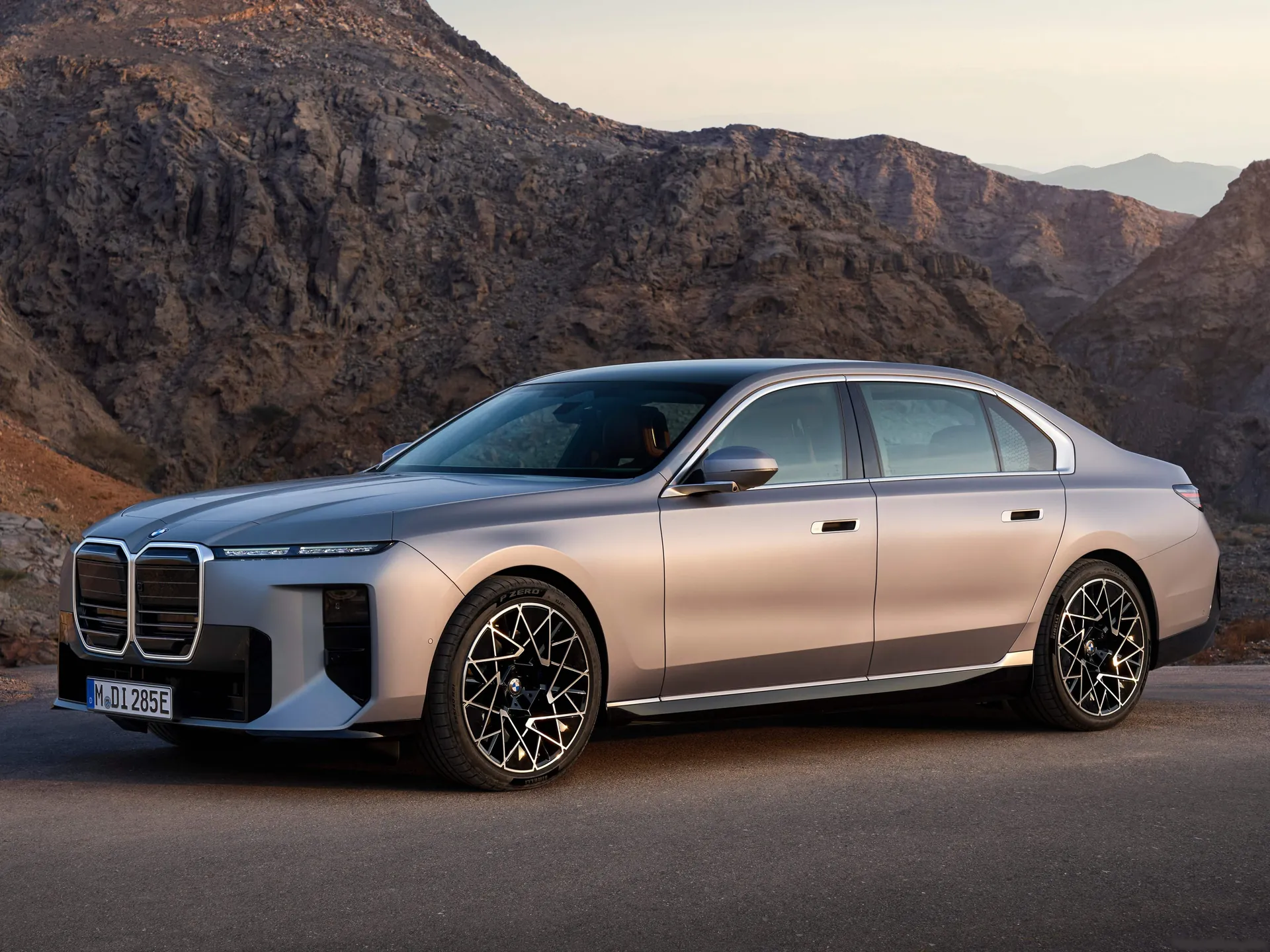
BMW 545i
For seven model years, the 4th-generation BMW 5-Series - BMW internal code E39 - won virtually universal praise from critics and customers alike. Remarkably, even during its final calendar year, BMW's "middle Series" defied convention by achieving higher U.S. sales than in the previous year. This doesn't "just happen" with a car line approaching the end of its production life; instead, it reflects the soundness of this Series' concept and the excellence of its execution.
Thus the 5-Series, as we've known it in recent years, was truly a tough act to follow. But BMW knows how to follow tough acts; the new 5-Series - internal code E60 - proves this once again. Launched as a 2004 model, the new Series broke new ground while remaining faithful to the tradition it has built since the first 5-Series models made their debut in 1972.
Excitingly new, yet true to the 5-Series tradition
Following the '02 debut of the new 7-Series and '03 launch of the Z4 Roadster, the new 5 takes BMW's "new look" to another vehicle category; yet upon the very first glance one knows that this is a BMW 5-Series.
Also in the BMW tradition, this is not merely a new look. For one thing, the new 5 is a roomier car: Riding on a wheelbase 2.3 inches longer than before, these new Sedans are 2.6 in. longer and 1.8 in. wider than their predecessors, as well as 1.3 in. taller. These dimensional gains result in greater rear seating space and comfort; entry into the rear seating compartment is easier, and there's fully 26% more trunk space.
And yet the new 5 preserves the trim look and driving feel, the maneuverability and agility that have always been a core value of the 5-Series. Contributing to this achievement is an all-aluminum front-end structure that allows the size increase, comfort and safety advances, and enhanced feature content with actual model-for-model decreases in overall vehicle weight.
Now moving into its second model year, the new Series continues in three models, each with its specific engine. The 525i Sedan ($41,995 including destination charge) is powered by a responsive and fuel-efficient 2.5-liter, 184-horsepower inline 6-cylinder unit that belies any thought of "entry-level" status. The 530i Sedan ($46,095) again offers a step up in 6-cylinder power (3.0 liters, 225 hp) and additional standard equipment over the 525i. And the BMW 545i Sedan ($56,495) derives its model designation from the remarkable Valvetronic engine, a 4.4-liter V8 delivering 325 hp.
Each model is available with a choice of 6-speed transmissions: manual, STEPTRONIC automatic and - for the 530i and 545i - a Sequential Manual Gearbox (SMG). Each is available with a wide range of optional Packages and stand-alone options, many of them new and innovative. And every new 5-Series offers, as either standard or optional equipment, exciting new technology - including the BMW 545i's Valvetronic engine, Active Roll Stabilization as part of each model's Sport Package, and Xenon Adaptive headlights (optional on 525i and 530i, standard on 545i). All three models come standard with Adaptive brakelights and an evolved iDrive driver/vehicle interface; all offer appealing options such as run-flat tires, a Head-Up Display, Active Cruise Control and BMW's unique Active Steering.
Under the aluminum hood: velvety inline 6-cylinder or V8 power
Each 5-Series model includes a powertrain that brings together exciting and effective new combinations and significantly advances BMW's state of the art.
The 525i and 530i are powered by 2.5- and 3.0-liter versions of the M54 inline
6-cylinder engine, a BMW hallmark as well as a never-ending source of critical praise and owner satisfaction. In its January '04 test of the 530i, Car and Driver declared this BMW engine "as ever, spectacularly smooth and spectacularly torquey" while according its quietness this left-handed compliment: "Our only quibble is that we can barely hear its rousing trill of an engine note. At full throttle it is now the quietest car in its class at 71 dBA."
Both of these "sixes" incorporate new fine-tuning of the intake and exhaust systems to enhance their response at low to medium speeds. The 525i engine delivers 184 hp, 175 lb-ft. of torque and a 0-60-mph time of 7.8 seconds with its standard 6-speed manual transmission, 8.2 sec. with the 6-speed automatic. With 225 hp and 214 lb-ft. of torque, the 530i achieves a 0-60-mph time of just 6.6 sec. with manual transmission, 6.9 with automatic.
Both these engines include many notable engineering features:
The BMW 545i is powered by BMW's advanced 4.4-liter N62 V8 engine, which delivers 325 hp. With the 6-speed manual transmission, official BMW data indicate a 0-60-mph time of just 5.7 sec.; Car and Driver recorded 5.5 sec. in its May '04 Short Take test. Again referring to BMW data, with the automatic the 545i comes within just a fraction of a stopwatch tick at 5.8 sec.
Equally remarkably, the BMW 545i achieves official EPA ratings of 17 mpg city/25 mpg highway with the manual transmission; 16/24 with SMG; and fully 18/26 with the 6-speed STEPTRONIC automatic. How BMW achieved such a combination of power and fuel economy is unique and fascinating:
Valvetronic: revolutionary "breathing" concept. Many engines now have variable valve timing, including all of BMW's. Some also vary valve lift. Valvetronic varies lift - but to a far greater, more fundamental degree than any other system. Indeed, engine breathing is controlled entirely by the valves, and the traditional throttle butterfly simply goes away.
The Valvetronic mechanism sits atop the intake valves on both of the V8's cylinder banks. Each of the engine's 32 valves is actuated as the camshaft lobe deflects a finger-type rocker arm. On the intake side, there is an added element between the cam lobe and rocker arm, an intermediate follower.
Upon contact by the camshaft lobe, this follower actuates the rocker arm and, in turn, the valve. The follower is held in place by an eccentric shaft that can be rotated by a small servo motor. This shaft, which rotates in response to the driver's accelerator-pedal movements, determines the intermediate follower's pivot point and thus varies the valve lift. The system's highlights:
Responding to operating conditions and the driver's demands for power, Double VANOS rotates the intake and exhaust camshafts steplessly between "earliest" and "latest" valve timing. In combination with Valvetronic, this variable valve timing helps achieve new levels of performance, efficiency and general operational excellence.
Fully variable intake manifold: another major new technology. The 525i and 530i engines employ 2-stage intake manifolds, with a flap mechanism that switches between two paths for air entering the engine: one tuned for low- to medium-speed operation (improving torque and response), the other for high-speed operation (improving top-end power).
For the N62 engine, BMW engineers conceived a system with two intertwined helical elements which, rotated by an electric servo motor, vary the effective intake length steplessly. Like Valvetronic and stepless Double VANOS, this manifold concept eliminates traditional compromises to achieve truly optimum performance.
Enhances performance and active driving pleasure. Compared to the 5- and 6-speed manual gearboxes of the predecessor Series, it offers:
As in all other current BMW models, this state-of-the-art transmission incorporates STEPTRONIC, with Manual and Sport modes. Its six speeds complement the engines' wide rpm range, facilitating a virtually seamless flow of power and providing a relaxed 6th gear for cruising at Interstate and freeway speeds.
6-speed Sequential Manual Gearbox (SMG), 530i and 545i
This is an electrohydraulically shifted, electronically controlled rendition of a 6-speed manual transmission, including an automatic clutch; as such it is an utterly different type of transmission from a conventional automatic such as the STEPTRONIC unit. There is no clutch pedal; the driver selects the desired mode (N, R, D) with a console-mounted selector lever, and can execute manual shifts via that lever or two "paddles" on the steering wheel. The fundamental advantages of SMG are that it fully preserves the performance of a manual transmission, yet facilitates both automated and very sporty driving.
Features and characteristics of the SMG driver interface include the following:
In D, shifts are automatic, and programmed according to how the driver is currently driving: More aggressive driving results in shift points at higher speeds. D is not to be interpreted as a substitute for the Drive range of a fully automatic transmission, but rather a convenient operational mode for those times when the driver wants ease of driving and is not primarily concerned with extracting maximum performance.
In the Sequential mode, operation is driver-initiated:
Engaging the Sport program via the Sport button on the console influences shifting as follows:
In the Sport program, throttle action is also "quicker"; that is, a given amount of movement at the accelerator pedal produces more engine response. An instrument-cluster display tells the driver which of the six speeds is currently engaged. In D, it also shows a "D."
Handling and riding comfort: once again advancing the state of the art
With its rigid structure, advanced aluminum suspension system and the fine-tuning at which BMW is famously capable, the 5-Series again advances BMW's unique combination of handling prowess and supple riding comfort. As always with new BMW vehicle generations, the chassis/body unit's structural rigidity has been further improved. The aluminum suspension is further evolved, and a revolutionary new steering system is offered optionally.
Aluminum front suspension, variable-ratio rack-and-pinion steering
The front suspension is of the double-pivot type, a unique BMW system that has proved its handling stability and response in upper-end BMWs such as the 7 and previous 5-Series. A further benefit derives from the reduced unsprung weight of aluminum, which optimizes the suspension's response to irregular road surfaces; this helps the suspension engineers achieve a supple ride in combination with precise, responsive and enjoyable handling.
Other aluminum components, though not part of the suspension, further contribute to overall weight savings: engine mounting brackets, transmission crossmember and mounting brackets, power-steering pump housing.
The 5-Series rack-and-pinion steering system has the special feature of variable ratio. Its rack's teeth are profiled to make the steering ratio become quicker as the wheel is turned outward from its center position. This fine-tunes the steering response according to the situation one is in, be it on a fast straightaway or maneuvering into a parking space.
Active Steering is a revolutionary new development that's included in the Sport Package for each model, and also newly available as a stand-alone option; it is described in the options & accessories section of this release.
Rear suspension system: careful evolution of BMW aluminum multi-link concept
As at the front, the new 5-Series shares its rear suspension concept with the 7-Series; this is BMW's highly sophisticated multi-link Integral system.
Here, in a continuation of existing 5-Series practice and sharing componentry with the current 7-Series, aluminum is again extensively employed. Because supple reaction of the suspension to bumps is especially critical for good road adhesion of the powered rear wheels, the benefits here are if anything more important than at the front. Aluminum components include:
The aluminum subframe, which carries the entire rear suspension system and final drive (differential), is mounted to the main structure with four large rubber bushings that help absorb road shocks. The final drive unit is mounted to the subframe through its own rubber bushings. With these two stages of vibration and noise absorption between it and the body, the differential is acoustically decoupled from the body, minimizing any gear noise heard inside the vehicle.
Conventional anti-roll bars standard, Active Roll Stabilization optional
In standard form, all models have conventional anti-roll (stabilizer) bars, which are as always carefully calibrated for an optimum combination of response and stability. BMW's innovative Active Roll Stabilization (ARS), first introduced on the 7-Series, comes to the 5-Series as part of the Sport Package and makes for amazingly "flat" cornering; it is described in the options & accessories section of this release.
Ventilated disc brakes: more stopping power and new weight-saving technology
Compared to the already powerful and fade-resistant brakes of the predecessor Series, the brakes of each 5-Series model are generously dimensioned for powerful braking performance:
All discs are ventilated. On the 6-cylinder (525i/530i) models, their cast-iron rotor construction has been optimized for a modest weight reduction. On the BMW 545i, an innovative weight-saving construction is employed.
In this aluminum/cast-iron construction, patented by BMW, the brake rotor consists of two components: the high-carbon cast-iron outer portion, which functions conventionally as the surface onto which the brake pads grip; and an aluminum "hat" in the center, which mounts the rotor to the vehicle. Advantages include:
All 5-Series front brake calipers are made of aluminum, which also reduce unsprung weight; the 525i and 530i have aluminum front and rear calipers. Thus in this respect too, BMW has maintained or extended its lead in reducing unsprung weight - a lead opened by the predecessor 5-Series that helped set new standards in combining top handling with amazing riding comfort.
Wheels and tires: upgraded all around, two choices for each model
Each model offers a choice of wheel-and-tire equipment: standard and Sport Package. Run-flat tires appear as part of all Sport Packages; new for '05 are 17-in. wheels and tires on the 525i, an upgrade from 2004's 16-in. equipment that brings the standard wheels and tires of all three models up to the same dimensional level
In their design and configuration, the self-supporting tires are distinguished primarily by their special sidewalls, which include specific inserts and highly heat-resistant rubber compounds. These features allow a deflated tire to maintain its essential shape and guidance characteristics for a considerable distance, so that when confronted with a flat the driver can continue on until reaching a convenient and safe place to have the tire repaired or replaced.
All models are equipped with a Flat Tire Monitor (FTM). Whenever tire pressure drops by 30% or more, the tire's rolling radius changes significantly; this means the wheel will rotate at a different speed from the other tires on the vehicle. FTM measures wheel rotation via the Dynamic Stability Control (DSC) system's wheel-speed sensors, recognizing any major deviation in wheel speed (and therefore tire pressure). Within a short time, the system triggers a pressure-loss signal via an indicator in the instrument cluster and an audible warning.
All models also come standard with a space-saver spare wheel/tire unit, which contributes to increased trunk space. Models equipped with run-flat tires retain the spare.
Dynamic Stability Control in its latest form
DSC appears in state-of-the-art form (version 8.0) in the 5-Series, incorporating programming refinements as well as the Dynamic Traction Control (DTC) function that first appeared in the 7-Series and is now included in the 3 and Z4 Series.
Activated by pressing the DSC console switch briefly, DTC improves utilization of available road traction under specific conditions:
With DTC selected, engine intervention is de-activated at low speeds, leaving only the individual wheel brakes to control wheelspin. When the vehicle reaches a speed of approximately 43 mph, normal DSC operation is re-instated until speed once again drops below this threshold. A longer push of the DSC button de-activates all DSC functions except antilock braking.
The look: esthetics and function in harmony
The new 5-Series body is tightly dimensioned, with short overhangs, lean-forward dynamics and compact overall size. This is 5-Series tradition - the unique combination of sedan practicality and BMW sportiness that has characterized the Series through its previous four generations.
If the concept is traditional, the "design language" is new; though by no means a resized version of either, the new 5 is clearly consistent with BMW's other recent new designs, moving decisively into the future.
Starting at the front: The "kidney" grilles, a strong link to BMW tradition, are up-front and prominent, surrounded by painted surfaces and flanked by "quad" headlights (with BMW's popular luminous rings) under break-resistant clear covers. The body sides are ultra-clean, deriving esthetic interest not from multiple lines and trim but from a complex interplay of concave and convex surfaces.
Deeply wrapped-around lighting units at the front and rear not only add visual interest, but perform their functional duties admirably. The turn signals have clear lenses front and rear; the front parking lights are a thin, wedge-shaped "eyebrow" of amber LEDs. Window areas are generous and incorporate the traditional BMW "reverse kink" in the rear door window, while allowing for beefy roof pillars that contribute to meeting customers' expectations of excellent accident protection.
At the rear, the 5-Series expresses BMW's contemporary trunklid concept - featuring a high lid for increased cargo capacity and excellent aerodynamics - with a flowing integration into the silhouette and attractive, highly functional taillight wraparounds.
Functional innovation: Adaptive brakelights
Adaptive brakelights made their world debut on the 7-Series; in the meantime they've appeared on all other BMW Series.
There are two taillight segments per side. In normal braking, these same two segments illuminate more brightly. Under heavy braking or anytime the ABS goes into action, round segments at the inboard side of each taillight unit illuminate to enlarge the total brakelight area. Following drivers are thus alerted to sharp braking by the BMW driver.
Aluminum/steel construction: More than just the look is innovative
By employing aluminum for the entire front end - structure as well as skin - BMW's body engineers have pared approximately 44 lb. off the body/chassis shell's weight while simultaneously improving its strength and occupant protection. This is the most extensive use ever of structure-and-skin aluminum in a regular-production BMW: The 7-Series employs aluminum for its hood and front fenders, and the Z8 Roadster (whose production was completed in '03) was all-aluminum but built in very small quantities.
Building the Z8 and aluminum body components for other current models has given BMW considerable experience with this weight-saving, effectively energy-absorbing material. Bringing structural steel and aluminum components together posed new challenges, especially with regard to maintaining BMW's excellent corrosion resistance: if steel and aluminum are directly joined, galvanic action can cause corrosion at the junctions.
According to the materials being joined, three types of joints appear in the main structure:
As is customary at BMW, nearly all steel panels are galvanized. Aluminum components receive a titanium/zircon coating that hinders oxidation and ensures clean, smooth surfaces for bonding with adhesives.
Once fully constructed, the body structure is dipped in a phosphate bath and then in a cathodic primer. Even in such immersion this primer may not reach every last nook and cranny, so all contact points between aluminum and steel are bonded together with the adhesive fully covering the joint - indeed, protruding at least 1 mm outside the joint. Thus direct contact between the aluminum and steel is completely avoided. Altogether, aluminum accounts for approximately 15% of the body/chassis structure.
Other weight-reducing techniques flowed into the new 5's body engineering. All four wheelwells incorporate textile inserts that eliminate the need for separate sound insulation, saving about 35% on weight in this area. The underbody is not only smoother than ever (for aerodynamics) but some 40% lighter, thanks to a new protective cladding material called Superlite. All models have an aerodynamic drag coefficient of 0.29, as compared to 0.29-0.31 for the various predecessor models.
BMW of North America schools personnel at the body shops of its BMW Centers so that accident damage to the aluminum structure and skin can be repaired competently throughout the U.S.
The cabin: space, advanced technology and appealing new materials
More space, particularly for rear-seat passengers, is an important facet of the new 5-Series interior:
Yet greater space for people and cargo is only one aspect of the new cabin. Its design is just as fresh as that of the exterior, and as always with BMW there is a wealth of new, thoughtful ideas to make the going even more comfortable, pleasant and esthetically satisfying than in the new 5's estimable predecessor.
Cockpit design: flowing lines, tasteful color schemes
The dash design is dominated by a "double wave" theme in two portions: one over the instrument cluster, defining the driver's area; and another that begins over the dash center and sweeps toward the right side. Maintaining an important BMW tradition, the instrument cluster is dominated by two main dials for the speedometer and tachometer; analog fuel and fuel-economy gauges appear at the bottom of these dials. The tachometer includes a variable warning segment: Its "caution" band extends downward to 4200 rpm when the engine is cold, then gradually increases the rpm limit to normal as the engine warms up.
At dash center is the display for the evolved iDrive control system, with ventilation outlets and "hard" climate controls below it, and basic audio controls farther down. Both front cupholders are positioned to the right of the center console, with the driver's holder swinging out to the left when opened.
A three-spoke steering steering wheel is standard in all models. Multi-function controls - including two switches that can be programmed by the driver to perform different functions - are conveniently arrayed on the wide horizontal spokes; the wheel incorporates quick-moving tilt/telescopic power adjustment and automatic tilt-up for ease of exit and entry.
Base equipment in all U.S. models is a simplified version of the iDrive system first seen in the 7-Series, with a 6.5-in. color monitor displaying 256 colors at 400 x 240-pixel resolution. Its controller provides four menu directions: Communication, Car Data, Entertainment and Climate.
iDrive Displays and control functions have been refined and optimized. There is an aluminum controller knob on the console, accessed equally conveniently by the driver and front passenger; this is complemented by a Menu button, which when pressed recalls the main menu or previous menu, depending upon the function being performed. A fifth " i " menu, not indicated on the main menu, is reached by pressing the controller while in the main menu; this allows users to choose settings and even turn off the monitor.
An optional GPS Navigation System, described under options, substitutes a larger monitor and includes additional iDrive functions.
All U.S. models come standard with a system which achieves even stronger heating and air-conditioning performance than its already capable predecessor, suited to the demands of the U.S. market. The system includes the following features:
Two audio systems are offered: standard and the optional Premium Sound Package, which includes a 6-disc CD-changer and Logic 7 Surround Sound simulation; for details see options.
The standard AM/FM/CD system includes 10 speakers, including two subwoofers optimally positioned at the bases of the B-pillars; this placement utilizes cavities in the body structure, a principle patented by BMW. Continuing in enhanced form is a reception-enhancing diversity antenna system; its amplifier has been moved to a more ideal position, closer to the antenna circuits. A fin-type roof-antenna housing serves the available phone system, Navigation System and SIRIUS Satellite Radio.
The 6-disc CD changer, available separately or as part of the Premium Sound Package, is positioned at the forward end of the glove compartment.
Formerly included with the optional Navigation system, these amenities are now standard in all 5-Series models. The SOS (Emergency) button is in the roof console; when it is activated, the hardware transmits the vehicle's location (via standard GPS technology) and the customer's phone number, as well as vehicle information, to the BMW Response Center for assistance.
Upholstery, trim and seating: appealing choices
The 6-cylinder models 525i and 530i come standard with leatherette upholstery; luxurious Dakota leather is standard in the V8 545i models and optional in the 525i and 530i. Dark Poplar wood trim is now standard in all models; an alternative wood finish, the distinctive gray Maple Anthracite, is available at no extra cost.
As before, 10-way power front seats are standard in all models, as is a memory system for the driver's seat, steering wheel and exterior mirrors. Seating options include 4-way power lumbar support (standard in 530i and 545i, optional in 525i), sport front seats (Sport Packages) and 20-way Comfort seats as well as heated front and rear seats. For details on availability, see options.
Extensive storage space is provided throughout the interior. Between the front seats is a two-part center console compartment; its upper portion can accommodate a phone handset, and the lower part is climate-controlled. A padded lid on the left side is adjustable fore-aft to give the driver two armrest positions.
The rear seat is offered in standard and split-folding forms, the latter released from inside the trunk for effective security. The trunk can accommodate four golfbags laterally, and employs single-link tubular hinges that eliminate any intrusion into the trunk space.
Safety and security: meaningful evolution of an award-winning concept
The 1997-2003 5-Series was widely recognized for its excellent occupant protection; it pioneered BMW's highly effective Head Protection System for front-seat occupants. For the new 5-Series, BMW's Research and Engineering Center in Munich, Germany carefully evolved the line's established safety concept.
Both front-impact airbags, for example, have been further developed to optimize their 2-stage, accident-severity-dependent deployment characteristics, their inflated shape, and their interaction with surrounding surfaces and components.
Front and rear Head Protection System newly engineered
The new Series adopts AHPS II, the integrated front-rear Advanced Head Protection System. AHPS II extends all the way from the A-pillar to the C-pillar, with a "sail" connecting the inflatable tube to the roof structure between these two end points. The sail is of airbag-type material; between it and the long inflatable tube itself, essentially all body-side and side-window areas likely to be impacted by an occupant's head are covered by the system.
Active Head Restraints available for front-seat occupants
Included with the optional 20-way Comfort front seats, this feature enhances protection from neck injuries in rear-end impacts. Via two additional sensors, the front head restraints pivot forward into close proximity with the driver's and front passenger's heads; thus if they prefer, occupants can adjust the head restraints away from direct contact with their heads during normal vehicle use, yet in the case of a rear-end impact gain optimum protection.
Ultra-sensitive "satellite" side-impact sensors
By sensing pressure change (rather than deformation) within the door structure, these sensors trigger deployment very early in a side impact, yet still minimize the chance of an unwanted deployment.
This familiar BMW feature employs diagonally positioned aluminum reinforcing bars in each door to strengthen the body side. At the aft end of each bar is a hook-like member that, in the event of a serious side impact, hooks into the body as the door deforms. The system is designed so that after most impacts, elastic snap-back releases the hook and the doors can be opened.
Intelligent Safety and Information System (ISIS)
An overall system for controlling the vehicle's safety systems and devices. ISIS is a decentralized system, with an overall Safety Gateway Module (SGM) and seven subordinate control units, each with a microprocessor of its own. This multiplicity of units provides a redundancy that helps preserve system reliability even when portions of the system might be damaged by accident forces. In interaction with the main and subordinate units, ISIS employs fully 14 sensors, which together achieve remarkable "tailoring" of the deployment of airbags, Battery Safety Terminal and safety-belt tensioners to actual accident circumstances.
Supporting the ultra-sophisticated electronic control scheme itself, fiber-optic cables are not susceptible to extraneous electromagnetic disturbances. System software can be updated over the life of the vehicle.
Options: an appealing array of Packages and individual choices
The range of factory options and BMW Center-installed accessories is multi-faceted. Some options, like the Premium and Cold Weather Packages and the stand-alone leather option for the 6-cylinder models, are continuations of familiar 5-Series offerings. Others, such as Active Steering and Active Cruise Control, arrived with the new 5-Series in 2004.
Adds to the 6-cylinder models features that are standard in the V8 BMW 545i:
Essentially the same for all models but with different wheel-and-tire equipment for each models. Includes some of the Series' most exciting new technology.
The Cold Weather Package for all models includes:
A significant step up from the already excellent standard audio equipment, including:
Newly available as a stand-alone option for customers who desire this feature but not the Sport Package.
Employing a radar sensor at the front of the vehicle, ACC senses the speed of vehicles traveling ahead, and adjusts speed to maintain a safe following distance.
When the road is clear, operation is essentially as with the standard cruise control, though with certain specific nuances:
When traffic is encountered ahead, ACC's special capabilities come into play:
ACC can also reduce vehicle speed when a curve is entered at too high a speed. However, the system does not "look ahead" to curves, so any such adjustment occurs only after the curve is entered. In sharp curves, ACC may react briefly to oncoming vehicles; the driver can cancel this action by stepping on the accelerator.
Park Distance Control (optional 525i and 530i, newly standard on 545i)
Employing four ultrasonic sensors each in the front and rear bumpers to warn the driver when the vehicle is approaching obstacles that may not be visible to the driver.
Xenon Adaptive headlights with dynamic auto-leveling (optional 525i and 530i, standard 545i)
Adaptive Light Control (ALC) literally "aims" at making night driving safer. With the headlight switch in its Automatic position, as soon as the vehicle is moving forward, the outboard lights steer with the front wheels, guided by an electronic control system and swiveled by small servo motors. The system responds not simplistically to the steering angle, but also to vehicle speed and the "yaw rate," or the rate at which the vehicle's direction is changing. The driver benefits from enhanced night vision around corners and curves. If the vehicle is stationary or backing up, the feature is inactive.
The Xenon lights include dynamic auto-leveling, which corrects the lights' aim not only for loads carried in the vehicle, but even for transitory acceleration and braking.
Head-up Display (all models; requires Navigation System)
Displays important information in color on a 6- x 3-in. field in the windshield. A virtual image is projected from the top of the instrument panel, appearing approximately in line with the end of the hood in the driver's line of sight so that the driver can observe the information with essentially no diversion of attention from the road ahead. Via the iDrive monitor and controller, the driver decides which information is to be displayed and the brightness of the display; the display can be de-activated via a switch on the instrument panel.
Information of the following categories can be displayed:
In addition to the basic brightness selection, the display's brightness is also automatically regulated according to ambient light and moisture conditions via the sensors that govern the automatic headlight control and rain-sensing wipers. Settings chosen by the driver are re-captured by the Vehicle and Key Memory when that individual user unlocks the car.
With Dark Poplar wood interior trim now standard in all models, this distinctive gray-tone wood is available at no extra cost.
Described earlier, these seats incorporate 20-way power adjustment and memory for both driver and passenger. In the 525i and 530i, they require leather upholstery.
Split folding rear seats and ski bag (all models)
The seats are split 60% left/40% right; the center-positioned ski pass-through and bag are part of the 60% segment.
Rear-seat heating (all models; requires Cold Weather Package and leather upholstery)
This upholstery is also available as a stand-alone option for 525i and 530i models not equipped with the Premium Package.
BMW On-board Navigation System (all models)
Vehicles with this option get an iDrive version with a larger (8.8-in.) monitor, a controller incorporating Force Feedback for enhanced tactile feel, and other distinctive features. One such feature is BMW's Voice Command System, which can be used to control the -
Sirius beams programming to satellites orbiting the earth; Sirius-equipped vehicles receive the programming. Except where reception is physically blocked, users can enjoy the same programs anywhere in the continental U.S. Includes 65 original channels of commercial-free music of virtually every genre; 50 sports, news and entertainment channels; and live NFL and NHL games. Customer activation is necessary and a monthly fee applies. Also optional is factory vehicle preparation so that the SIRIUS system can be installed later by a BMW center.
Power rear sunshade and manual rear side-window sunshades (all models)
The rear-window shade is controlled from a console switch; dual-segment side-window shades cover the lowerable door windows and the fixed quarter panes.
Rear-seat side-impact airbags (all models) are offered as an option so that customers may make the choice. This option also includes automatic tensioners on the rear outboard safety belts.
A BMW center-installed cradle accommodates any Motorola V60c phone, or the customer can acquire a BMW-specific version of the V60c whose functionality BMW guarantees. Vehicles are appropriately pre-wired at the start of production; actual phone-system installation is relatively simple.
Like all current models, each 5-Series vehicle is covered by BMW's 4-year/50,000-mile limited warranty - and continues to come with a standard 4-year/50,000-mile Full Maintenance Program for customer convenience, peace of mind and economic benefit.
BMW strives to produce its motor vehicles and other products with the utmost attention to environmental compatibility and protection. Integrated into the design and development of BMW automobiles are such criteria as resource efficiency and emission control in production; environmentally responsible selection of materials; recyclability during production and within the vehicle; elimination of CFCs and hazardous materials in production; and continuing research into environmentally friendly automotive power sources. Tangible results of these efforts include the recycling of bumper cladding into other vehicle components; water-based paint color coats and powder clear coats; near-future availability of hydrogen-powered models; and various design and engineering elements that help make BMWs easier to dismantle at the end of their service life.