Audi SQ9
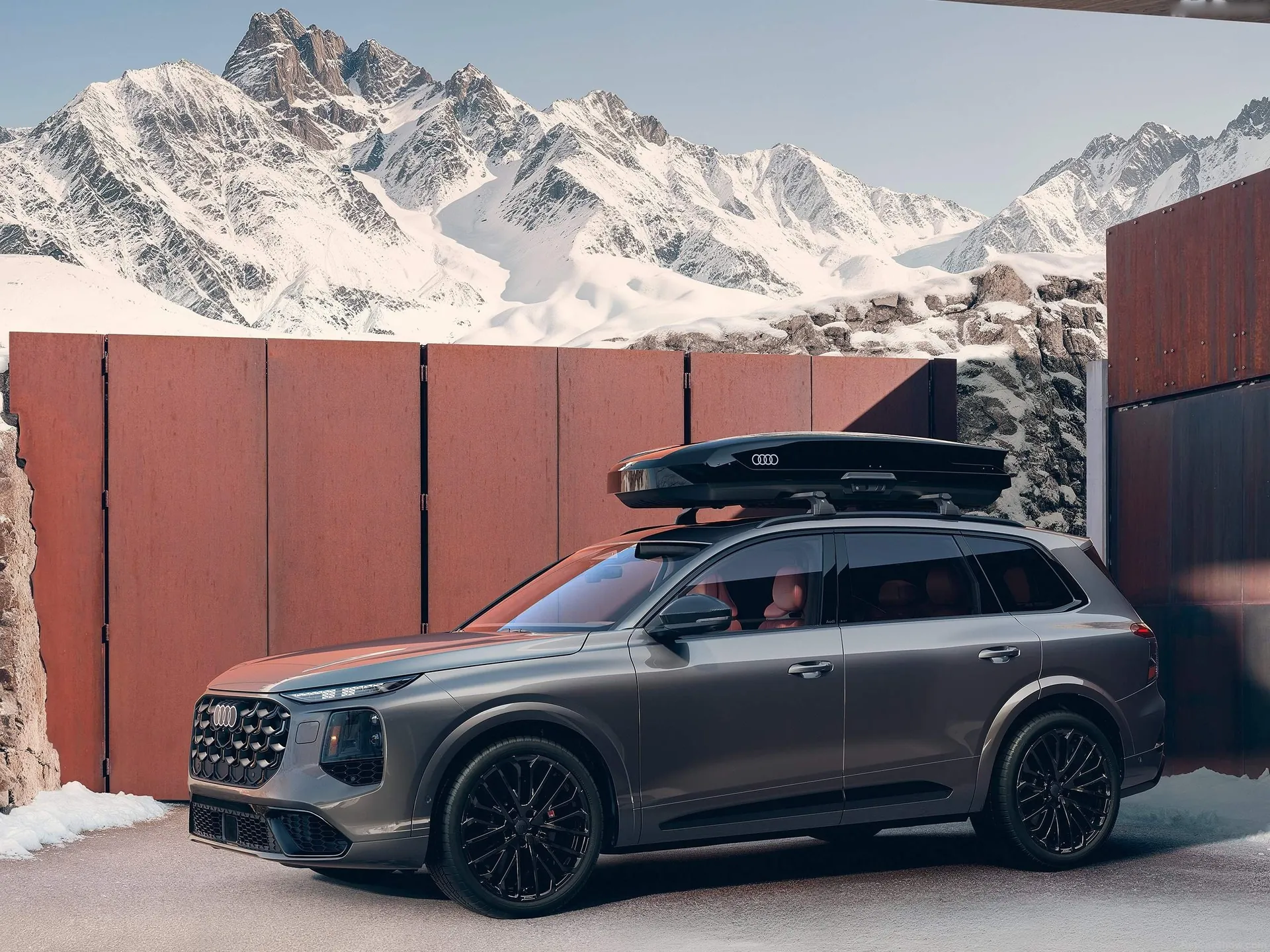
Audi debuted its first-ever SQ9, a spacious three-row SUV built for the U.S. market and the performance halo for the brand's full-sized SUV flagship Q9 model family. Delivering 591 hp (441 kW) and best-in-class 0-60 mph acceleration in 3.8 seconds, effortless performance comes standard in the SQ9. Launching in the fourth quarter of 2026, the Q9 and SQ9 represent a focused commitment to deliver a vehicle designed to meet the needs of U.S. buyers as well as those seeking a prestigious flagship SUV with effortless performance.
The Audi SQ9 is powered by a revised 4.0-liter twin turbo V8 producing 591 hp and 590 lb.-ft. of torque, delivering 0-60 mph in 3.8 seconds - making it the quickest accelerating three-row SUV to 60 mph in its class. The engine is paired with an eight-speed Tiptronic transmission and Audi quattro with electronically controlled rear-axle differential lock. Thanks to its new rear-biased architecture, the SQ9 delivers a very dynamic driving experience while offering the benefit of comfort and spaciousness for six or seven passengers. An electromechanical clutch modulates torque flow between the front and rear axles. When needed for dynamic driving, the system can send almost all available torque to the rear. An electronically controlled locking rear differential and a staggered-width tire setup mounted on wheels sized up to 23 inches with available summer tires further enhance traction and cornering precision. Thanks to an optional integrated tow hitch with a removable cover, the SQ9, like the Q9 offers heavy-duty towing capability of 7,700 pounds.
Many comfort features large and small make the Audi SQ9 and Q9 joys to use every day. The model family comes standard as a seven-seater with three rows of seating; two captain's chairs are available for limousine-like comfort in the second row which also provide easy access to the third row. Automatic electric-assisted power doors and five-zone climate control are available, and eight USB charging ports throughout the cabin add to the usability and comfort offered to passengers. The largest panoramic sunroof ever fitted to an Audi enhances comfort and ambiance. In the SQ9, the roof spans more than 16 square feet and features a power-opening function as well as switchable transparency with nine individual segments for maximum customization. An optional illuminated panoramic sunroof is also planned for availability after the model's launch.
Second-row seats - whether in six- or seven-seat configuration - are power-adjustable and can tilt forward, even with unoccupied front-facing child seats installed, providing unobstructed access to the third row. The seven-seat configuration for the SQ9 offers three mounting points for LATCH child seats in the second row and two mounting points in the third row as well. With an overall length of 208.9 inches, the SQ9 provides 19.3 cubic feet of cargo space behind the third row, expanding to an impressive 87.7 cubic feet with the second and third row seats folded.
Matrix LED lighting comes to the U.S. for the first time
The Q9 model family introduces several Audi lighting technologies to the U.S. market for the first time, most prominently adaptive driving beam functionality enabled by the Digital Matrix LED headlights that limit glare for vulnerable road users. With the introduction of the all-new, full-size, 2027 Q9 family of flagship SUVs, Audi engineers have developed a system which meets the United States' Department of Transportation (DOT) regulations for glare, while simultaneously delivering the high performance of the adaptive systems already widely used in Europe for more than a decade.
The Digital Matrix LED headlights project light with maximum accuracy by selectively illuminating different road sections with varying brightness. As a result, the road stays illuminated without blinding oncoming traffic or cars ahead. Digital Matrix LED technologies are standard on the SQ9 and available on the Q9.
At the rear, available new third-generation curved digital OLED taillights can use symbols in the digital light signatures to communicate with other road users. In a world-first application of curved digital OLED technology in automotive taillights, their curved three-dimensional shape enhances both looks and visibility. The available illuminated Singleframe grille and standard front and rear illuminated Audi rings provide exterior light signatures unique to North American models that create an unmistakable fascia even at night.
Advanced turn signals for better visibility when turning
Advanced turn signals are another lighting highlight in the Audi SQ9, working in combination with the digital OLED taillights and Digital Matrix LED headlights. When turning or changing lanes at night, the advanced turn signals cast a stylized turn signal indicator onto the ground - in sync with the dynamic turn signals at the front and rear of the vehicle. This is more visible to other road users and is designed to significantly increase visibility for pedestrians, cyclists and other drivers versus a traditional turn signal alone.
U.S. deliveries are set to begin in the fourth quarter of 2026, with pricing starting at $118,000 for the SQ9 and $87,700 for the Q9, respectively.
Both models arrive very well equipped, with a comprehensive suite of premium features commensurate with the new full-sized Audi flagship SUV. Optional equipment packages and key standalone options are available to meet individual customer tastes.
The SQ9 produces 591 hp and 590 lb.-ft. of torque from a 4.0-liter twin turbo V8. Power is sent through an eight-speed Tiptronic automatic transmission. The result is 0-60 mph acceleration in 3.8 seconds, positioning the Audi SQ9 as the quickest accelerating three-row SUV to 60 mph available in its class. The power and torque of the SQ9 also helps maintain a key capability American buyers demand: towing up to 7,700 pounds, enough to tow boats or horse trailers, as well as multipurpose trailers for towing jet skis or motorcycles, for example.
Rear-biased dynamics with new quattro architecture
Befitting Audi heritage, quattro all-wheel drive is standard on both the SQ9 and Q9. The SQ9 is equipped with a completely new Audi drivetrain. It is now possible to actively distribute drive torque between the front and rear axles. The SQ9 also features an electronically controlled differential lock on the rear axle. This drive system is further enhanced by brake torque vectoring and standard rear-axle steering, resulting in optimal driving dynamics and traction in a variety of situations, combined with improved high speed stability and low speed maneuverability. This configuration focuses on enhancing vehicle dynamics, providing the vehicle with rear-wheel drive focused driving characteristics combined with the traction of all-wheel drive.
The quattro system continuously monitors driving conditions, vehicle behavior, and driver inputs, and is designed to adjust torque distribution in milliseconds. In more dynamic cornering situations, power can flow predominantly rearward, helping turn-in by making the car rotate into curves. When accelerating out of a bend, the quattro system is designed for optimum traction and maximum acceleration. In low-traction conditions, quattro sends torque to the front axle and offers the grip for which Audi is famous. The result is a more dynamic, rear-biased character than typical SUV all-wheel-drive systems, without sacrificing the strengths that make quattro so successful.
The SQ9 also has an electronically controlled limited-slip differential at the rear that manages torque distribution between the left and right wheels, enhancing traction during acceleration and improving stability during sporty driving. Combined with quattro with regulated rear-axle differential lock, power reaches the ground effectively even under hard acceleration.
Staggered tire setup provides exceptional acceleration and handling
The Audi SQ9 employs staggered-width performance tires - 10-inch front width wheels, 11.5-inch rear width wheels - on standard 22- and available 23-inch diameter wheels. 22-inch 285/40 front and 305/35 rear all-season tires come standard, while 285/35 front and 315/30 rear summer tires are fit to the optional 23-inch wheels. The wider rear tires work in conjunction with the rear-biased quattro system, optimizing grip for both acceleration and cornering while helping put 590 lb.-ft. of torque to the pavement. The staggered setup reflects the SQ9's performance-oriented engineering.
Six Audi drive select modes offer excellent bandwidth between comfort and dynamism
The drive select modes in the SQ9 leverage the strengths of the hardware to deliver a noticeably greater differentiation between comfort and dynamics; the new Audi drive select assistant adjusts its characteristics based on driving behavior and the driving situation.
This allows the SQ9 and Q9 to adapt from comfortable cruiser to dynamic performance SUV with ease. Available modes include balanced, comfort, dynamic, offroad, individual, and assistant. Each mode adjusts throttle response, transmission shift points, steering weight, suspension damping, ride height, and all-wheel-drive torque distribution - transforming the vehicle's character to match the driver's intent or the road ahead.
Air suspension: 3.5 inches of adjustment for comfort and capability
The Audi SQ9 comes standard with adaptive air suspension, pairing continuously variable damping with ride-height adjustment to balance comfort, performance, and utility. The system works automatically to suit the car's speed, load, and driving. The total range of adjustment between the lowest (Highway) and highest (Lift) modes is approximately 3.5 inches, resulting in a maximum ground clearance of 10 inches.
The air suspension brings maximum ride comfort to the performance-oriented SQ9 without compromising its dynamic capabilities. Damper valving is optimized for isolation and refinement, delivering a compliant ride over broken pavement while maintaining control during dynamic driving. An optional sport adaptive air suspension - part of the S sport package - is also available, making the SQ9 even more agile and versatile.
Rear-wheel steering: maneuverability meets stability
Rear-wheel steering is standard equipment on the SQ9, improving both low-speed maneuverability and high-speed stability. The system can steer the rear wheels several degrees in either direction, effectively shortening the vehicle's 123.5-inch wheelbase depending on speed.
The system requires no extra steps from the driver. At lower speeds - in parking lots or on tight urban streets - the rear wheels turn opposite the front wheels, reducing the turning circle. At highway speeds, the rear wheels turn in the same direction as the front wheels, improving stability during lane changes and enhancing composure in sweeping corners. Rear-wheel steering also supports avoidance maneuvers, helping the vehicle respond more predictably and precisely.
All SQ9 and Q9 models feature progressive steering at the front axle, with a variable ratio that adapts to vehicle speed and steering angle. At low speeds and small steering inputs, the system provides a quicker, more direct response for easier parking and maneuvering. At highway speeds and larger inputs, the ratio becomes more gradual, delivering stability and reducing the need for constant corrections. Engineers have also optimized the steering calibration in the SQ9; tuning it for sharper response and greater feedback, complementing its performance-oriented chassis setup.
Exterior design: commanding proportions, refined execution
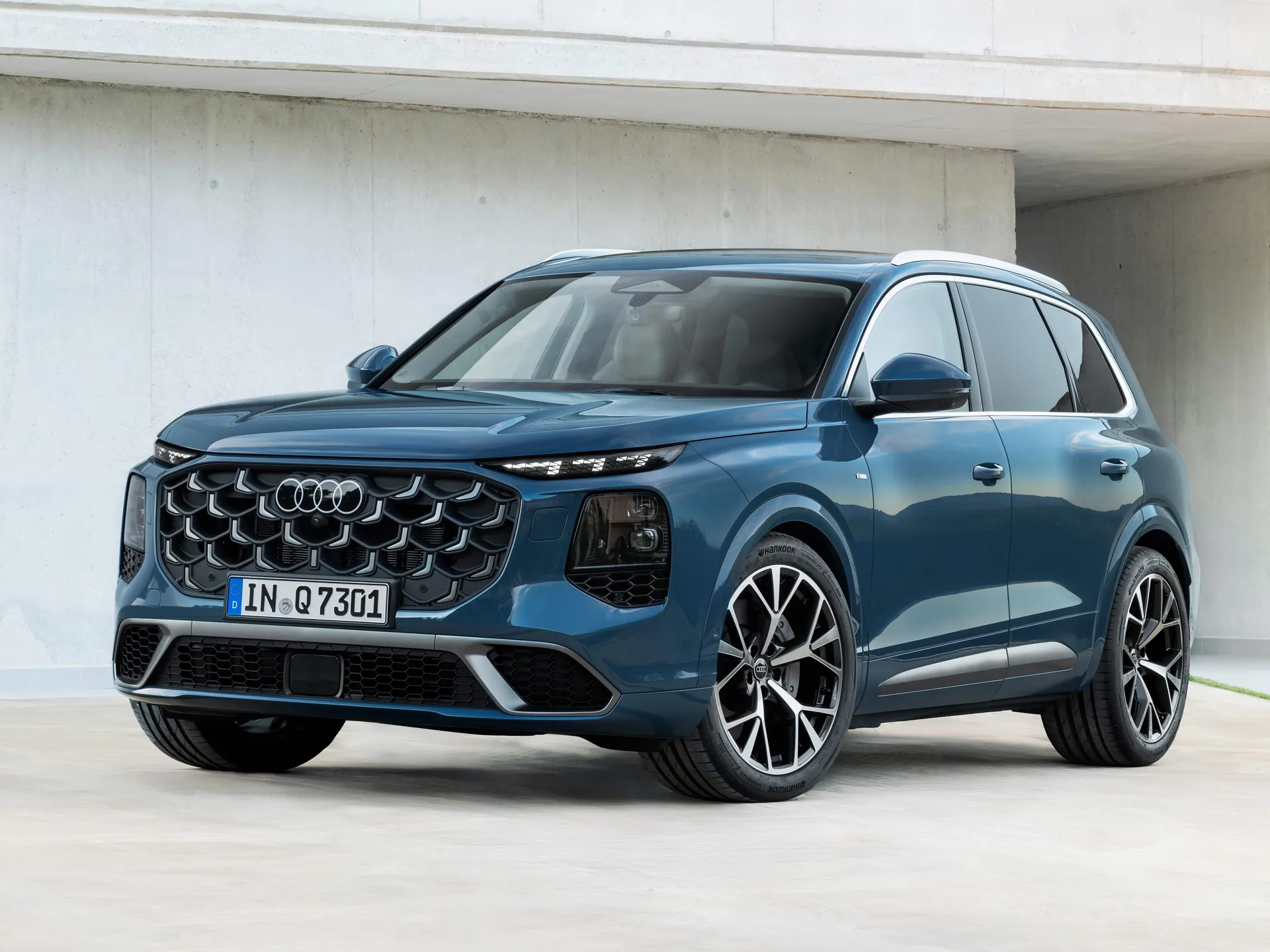
The design of both the Audi SQ9 and Q9 and their unmistakable road presence speaks to the model family's flagship position within the Audi portfolio. With a raised shoulder line, tall hood, and monolithic front fascia, the design confidently embraces the commanding presence of a full-size SUV while maintaining a clean, surface-focused aesthetic that defines the brand's design language.
With an overall length of 208.9 inches and a 123.5-inch wheelbase, the proportions of the Audi flagship SUV emphasize space and substance. A longer rear door and extended rear overhang visually signal roominess and comfort as much as they enhance interior volume. A straight window line stretches the profile and lends a sense of planted confidence. The elevated roofline rises subtly toward the rear, visually elongating the vehicle and emphasizing its three-row layout.
Rather than relying on athletic character lines or sharp creases, the exterior surfaces are deliberately calm and muscular, with softly modeled forms that catch the light without visual clutter. The effect is one of quiet confidence - an SUV secure in its presence rather than shouting for attention.
Vertical front and rear emphasize monolithic presence
The front fascia of the SQ9 integrates the Audi Singleframe grille and headlights into a unified black mask, creating an appearance that conveys prestige. The grille extends lower than on smaller Audi SUVs, giving the design more verticality and reinforcing the models' position atop the lineup. The lower sections are intentionally restrained, avoiding visual busyness in favor of clean, cohesive surfaces.
At the rear, the tailgate is left largely unadorned; the license plate is positioned low on the bumper. These deliberate design choices emphasize calm and refinement, creating a clean, expansive rear surface. Curved digital OLED taillights create a distinctive nighttime signature while supporting the clean aesthetic. The application of curved OLED panels in a production vehicle is a world first. A continuous light strip with illuminated Audi rings visually links the two taillights.
The Audi SQ9 builds on the design foundation of the Q9 with specific performance-inspired details that signal its 591 hp (441 kW) capability while maintaining its prestigious flagship character. Aluminum optic exterior accents - a well-known hallmark of S models - make a return. The front grille has a hexagonal pattern with emphasized inlays and aluminum accents. The SQ9's broader rear track and flared fenders are both functional and visual, accommodating the staggered-width performance tires and creating a planted, athletic stance.
At the rear, the SQ9 features signature S-model quad exhaust outlets. The rear spoiler is more pronounced than on the Q9 and has a distinctive design with two raised sections. At night, the available curved digital OLED taillights enable beautiful three-dimensional light designs.
The three sportiest wheel designs available are reserved for the SQ9. One 22-inch 5-double-spoke design wheel in a bicolor finish and two 23-inch Multispoke-S design wheels - one in bicolor finish and the other in black metallic finish - are available. From the factory, the 22-inch and 23-inch tires feature acoustic foam absorbers to reduce tire noise. Detail-oriented touches include color-matched wheel weights and silver or black valve stems and caps coordinated to the chosen wheel finish.
The interior: space, technology, and light
The Q9 model family is designed around North American expectations for large full-size SUVs: genuine three-row capability with adult-usable space in all three rows. Thanks to their overall size and wheelbase, they offer plenty of knee room in the second and third row. To maximize this effect, Audi positioned the second row seats further rearward and extended the rear overhang.
Automatic electric-assisted powered doors, five-zone climate control, and eight USB charging ports throughout the cabin address the practical demands of family travel. The largest electrically opening panoramic sunroof ever fitted to an Audi - spanning more than 16 square feet and featuring an electronically dimmable "virtual shade" with nine adjustable segments - enhances comfort and ambiance.
Second row seats - in both seven- and optional six-seat configurations with two individual captain's chairs - are power-adjustable and can tilt forward even with unoccupied front-facing child seats installed, providing unobstructed access to the third row. This function can be activated using physical buttons near the rear doors, as well as via the MMI.
On the seven-seat models, the seats are split 35/30/35 and all three feature mounting points for LATCH child seats, meaning up to three child seats can be installed side by side in the second row. The longer rear doors ease access to the third row, while power-assisted doors on all four corners add a premium touch and simplify entry and exit when hands are full.
All U.S. SQ9 models are built with premium essentials including heated seats in the first row and second-row outboard seats, as well as heated armrests; ventilated front seats with a massage function for the driver and front passenger are also standard, as well as heated third-row seating. All U.S. SQ9s also feature an integrated dashcam mounted under the rearview mirror as standard.
A new aluminum rail system on the sides of the trunk allows users to secure cargo with sliding hooks and adjustable tie-downs. Sequential folding buttons located at the rear right side allow the second and third rows to be folded remotely, while easy entry buttons provide quick and comfortable third row access. In models with seven-seat configuration, all second and third row seats fold completely flat via buttons in the rear doors and in the trunk. Depending on how many of the second and third row seats are folded, owners can achieve up to 87.7 cu. ft. of storage space.
Every SQ9 features the Audi Digital Stage MMI panoramic display - a seamless display architecture spanning from the driver's instrument cluster to the center console. It includes the Audi virtual cockpit plus as well as the 14.5-inch MMI touch display and is further augmented by the standard head-up display. The digital stage furthermore consists of a large 12.3-inch MMI front passenger display that provides screen space for media, navigation, and vehicle information without distracting the driver thanks to its active privacy mode. The MMI interface integrates Amazon Alexa. Around the displays and stretching all the way to the front doors, a combination of wood and soft material wraps the front passengers in a cocoon of craftsmanship and quality.
Beginning below the center display, the redesigned and versatile center console in the SQ9 offers flexibility: it features innovative magnetic wireless charging solutions for cell phones, such as a dual charger for two smartphones compliant with the Qi2.2 standard, two oversized cupholders fit for large, insulated tumblers, and reduced piano black trim in favor of more premium materials. A comfort center armrest enhances long-distance ergonomics.
Audi SQ9 owners also benefit from a standard factory-integrated dashcam system mounted into the rearview mirror which can record forward-facing video when a micro-SD card is installed, providing documentation in the event of an incident. A digital compass integrated into the auto-dimming rearview mirror also provides constant heading information, alongside HomeLink® capability with three programmable buttons that can open garage doors conveniently.
The SQ9's cabin reflects its performance mission through different materials and seating as well as physical and digital visual accents that distinguish it from the Q9's more luxury-focused interior. Both vehicles share the same acoustic optimization, so the SQ9 remains an excellent long-distance travel companion.
Heavily bolstered sports seat plus come standard on the SQ9 which integrate welcome lighting to set the mood from the moment the doors are unlocked. Carbon fiber trim is exclusive to the sporty model, as are S badging and graphics throughout the cabin. In addition to Black leather, Arras Red and Pastel Silver leather interiors are optionally available. An Audi exclusive Baikal Blue leather design package is also available and adds a sporty edge.
The seats in the Audi SQ9 are finished in Fine Nappa leather and feature ventilated and massaging functions for the front seats as standard. Premium touches include a full leather interior, color-matched trim details and a reduced use of glossy surfaces; instead relying on a standard carbon basalt structure inlay that resists fingerprints and maintains a cleaner appearance throughout.
Standard ambient lighting offers full-color customization with contour and surface lighting - a chauffeur-focused feature uncommon in the segment. Interior lighting colors coordinate throughout the cabin, and an illuminated version of the optional electrically dimmable 'Light in Glass' panoramic roof is planned for availability after launch.
Five-zone automatic climate control comes standard on the SQ9, with the fifth zone extending independent control to the third row - a valuable feature for fully occupied long-distance travel. The power-adjustable dashboard vents are operated via the MMI.
The Q9 model family's damper tuning emphasizes isolation and refinement, while acoustic foam in the tires and optimized door seals help reduce road and wind noise. The model family is further equipped with standard dual-pane acoustic glass on all side windows to keep outside noise out.
Audiophile sound quality with headrest speakers and 4D sound
Bang & Olufsen and Audi have long partnered to offer next-level in-car audio innovation. The available Bang & Olufsen Premium Sound System with 4D Sound arriving in the SQ9 takes the system to an even more elevated level.
The headline addition is a pair of seat actuators in the front seats, tuned to reproduce bass frequencies physically, similar to how the audio system at a concert pushes air into a listener's chest to feel the bass. Users have control over this feature at any time, either through a dedicated bass immersion setting or by choosing one of the preset listening modes, including Concert and Podcast.
Furthermore, the system is powered by a 1,360 watt amplifier with 24 channels - 22 speakers and two seat actuators - with Fraunhofer Symphoria technology handling the spatial distribution of sound across every seat. Headrest speakers for the driver and front passenger can keep phone calls, navigation, and music personal rather than piped throughout the cabin. There's also a powerful center speaker, as well as tweeters, mid-range drivers, and a subwoofer.
Lighting technology: better nighttime visibility and dramatically reduced glare for other U.S. road users
Befitting of the new Audi flagship, the Q9 model family introduces Audi adaptive high-beam technology to the U.S. for the first time. Using arrays of individually controlled micro-LEDs, the Digital Matrix LED headlights significantly reduce glare with new functionality that selectively dims segments that would otherwise blind oncoming or preceding traffic while maintaining maximum illumination where possible.
The result is significantly improved nighttime visibility without relying on traditional high/low beam switching that conventional headlights require. Drivers benefit from better long-range vision on rural roads, while the glare risk for vulnerable road users is minimized.
The new Digital Matrix LED headlights feature a new micro-LED chip, measuring just 13 millimeters wide and housing 25,600 individual micro-LEDs - each approximately 40 micrometers in size, or thinner than a human hair. Together, they deliver powerful illumination, high contrast, and precise high-beam distribution.
In addition, thanks to the all-weather light, the car automatically projects additional light into curves based on steering angle and navigation data, as well as illuminating intersections and side roads when turning.
The digital daytime running lights of the Audi SQ9 feature 68 segments per side, creating a distinctive and recognizable light signature as a visual highlight. Drivers can personalize their vehicle through the MMI with up to eight digital light signatures, each paired with matching Coming and Leaving Home lighting scenarios for both front and rear.
A multitude of premium lighting elements add to the presence of the new Audi flagship SUV. Illuminated Audi rings are standard on both the front and rear of all SQ9 and Q9 models, while an available exterior lighting package - part of the Luxury package on SQ9 - adds an illuminated Singleframe grille and ground projection in the door area.
When the package is equipped, the front grille is illuminated with a combination of direct and indirect LED elements. On SQ9, LEDs positioned at the top of the hexagonal grille opening cast light downward across the lower surface. The illuminated grille activates only at night in conjunction with the headlights.
In addition, the exterior lighting package adds side-mounted projectors that cast pools of light onto the ground alongside the vehicle during entry and exit, serving as both welcome and goodbye scenarios as well as practical illumination for better footing in dark conditions. If automatic power-assisted doors are also equipped, the projection can activate automatically as the driver nears the car or the doors open, and in conjunction with the exit warning, when cyclists or cars are recognized as approaching while an occupant is getting out of the SUV.
Curved digital OLED technology: a world premiere at the rear
The Q9 Prestige and SQ9 models debut the third generation of Audi's digital OLED taillights. In a world first for a production vehicle, the OLED panels - not available on Q9 Premium and Premium Plus models - are curved to take a three-dimensional shape, allowing them to emit light in more than one direction. As a result, the taillights can be seen from more angles, helping to improve visibility in traffic and in other poor-visibility conditions.
Made possible by ultra-thin glass backing just 0.1 millimeters thick - roughly the width of a human hair - the OLED panels can be bent to a radius of up to 200 millimeters, following the natural contour of the vehicle's bodywork. Despite this curvature, the panels maintain exceptional durability, contrast, and near-perfect light homogeneity.
The third generation also brings more segmentation than ever before in a production Audi. Across six large OLED panels, a total of 512 individual segments work together to create a wider, more imposing rear light signature at night. This expanded segmentation also unlocks greater personalization options - including striking 3D light designs and the communication light feature first introduced in the previous generation, which is now even more visible thanks to the curved panels.
Their shape is not the only thing that visually sets the SQ9 and Q9 Prestige's taillights apart. They also feature up to eight digital light signatures - customizable lighting designs users can select via the MMI. Another advantage of the 3rd generation of digital OLED technology: each panel is divided into more individually controllable segments than in previous models. An increased number of segments across the two rear lights delivers crisper and more detailed digital light signatures than ever before.
In key driving situations, the Q9 Prestige and SQ9 can use specific light signatures to communicate with other road users. They can provide proximity alerts when other vehicles or pedestrians approach, display a warning triangle when the hazard lights are illuminated, or signal that the car is in automated parking mode.
Finally, the spoiler light - integrated into the third brake light on the SQ9 - projects an additional brake light onto the rear window when braking, enhancing visibility for following traffic, but is not visible to the driver in the rearview mirror.
Turn signal ground illumination for enhanced visibility
A new feature debuting on the Q9 family are the advanced turn signals. When equipped with the available Digital Matrix LED headlights and the Digital OLED taillights, when using the turn signal at night, the vehicle casts a stylized indicator onto the ground that is synchronized to the dynamic turn signals at the front and rear. This makes the driver's intent to turn more visible to other road users, particularly pedestrians, cyclists, and motorcyclists who may not have a clear view of the vehicle's conventional turn signals. The system automatically activates when the low beams are turned on.
Beyond highway assistance, the Audi SQ9 includes a full suite of active and passive driver assistance technologies designed to help mitigate or prevent collisions and better protect occupants. These include:
The models also feature exit warning. Radar sensors at the rear of the vehicle can detect approaching vehicles, cyclists, and pedestrians when occupants prepare to exit. If the system detects a potential collision, it prevents the power-assisted doors from opening. At the same time and besides acoustic warning, it uses light to display visual warnings both inside and outside the car. A light on the inside of the door signals to the occupants that they must wait. Light elements underneath the sills project a white diamond onto the ground below, alerting oncoming cyclists and other road users. This feature is particularly important for rear-seat passengers - especially children - who may not check for traffic before exiting.
Level 2+ partial automated driving in U.S.
With adaptive cruise assist plus with hands-free highway driving, Audi offers hands-free, partial automated driving on approved highway segments for the first time in the SQ9. Standard on all Audi SQ9 models, adaptive cruise assist plus drivers can take their hands off the wheel while the system handles steering, acceleration, and braking operates at speeds of up to 85 mph (130 km/h). Activating the turn signal prompts the Q9 to assist with a lane change in the desired direction.
This feature significantly enhances driving comfort on long trips and is initially available on select road and divided highways in both Germany and the U.S. It will gradually be rolled out to other markets and Audi models.
A long-range radar mounted in the front bumper, side radar sensors, and a front camera in the windshield can detect and monitor road conditions. Using navigation geodata, the system identifies approved road segments and offers to activate hands-free driving, with a notification appearing in the Audi virtual cockpit. Another notification and escalating prompts - through audible and visual warnings - are issued when the driver needs to resume full control of all driving functions.
The system is classified as "partial automated driving" under SAE Level 2: the driver remains responsible and must stay alert at all times. A driver monitoring camera on the steering column tracks eye position and head movement to monitor the driver's attention. If their attention wanes, the system issues progressive warnings - visual, audible, and haptic. If the driver fails to take over, the emergency assist brings the vehicle to a controlled stop.
The SQ9 arrives exceptionally well equipped from the factory. The comprehensive suite of standard features covers anything from advanced driver assistance systems and premium interior appointments to cutting-edge infotainment technology. For customers seeking to further distinguish their vehicle, Audi offers curated equipment lines as well as select individual options.
The SQ9 is currently planned to offer five distinct optional packages which amplify performance and presence:
Individual options for both models include the captain's chairs for limousine-like comfort, a trailer hitch with intelligent trailer assist, and a range of paint finishes. SQ9 customers can also specify the exclusive Bang & Olufsen Premium Sound System with headrest speakers for an immersive 4D audio experience.
Order books for the Audi SQ9 and Q9 in the US open in July 2026. Deliveries are set to begin in the fourth quarter of 2026, with pricing starting at $118,000 for the SQ9 and $87,700 for the Q9, respectively.