Ferrari 296 Challenge Evo
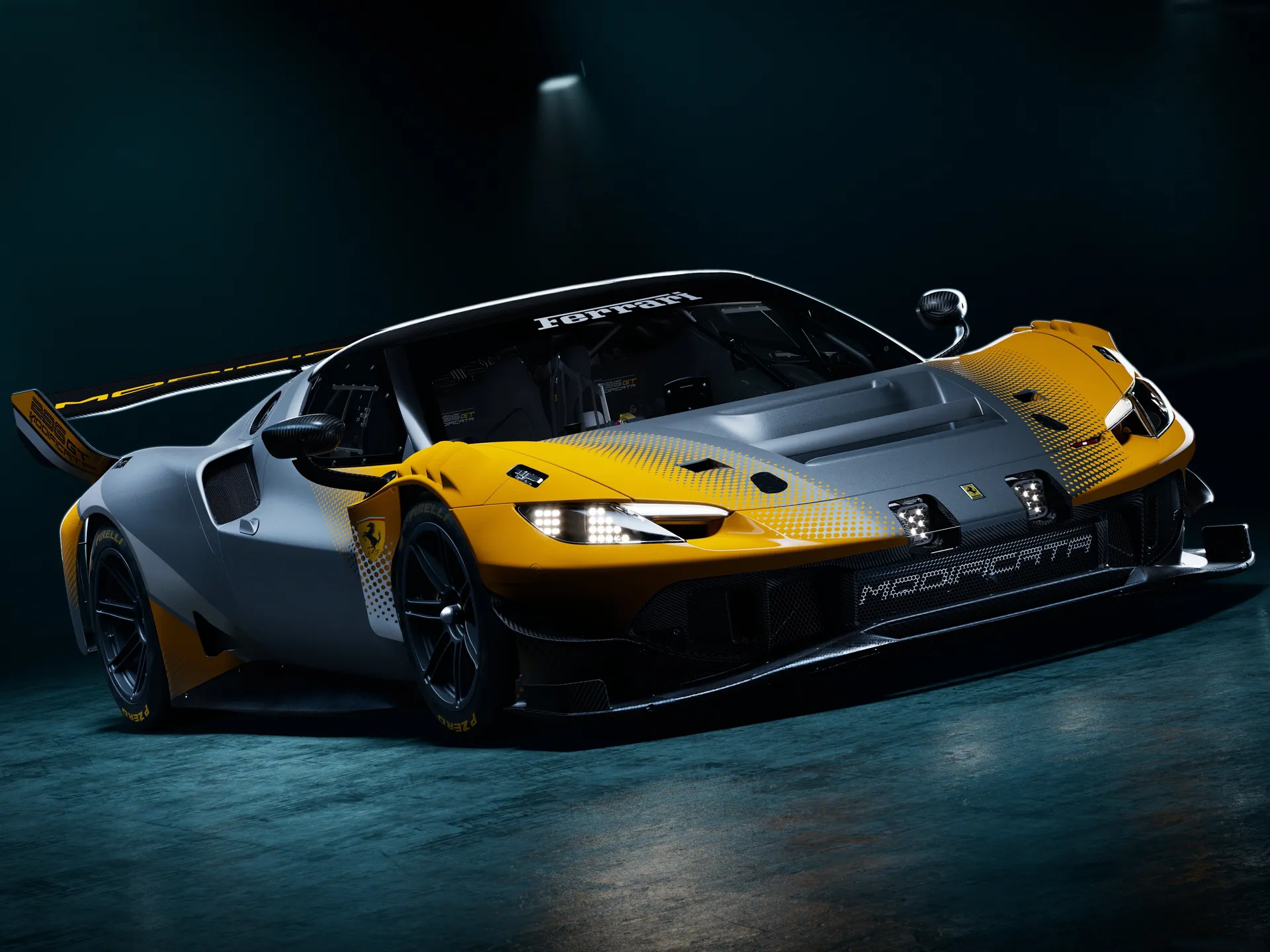
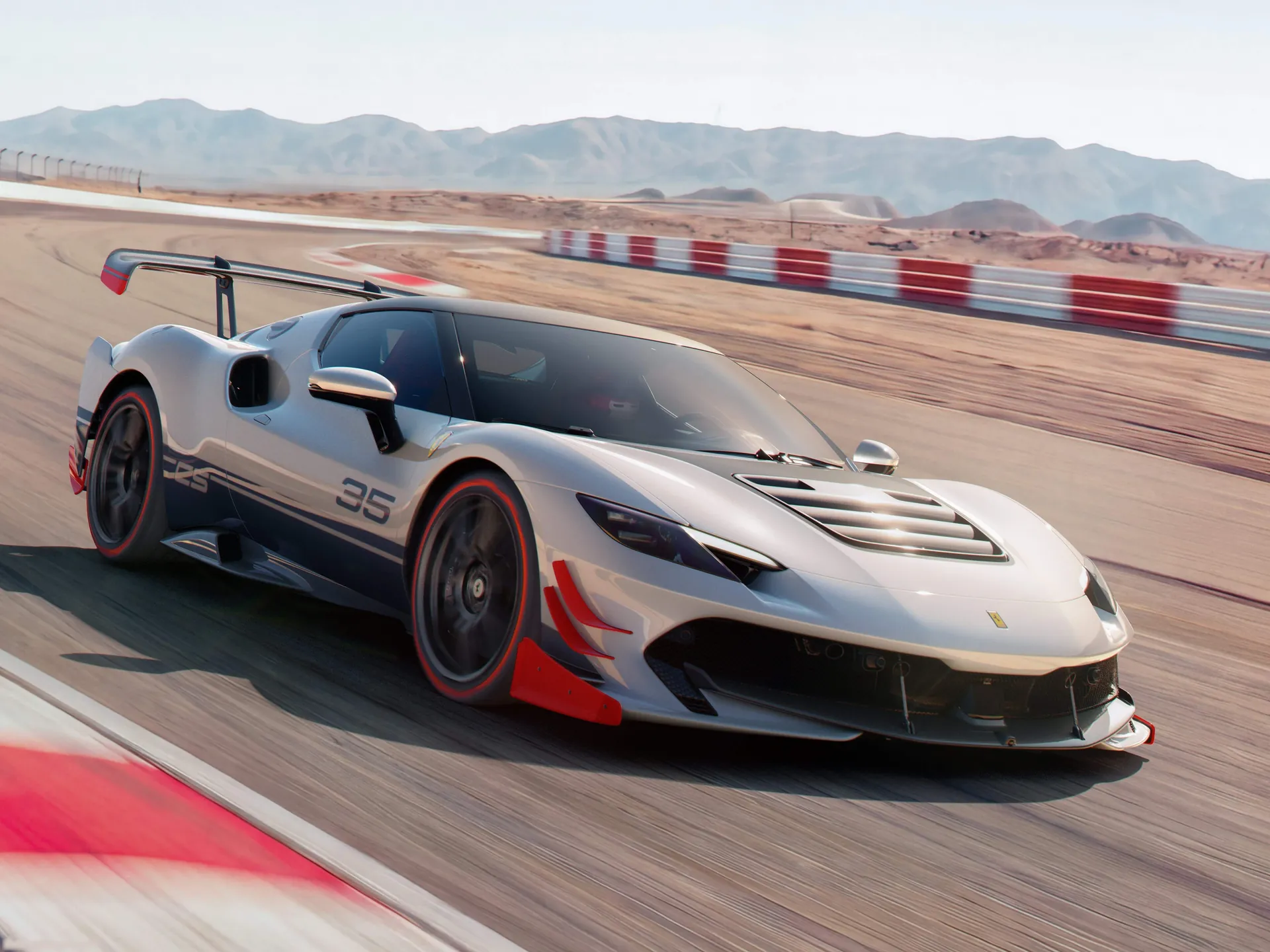
Designed to push the limits of on-track performance in the Ferrari Challenge Trofeo Pirelli, the 296 Challenge EVO has been unveiled at the Finali Mondiali Ferrari in Barcelona. It will make its racing debut in 2027, beginning with the international Europe and North America series, as the single-marque series reaches its 35th year. The car is an evolution of the current 296 Challenge, which has been competing since 2024. That model was the first car in the Prancing Horse's single-marque series to use a V6 engine, and it achieved the highest downforce levels seen in the series to that point.
Development of the car focused particularly on aerodynamics, vehicle dynamics and broadening its operating window. The aim was to improve outright performance without compromising driveability or consistency on any type of circuit.
The result is a car that is even faster, more efficient and easier to exploit in all conditions. This further strengthens its position as the performance benchmark in its category and brings the driving experience even closer to that of the 296 GT3 Evo.
The tenth model designed for the Ferrari Challenge aims to build further on the car's strengths to meet the needs of an increasingly demanding clientele. That clientele spans experienced gentleman drivers and emerging young talent, for whom the single-marque series offers a chance to gain experience and build towards a career in motorsport. For them, the step up to GT3 racing is the dream.
In High Downforce (HD) configuration, the 296 Challenge EVO laps Mugello 0.8 seconds faster than the 296 Challenge. This was made possible by the new aerodynamic package and the revisions to the vehicle dynamics, informed by feedback from drivers and teams.
The revised aerodynamic package, a wider range of set-up options and an updated eDiff (electronic differential) provide a more consistent handling balance throughout the race, including over long runs. They also help reduce tyre degradation and wear. The result is a car that is even more stable and predictable on corner entry, mid-corner and on exit.
Compared with the 296 Challenge, the 296 Challenge EVO offers significantly greater adaptability to different aerodynamic requirements. In the previous generation, this adaptation was achieved solely by adjusting the rear wing, with a relatively limited range of adjustment. On the 296 Challenge EVO, however, two standard configurations have been introduced: HD (High Downforce) and LD (Low Drag), the latter characterised by a lower wing angle and the removal of the front aerodynamic appendages. Both configurations ensure the correct aerodynamic balance between the front and rear axles, allowing the car to operate across a significantly wider downforce range.
Added to this is the new high-performance half-shaft, which allows for more extreme set-ups, further expanding the car's aerodynamic configuration window.
These changes allow the car to be optimised for both technical circuits and very high-speed tracks.
Specifically, maximum downforce is 12% higher than on the 296 Challenge (+100 kg at 250 km/h), while the new LD configuration for high-speed circuits reduces aerodynamic drag by 4%.
The main components of the aerodynamic package - the splitter, front bumper, rear diffuser and exterior rear-view mirrors - are made from carbon fibre. This material makes it possible to reach higher downforce targets while keeping overall weight in check and simplifying trackside repairs for mechanics.
The 296 Challenge's already excellent aerodynamics have been further refined through innovative, sophisticated solutions. The most significant changes are to the underbody, front and rear bumpers, rear wing pylons and endplates, and exterior rear-view mirrors.
The Ferrari 296 Challenge EVO can be configured specifically for high-speed circuits thanks to its wider range of rear wing angles of attack and the option to remove the aerodynamic elements from the front bumper.
The car can be converted to the innovative Low Drag configuration using a dedicated package that involves removing certain front aerodynamic elements: two flicks and one nolder on the wheel arch. This makes it possible to reduce aerodynamic drag by 4 per cent, thereby optimising performance.
At the front, the downforce figures have been achieved by increasing the splitter's plan area and completely redesigning its profile. In the central section, ground effect has been maximised by lowering the ride height. At the same time, the aero damper introduced on the 296 Challenge continues to fulfil its original function.
The bodywork ahead of the front wheel has been reshaped to generate downforce and improve the car's handling along typical racing lines.
The central intake for the high-temperature radiator and the brake duct intakes on either side are even more prominent than on the 296 Challenge. Purpose-designed slots around the outer edge of the brake duct intake effectively control the airflow directed towards the front bumper.
An aerodynamic channel has been added on the outer side to direct high-energy airflow beneath the lower flick, ahead of the wheel. By encouraging air to flow outwards, it reduces aerodynamic interference from the tyre, increasing front downforce. The nolder added to the front wheel arch also contributes significantly to this outwash effect and helps draw the wheel wake outwards.
Enlarging the lower flick's plan area and adding an upper flick complete the measures to increase front downforce.
Finally, a specially designed rear-view mirror has been introduced, similar in concept to that of the 296 GT3 Evo. Its slim, aerodynamically-profiled stalk improves efficiency while maintaining intercooler cooling performance at least equal to that of the 296 Challenge, without compromising rearward visibility in racing conditions. The increase in rear-axle downforce comes largely from changes to the fixed rear wing. The main plane remains unchanged, while the pylons have been redesigned to provide a revised adjustment range. This increases the maximum angle of attack by 4° and reduces the minimum by 1° compared with the 296 Challenge. The rear wing therefore offers two benefits: increased downforce at the maximum angle of attack and reduced drag at the minimum setting.
The new endplates, inspired by aircraft winglets, further increase the wing's effective aspect ratio, improving efficiency. They also delay the onset of stall, allowing the wing to operate at these higher angles of attack.
The rear underbody has been completely revised: the diffuser has been extended, with its channels projecting further rearwards to increase downforce.
The vortex generators have been moved inwards to harness the higher-energy airflow near the car's centreline, increasing the suction they produce. The innermost underbody fin extends onto the bumper to form a single vortex generator, with an intermediate slot that energises the airflow and strengthens the resulting vortex. As well as generating more rear downforce, this new vortex generator layout stabilises the car's aerodynamic behaviour during body movements.
Updates to the vehicle dynamics controls and the brake pedal force curve allow the driver to fully exploit the increased aerodynamic potential intuitively and progressively. The driver can therefore count on even more predictable handling, more consistent race pace and further reduced tyre degradation.
Braking is easier to modulate thanks to increased pedal travel and force for a given level of deceleration. This allows the driver to get the best from the wider braking range available with the increased downforce.
Agility and stability have also been improved through revised TC (Traction Control) strategies, which enhance performance under combined cornering and acceleration loads, and an upgraded eDiff, which delivers greater stability under braking and increased agility through high-speed corners.
The instrument panel, the main interface between driver and car, has also been updated. Its redesigned display presents driving information and the intervention levels of the vehicle dynamics controls even more intuitively.
One immediately noticeable change is how TC and ABS intervention levels are displayed. The icons are now more dynamic, filling from left to right for TC and from right to left for ABS to indicate the degree of intervention. This allows the driver to read the information quickly, clearly and safely.
The main changes focused on Traction Control, which the driver adjusts on the 296 Challenge EVO using two independent manettino switches, TC1 and TC2. Each offers five settings, from 0, which disables the control, to 4, which provides maximum intervention.
TC1 adjusts the strategies that determine the level of torque reduction applied by Traction Control, while TC2 adjusts the strategies that adapt this intervention to the car's dynamic behaviour by controlling wheel slip and vehicle stability.
The 1-1 configuration, with both manettino switches set to level 1, has been revised to improve performance and driveability on corner exit and to give the driver more torque to manage with the throttle.
The ABS intervention threshold can be set to four levels using the manettino on the control panel: ABS1 (dry conditions, maximum performance), ABS2 (dry conditions, stability), ABS3 (wet conditions, performance), ABS4 (wet conditions, stability).
The eDiff electronic differential features updated calibrations with two aims. The first is greater stability under braking and on corner entry, with a more linear differential response as the driver lifts off, brakes and turns in. The second is greater stability in fast corners, supported by the increased downforce, allowing the driver to accelerate harder through and out of corners. The revised calibration achieves this by making the car more agile and less prone to understeer.
Like the 296 Challenge, the Evo is fitted with Pirelli tyres, the result of close collaboration between the Maranello Manufacturer and the Milan-based company, a synergy that has been evident throughout the entire development process of the 296 Challenge EVO with the aim of enabling the tyre compound to make the most of the car's greater potential.
The Ferrari 296 Challenge EVO is powered by a twin-turbo V6 that delivers up to 700 cv at 7,500 rpm - a specific power output of 234 cv/l - paired with a seven-speed dual-clutch F1 gearbox. This follows the approach adopted for the 296 Challenge, the first car in the history of the single-marque series to use a six-cylinder engine, in this case without a hybrid system.
The architecture draws on the Maranello Manufacturer's six-cylinder engine platform, adapted for numerous track and road cars. Track models include the 296 GT Modificata, unveiled in September 2026; the 296 GT3 Evo; the 499P, which has competed in the FIA WEC since 2023; and the 499P Modificata. Road-going models include the 296 Challenge Stradale, 296 GTB and F80, to name just a few.
Clients can order a range of options as factory-fitted equipment or purchase them later. These include a passenger seat for drivers who wish to work with a coach on track or share the experience with a guest. The seat can be easily removed to return the car to race specification. An LTE antenna enables the Marshalling function, allowing messages from Race Control to be sent to the instrument panel. This equipment will be mandatory for cars competing in Ferrari Challenge Trofeo Pirelli. A silencer is also available for circuits with noise restrictions and can be fitted simply by removing the two exhaust tips.
FERRARI CHALLENGE TROFEO PIRELLI: THE CHAMPIONSHIP
The single-marque series will reach its 35th season in 2027. Prancing Horse clients will compete in the international Europe and North America series, each featuring six rounds before the Finali Mondiali, and in the regional UK, Japan and Australasia series, each comprising five rounds. A new Middle East series will also join the regional line-up, with its inaugural round in Bahrain on 11-12 December 2026, followed by rounds in Qatar and Saudi Arabia in January 2027 and in Abu Dhabi in March 2027. In 2027, the 296 Challenge EVO will compete exclusively in the Europe and North America series, before taking to the track in the regional series from 2028.
From 2027, the European series will also introduce a new Endurance race format, with 40-minute races plus one lap scheduled at Mugello, Hockenheim and Valencia. The races will allow two drivers to share a car and will feature a mandatory pit stop.
As mentioned above, the 296 Challenge EVO is the tenth model in the Prancing Horse's single-marque series, first held in 1993. Since then, the series has featured the 348 Challenge (1993-1995), F355 Challenge (1995-2001), 360 Challenge (2000-2006), F430 Challenge (2006-2011), 458 Challenge (2011-2013), 458 Challenge Evo (2014-2017), 488 Challenge (2017-2019), 488 Challenge Evo (2020-2025) and 296 Challenge (2024-).